Introduction: Finding a Reliable IVD Manufacturing Company
Choosing the right IVD manufacturing company is a critical decision for diagnostic brands, medical device companies, biotechnology businesses, and healthcare innovators. The right manufacturing partner can help transform an early-stage diagnostic concept into a technically validated, consistently manufactured, and commercially viable in vitro diagnostic (IVD) product.
However, IVD manufacturing involves much more than assembling test kits or producing diagnostic reagents. Depending on the product, it may require assay development, reagent formulation, biological material sourcing, analytical performance evaluation, method validation, instrument integration, quality management, regulatory documentation, and controlled commercial production.
For companies developing new diagnostic products or expanding an existing portfolio, the challenge is to identify a manufacturer whose technical capabilities, quality systems, development experience, and regulatory responsibilities match the intended product and target markets.
This guide explains how to evaluate IVD manufacturers, compare OEM, ODM, and CDMO services, understand essential quality and regulatory considerations, and establish a manufacturing partnership that supports long-term business growth.
1. What Does an IVD Manufacturing Company Do?
An IVD manufacturing company develops, manufactures, assembles, or supplies products used to examine human-derived specimens, such as blood, serum, plasma, urine, swabs, and other biological materials, to provide information about a person’s health status.
IVD products support disease screening, diagnosis, prognosis, treatment monitoring, and other clinical or laboratory decisions, depending on their intended use.
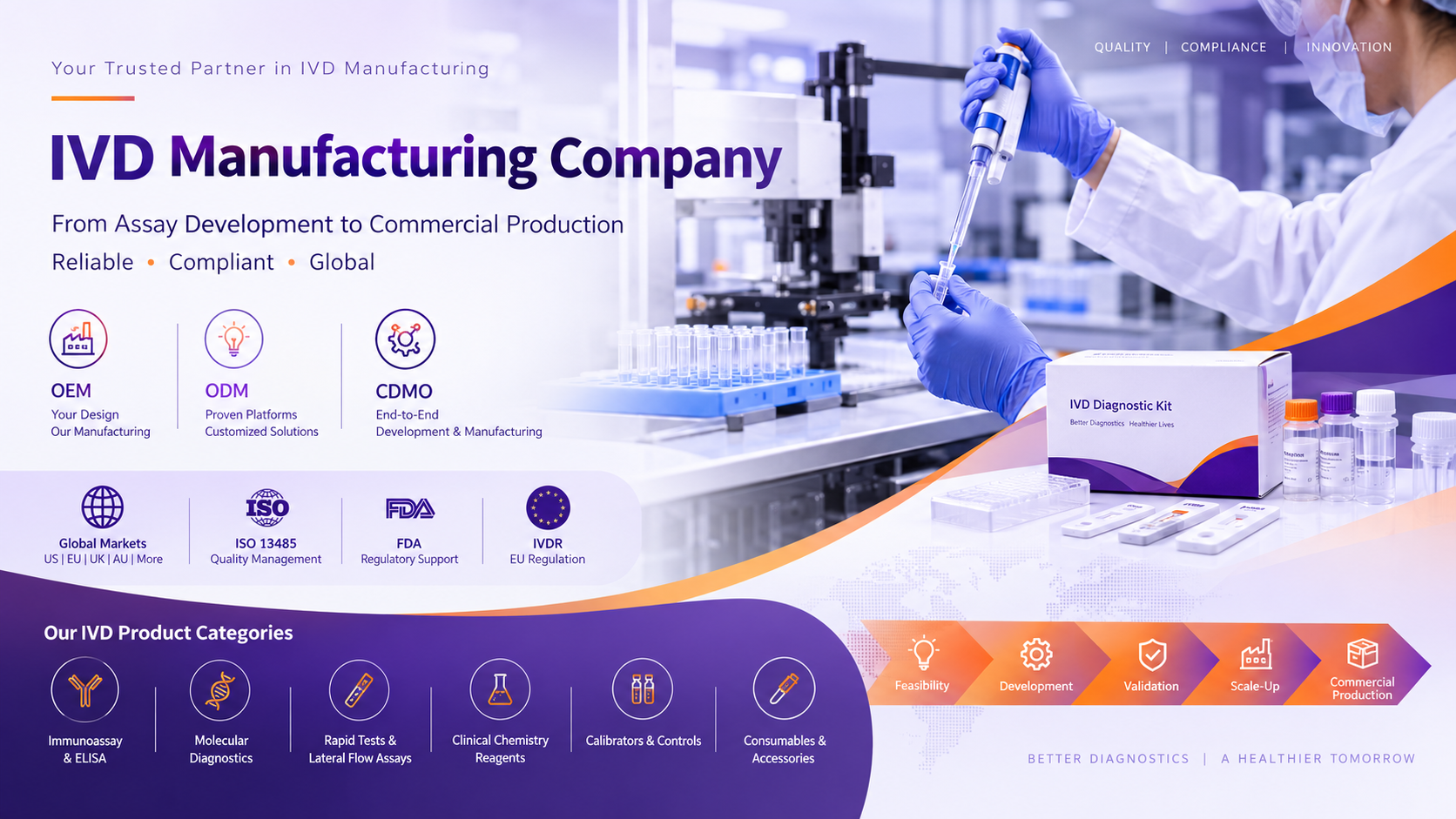
Typical IVD manufacturing capabilities include:
- Diagnostic reagent development and production
- Immunoassay and ELISA kit manufacturing
- Molecular diagnostic reagent and assay production
- Rapid diagnostic test and lateral flow assay manufacturing
- Clinical chemistry reagents and related consumables
- Calibrators, controls, and reference materials
- Sample preparation reagents and consumables
- Diagnostic instrument and assay system integration
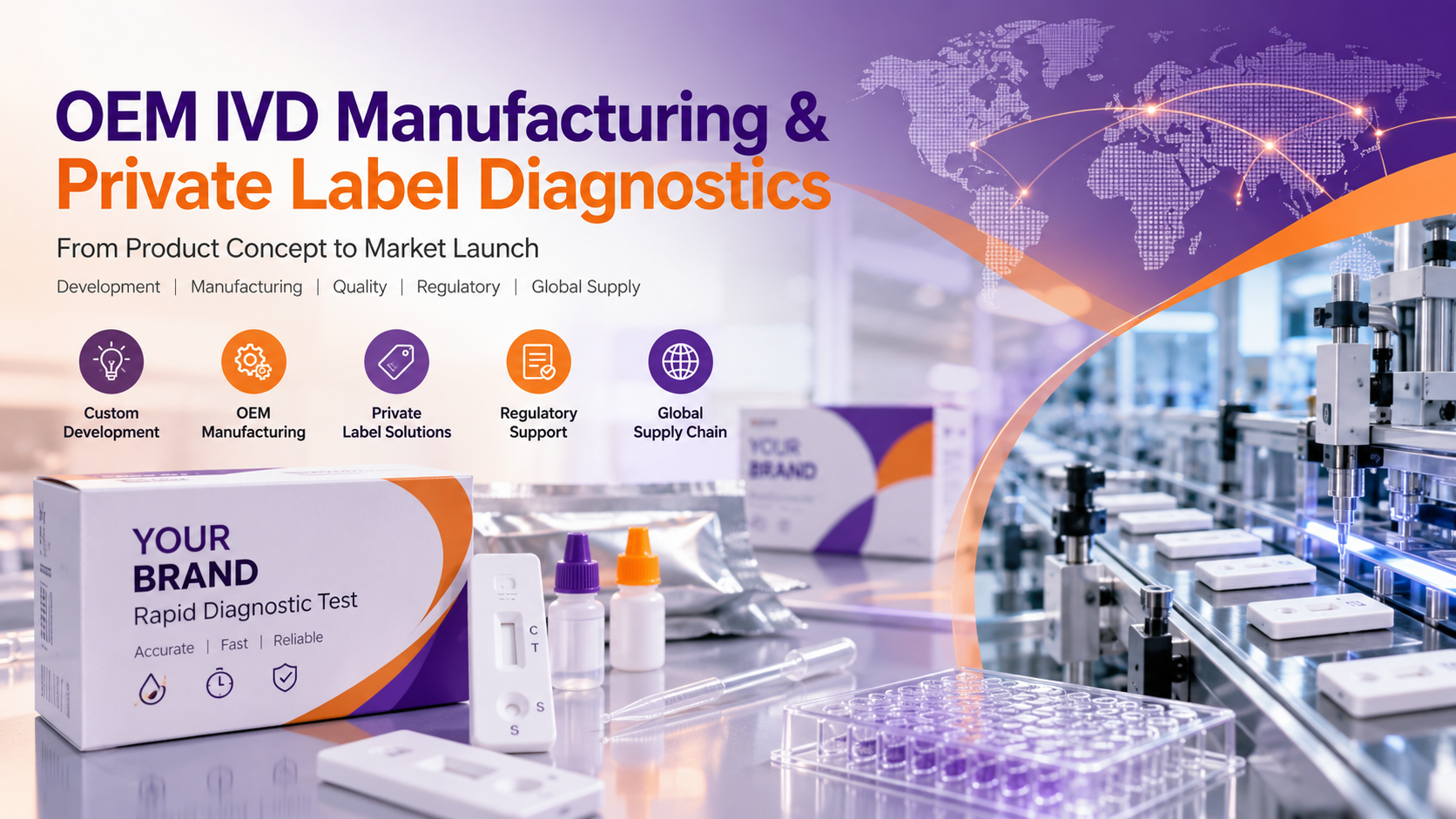
- Private-label, OEM, ODM, and contract development services
Not every IVD manufacturing company provides all these services. Some specialize in a particular technology, such as immunodiagnostics or molecular testing, while others offer integrated development and manufacturing services across several product categories.
The key is to match the manufacturer’s actual technical scope to the requirements of your diagnostic product.
2. Types of IVD Manufacturing Services
Understanding the differences between OEM, ODM, and CDMO services helps buyers select the right partnership model.
IVD OEM Manufacturing
Original Equipment Manufacturer (OEM) services generally involve producing a product according to the customer’s defined specifications, design, or technical requirements, subject to the agreed allocation of design and manufacturing responsibilities.
An IVD OEM manufacturer may support:
- Production of established diagnostic kits
- Reagent preparation and filling
- Test cassette and kit assembly
- Packaging and labeling
- Private-label manufacturing
- Batch testing and release documentation
OEM manufacturing is often appropriate for companies that already have a defined product design and need a qualified manufacturing partner to support production, cost management, and supply continuity.
Before signing an OEM agreement, buyers should clarify who owns the design, who controls specifications, who approves changes, and who is responsible for regulatory submissions and post-market obligations.
IVD ODM Manufacturing
Original Design Manufacturer (ODM) services typically involve a manufacturer supplying an existing product design or developing a customized solution based on the customer’s requirements.
Depending on the provider, ODM capabilities may include:
- Product configuration and customization
- Reagent or formulation optimization
- Kit format and packaging development
- Adaptation of existing assays
- Instrument or consumable compatibility
- Private-label product development
ODM can shorten development timelines when a suitable existing platform is available. However, an existing product does not automatically meet the customer’s intended use, performance requirements, or regulatory obligations in a new market.
The buyer should confirm the extent of customization, access to technical documentation, intellectual property ownership, and the evidence required to support the final product claims.
IVD CDMO Services
A Contract Development and Manufacturing Organization (CDMO) provides a broader combination of development and manufacturing services. The exact scope varies by provider.
An IVD CDMO may support a project from early feasibility assessment through assay development, process development, analytical validation, pilot production, manufacturing transfer, and commercial-scale production.
Typical IVD CDMO services include:
- Product concept assessment and feasibility studies
- Assay development and optimization
- Reagent formulation and process development
- Analytical method development and validation
- Stability study planning and execution
- Design verification and manufacturing process validation, where applicable
- Pilot batch production and scale-up
- Technical documentation support
- Routine manufacturing and quality control
Which model is best?
| Partnership model | Best suited for | Main consideration |
|---|---|---|
| OEM | A defined product requiring outsourced production | Manufacturing controls and design responsibilities |
| ODM | A product based on an existing platform with customization | Design ownership and suitability of the existing platform |
| CDMO | New product development and integrated technical support | Development scope, milestones, intellectual property, and validation responsibilities |
For startups developing new assays, established diagnostic brands launching additional products, and businesses without their own manufacturing infrastructure, an appropriately qualified IVD CDMO may provide a more integrated solution than a production-only supplier.
3. Major IVD Product Categories and Manufacturing Capabilities
The technical requirements of IVD manufacturing vary significantly by technology. Buyers should assess product-specific experience rather than relying on a manufacturer’s general claim of providing comprehensive diagnostic solutions.
Immunoassay and ELISA Manufacturing
Enzyme-linked immunosorbent assay (ELISA) products are used in many laboratory testing applications, including infectious disease testing, hormone analysis, autoimmune testing, and selected biomarker applications.
Relevant manufacturing capabilities may include:
- Antigen and antibody sourcing or production
- Coating and blocking process optimization
- Reagent formulation and dispensing
- Microplate preparation and assembly
- Calibrator and control material preparation
- Analytical performance studies
- Stability and lot-to-lot consistency evaluation
Important performance characteristics depend on the intended use and may include analytical sensitivity, specificity, precision, measuring range, interference, and cross-reactivity.
A supplier’s experience with ELISA kit assembly alone does not necessarily demonstrate competence in developing or validating a new assay.
Molecular Diagnostic Manufacturing
Molecular diagnostics detect or analyze nucleic acids and related molecular targets. Depending on the platform, products may involve PCR, real-time PCR, isothermal amplification, extraction reagents, and associated controls.
Relevant capabilities can include:
- Primer and probe design support
- Enzyme and reagent formulation
- Nucleic acid extraction chemistry
- Contamination control procedures
- Assay optimization and analytical studies
- Compatibility evaluation with specified instruments
- Stability assessment and manufacturing process controls
Buyers should confirm that the manufacturer can support the specific molecular technology, workflow, specimen type, and performance claims required for the intended application.
Rapid Diagnostic Tests and Lateral Flow Assays
Rapid diagnostic tests are widely used in point-of-care, decentralized, and selected laboratory settings.
Depending on the product, manufacturing may involve membrane selection, conjugate preparation, reagent dispensing, strip assembly, cassette integration, packaging, and environmental control.
Critical evaluation areas include:
- Membrane and component consistency
- Antibody or antigen performance
- Dispensing and assembly reproducibility
- Control-line and test-line consistency
- Analytical and clinical performance evidence, as applicable
- Moisture protection and packaging integrity
- Real-time or scientifically justified accelerated stability studies
A mature lateral flow manufacturing process should demonstrate control of critical materials and process parameters, not simply high-volume assembly capability.
Clinical Chemistry and Other Diagnostic Products
Clinical chemistry reagents, calibrators, controls, and related consumables may require specialized formulation, compatibility testing, packaging controls, and stability management.
When selecting a supplier, buyers should evaluate whether the manufacturer has the necessary analytical instruments, reference materials, environmental controls, and validated methods to support the intended product.
4. How to Evaluate an IVD Manufacturing Company’s Technical Capabilities
A manufacturer’s technical capabilities should be assessed against a defined product brief rather than a generic service catalogue.
Before requesting a quotation, prepare the available information about the product’s intended use, target analyte, specimen type, testing method, expected throughput, required performance, packaging, annual demand, and target markets.
Use the following criteria to compare prospective manufacturers.
Technology and Development Capability
Determine whether the company can independently develop the required assay or only manufacture an established formulation.
Questions to ask include:
- Does the team have experience with the relevant diagnostic technology?
- Can it support feasibility studies and formulation optimization?
- Are assay development and manufacturing transfer performed under documented procedures?
- Can it explain the proposed analytical validation strategy?
- How are failed experiments, design changes, and technical risks documented?
A strong development partner should be able to explain the technical rationale behind its proposed approach and identify unresolved risks early.
Analytical Performance and Method Validation
Analytical validation should be designed around the product’s intended use, technology, applicable standards, and regulatory pathway.
Depending on the assay, the evaluation may include:
- Limit of blank, limit of detection, and limit of quantitation, where applicable
- Precision and reproducibility
- Analytical specificity and cross-reactivity
- Interference studies
- Measuring range and linearity, where relevant
- Cut-off determination and verification
- Method comparison and agreement
- Specimen stability and handling requirements
- Lot-to-lot performance
Not every characteristic applies to every IVD product. A qualified partner should justify the selected study design, acceptance criteria, sample strategy, and statistical methods.
Analytical performance is also distinct from clinical performance. Where required, clinical evidence must support the intended diagnostic claims and use population.
Scale-Up and Manufacturing Transfer
A promising laboratory prototype does not automatically translate into a robust commercial product.
During scale-up, reagent mixing, dispensing accuracy, raw material variability, equipment configuration, environmental conditions, and operator practices can affect performance.
Evaluate whether the manufacturer can establish appropriate process controls, define critical quality attributes, transfer methods between development and production, and demonstrate that the resulting process consistently meets approved specifications.
For new IVD products, early manufacturing input can reduce the risk of expensive redesigns late in development.
5. IVD Quality Management and Regulatory Compliance
Quality and regulatory readiness are central to choosing an IVD manufacturing company. A low quotation or short lead time cannot compensate for an inadequate quality system or insufficient evidence of product performance.
ISO 13485 Quality Management System
ISO 13485:2016 is an internationally recognized quality management system standard for medical devices. It provides a framework for controlled design and development, production, supplier management, traceability, corrective action, and other quality-related processes. Its relevance depends on the organization’s activities and the scope of its quality system.
When evaluating an IVD manufacturer, request the applicable certificate, verify its validity and certification scope, and confirm that the activities relevant to your project are covered.
Certification should not be treated as automatic proof that every product manufactured by the company is compliant or suitable for your target market.
United States: FDA Requirements
IVD products marketed in the United States are subject to applicable FDA requirements, which may include establishment registration, device listing, quality system obligations, labeling requirements, and premarket authorization or notification, depending on the product and applicable exemptions.
The FDA’s Quality Management System Regulation (QMSR) became effective on February 2, 2026, incorporating ISO 13485:2016 by reference into the relevant device quality system framework. https://www.fda.gov/medical-devices/postmarket-requirements-devices/quality-management-system-regulation-qmsr
Buyers should distinguish between a manufacturer’s registration or listing and actual marketing authorization for a particular device. These are not interchangeable.
European Union: IVDR Requirements
The European Union’s In Vitro Diagnostic Medical Devices Regulation (IVDR), Regulation (EU) 2017/746, has applied since May 26, 2022, subject to applicable transitional provisions and amendments.
The framework includes risk-based classification, performance evaluation, technical documentation, post-market surveillance, and notified-body involvement where required.
Before engaging a manufacturing partner, determine which entity will act as the legal manufacturer, who will maintain the technical documentation, and how conformity assessment, labeling, traceability, and post-market responsibilities will be allocated.
Regulatory classification and conformity assessment must be determined for the actual product; they cannot be inferred solely from the product category or the supplier’s existing certificates.
Regulatory Planning for Other Markets
Australia, the United Kingdom, Canada, and other jurisdictions have their own requirements for IVD products. A manufacturer’s previous experience in one market does not automatically establish compliance in another.
A practical supplier assessment should therefore include:
- Intended destination markets
- Product classification and applicable regulatory pathway
- Legal manufacturer and importer responsibilities
- Available technical and performance documentation
- Labeling and language requirements
- Traceability and post-market processes
- Change notification and regulatory maintenance responsibilities
For authoritative guidance, consult the FDA’s IVD regulatory overview, the European Commission’s IVD manufacturer guidance, and the ISO 13485 standard information page.
6. Why Consider an IVD Manufacturing Company in China?
China has an established medical device and biotechnology manufacturing sector, offering international buyers a range of potential partners for diagnostic reagent production, consumables, assay development, and contract manufacturing.
However, China is not a single uniform supplier market. Technical expertise, quality systems, product maturity, export experience, and regulatory readiness differ substantially between individual companies.
For international buyers, the business case should be based on verified supplier capabilities rather than country of origin alone.
Potential Commercial Advantages
Integrated supplier ecosystems. In some manufacturing clusters, buyers can access reagent suppliers, consumables producers, packaging vendors, engineering resources, and specialized testing services within a coordinated supply chain.
Flexible development arrangements. Certain manufacturers offer project-based development, customized formulations, private-label production, and pilot manufacturing for companies that do not have an established internal production team.
Manufacturing cost optimization. Depending on product complexity, material requirements, order volume, and quality controls, a qualified Chinese partner may offer a competitive total cost of production.
Scalable supply arrangements. Suppliers with appropriate equipment, validated processes, and capacity planning may support a transition from pilot production to recurring commercial orders.
These potential advantages must be evaluated against development costs, quality assurance requirements, shipping, lead times, intellectual property protection, regulatory responsibilities, and supply continuity.
How to Verify a Chinese IVD Manufacturer
Before selecting a supplier, conduct a structured due diligence process:
- Verify the company’s legal identity, actual manufacturing location, and relevant business scope.
- Request current quality certificates and verify their issuing organizations and scope.
- Review product-specific technical experience, not just general medical device experience.
- Assess whether development, production, testing, and release activities are conducted in-house or outsourced.
- Review representative technical documentation and quality records under appropriate confidentiality arrangements.
- Evaluate raw material controls, traceability, change control, and corrective action procedures.
- Arrange a remote or on-site audit when appropriate to the project’s risk.
- Define acceptance criteria and responsibilities before approving pilot production.
A trading company may be suitable for sourcing and coordination, but buyers seeking direct manufacturing control should establish which legal entity actually performs the relevant activities.
7. IVD Product Development: From Concept to Commercial Manufacturing
For a company developing a new diagnostic product, the manufacturing partnership should be organized around technical milestones rather than a simple purchase order.
Stage 1: Product Requirements and Feasibility
Define the intended use, target population, analyte, specimen type, test environment, expected performance, user requirements, and target markets.
The manufacturer should assess technical feasibility, identify missing information, and propose a preliminary development plan.
Stage 2: Assay Development and Optimization
The team develops or adapts the assay, selects relevant materials, optimizes critical parameters, and documents experimental results.
The output may include a prototype, preliminary performance data, identified risks, and a plan for further development.
Stage 3: Analytical Performance Evaluation
The project moves into a predefined performance evaluation plan, with study designs and acceptance criteria appropriate to the technology and intended use.
Additional clinical performance studies or other evidence may be necessary depending on the product and regulatory pathway.
Stage 4: Process Development and Pilot Production
The manufacturer defines production procedures, identifies critical process parameters, establishes material specifications, and assesses process reproducibility.
Pilot production helps identify manufacturing issues before routine commercial supply.
Stage 5: Verification, Validation, and Regulatory Preparation
The development team completes applicable design verification, design validation, analytical and clinical performance activities, process validation, and documentation.
These activities are related but not interchangeable. Their scope and timing should be determined by the product’s design, intended use, manufacturing process, and regulatory obligations.
Stage 6: Commercial Production and Lifecycle Management
After the necessary release and regulatory requirements have been satisfied, routine manufacturing should operate under controlled procedures.
Ongoing responsibilities may include batch release, trend analysis, supplier monitoring, stability monitoring, complaint handling, change control, corrective action, and post-market surveillance where applicable.
A clear development plan helps both parties manage technical risks, budget, schedule, and responsibilities throughout the product lifecycle.
8. How to Compare IVD Manufacturing Companies
A structured scorecard helps procurement teams compare suppliers on evidence rather than sales presentations.
| Evaluation factor | Evidence to request |
|---|---|
| Product experience | Relevant products, technologies, and project references |
| R&D capability | Development scope, personnel expertise, and technical milestones |
| Analytical performance | Study plans, methods, acceptance criteria, and representative reports |
| Quality management | Valid certificates, documented procedures, and audit findings |
| Regulatory support | Defined responsibilities and market-specific documentation experience |
| Manufacturing capacity | Equipment, production processes, capacity assumptions, and scale-up plan |
| Supply chain | Critical material controls, qualified suppliers, and continuity planning |
| Intellectual property | Ownership, confidentiality, access rights, and transfer provisions |
| Commercial terms | Development fees, unit pricing, minimum order quantities, and lead times |
| Communication | Named project lead, reporting cadence, escalation process, and change management |
The lowest initial unit price is not always the lowest-cost solution. Repeated development cycles, inconsistent batches, delayed regulatory documentation, and unexpected change costs can outweigh a modest price advantage.
For early-stage projects, assess development risk and technical responsiveness. For established products, place greater emphasis on process consistency, cost structure, capacity, and supply continuity.
9. Common Mistakes When Selecting an IVD Manufacturer
Choosing Based on Price Alone
An attractive quotation does not demonstrate assay competence, process control, or regulatory readiness. Compare the full cost of development, testing, validation, documentation, and ongoing supply.
Confusing Product Assembly with Assay Development
A manufacturer that can assemble an established kit may not have the expertise to develop a new diagnostic assay. Confirm exactly which development tasks the supplier can perform and which require external partners.
Assuming Certifications Guarantee Market Access
A quality certificate does not replace product-specific performance evidence, required conformity assessment, or marketing authorization. Verify both the certificate’s scope and the obligations applicable to the finished product.
Ignoring Intellectual Property and Data Ownership
Contracts should address ownership of background and newly developed intellectual property, assay formulations, design files, raw data, validation reports, manufacturing documentation, and rights to transfer production.
Starting Without Clear Acceptance Criteria
Before development begins, agree on deliverables, technical milestones, testing methods, acceptance criteria, change-control procedures, and the process for handling unsuccessful studies.
Overlooking Long-Term Manufacturing Risks
Critical reagents and biological materials may be affected by supplier changes, lot variability, storage conditions, and availability. A robust supply plan should identify critical components and define controls for substitutions and changes.
10. Who Should Work with an IVD OEM, ODM, or CDMO Partner?
External IVD manufacturing can be appropriate for several types of organizations, provided the chosen supplier matches their product and regulatory requirements.
IVD startups and diagnostic innovators may need assay development, prototype production, feasibility assessment, and a pathway toward scalable manufacturing.
Established diagnostic brands may seek additional production capacity, new product formats, private-label manufacturing, or a second-source supplier.
Biotechnology and life science companies may require specialized reagent formulation, analytical testing, or support transferring a research-stage assay toward an IVD product.
Medical device distributors and healthcare suppliers may be interested in private-label diagnostic products, subject to the applicable legal manufacturer, quality, and market access requirements.
International diagnostic companies may evaluate Chinese manufacturing partners to diversify their supply chains, improve cost efficiency, or access specialized development resources.
The most suitable partner is not necessarily the largest manufacturer. It is the company whose capabilities, quality system, project management, and commercial model fit the specific requirements of the product.
11. Request a Technical Assessment from an IVD Manufacturing Partner
If you are sourcing an IVD manufacturing company for a new product or an existing diagnostic portfolio, begin with a concise technical brief.
Providing clear requirements helps manufacturers determine feasibility, identify missing information, and prepare a more meaningful proposal.
Your initial inquiry should include:
- Product type: ELISA kit, molecular diagnostic assay, rapid test, clinical chemistry reagent, or another IVD product.
- Development stage: Concept, feasibility, prototype, analytical validation, manufacturing transfer, or established commercial production.
- Target application: Intended analyte, specimen type, user setting, and intended use.
- Required services: OEM, ODM, assay development, analytical validation, pilot production, or full CDMO support.
- Target markets: United States, European Union, United Kingdom, Australia, or other destinations.
- Estimated demand: Expected pilot quantity and forecast annual volume, if available.
- Timeline: Key development milestones and target commercial launch.
- Existing documentation: Specifications, preliminary data, prototype information, and relevant performance requirements.
If some information is not yet available, state the current development stage rather than making unsupported assumptions. Early technical discussions can help determine which requirements need to be established before a reliable quotation or project schedule can be prepared.
Frequently Asked Questions
1. What is an IVD manufacturing company?
An IVD manufacturing company develops, produces, assembles, or supplies in vitro diagnostic products used to examine biological specimens and provide information about a person’s health. Its scope may include reagents, diagnostic kits, consumables, instruments, and associated manufacturing services.
2. What is the difference between an IVD OEM and an IVD CDMO?
An IVD OEM typically manufactures products to agreed customer specifications, while an IVD CDMO can provide a broader combination of product development, process development, analytical support, scale-up, and manufacturing. Actual responsibilities depend on the service agreement.
3. Can an IVD manufacturer help develop a new diagnostic test?
Yes, if the manufacturer has the relevant R&D capabilities. Depending on the project, services may include feasibility studies, assay optimization, reagent formulation, analytical performance evaluation, pilot production, and manufacturing transfer. Clinical performance evidence and regulatory activities must also be addressed where applicable.
4. How do I verify whether an IVD manufacturer is qualified?
Review its legal identity, relevant quality certifications, certificate scope, product-specific experience, technical capabilities, manufacturing controls, traceability, and regulatory documentation. Conduct a risk-based audit and verify the requirements for your intended markets.
5. Is an ISO 13485 certificate sufficient for selling IVD products internationally?
No. ISO 13485 certification relates to a quality management system within a defined scope. It does not automatically authorize every product for sale. Market access depends on applicable product classification, performance evidence, conformity assessment, registration or authorization, and other jurisdiction-specific obligations.
6. What information is needed for an IVD manufacturing quotation?
At minimum, provide the product type, development stage, technical specifications, intended use, target markets, requested services, estimated volume, packaging requirements, and target timeline. For new products, the quotation may need to be divided into development, validation, tooling or equipment, and recurring manufacturing costs.
7. What should an IVD CDMO agreement cover?
The agreement should define the development scope, deliverables, milestones, acceptance criteria, confidentiality, intellectual property, data ownership, quality responsibilities, regulatory responsibilities, change control, supply terms, and procedures for transferring or discontinuing manufacturing.
Conclusion: Choose an IVD Manufacturing Partner for Long-Term Success
Selecting the right IVD manufacturing company requires a careful assessment of technical capability, product-specific experience, quality management, regulatory responsibilities, manufacturing consistency, and commercial fit.
For established diagnostic products, an experienced OEM partner may provide a practical route to reliable production. For customized products, ODM services may offer a suitable balance between existing technology and product adaptation. For new diagnostic assays and more complex development programs, a capable IVD CDMO may provide the integrated technical support needed to progress from feasibility to commercial manufacturing.
The most effective sourcing process begins with a clearly defined product brief, evidence-based supplier evaluation, and a transparent agreement on responsibilities and deliverables.
Looking for an IVD manufacturing partner for your next diagnostic project? Prepare your product requirements and request a technical feasibility assessment to identify the right development and manufacturing model for your product, target market, and commercialization plan.
Author Profile

- Written by the IVDCDMO technical and regulatory team, with expertise in diagnostic assay development, GMP manufacturing, ISO 13485 systems, and global IVD commercialization for biotech innovators worldwide.
Latest entries
 IVD ManufacturingNovember 2, 2026OEM IVD Manufacturing & Private Label Diagnostics: A Practical Guide from Product Concept to Market Launch
- IVD ManufacturingOctober 29, 2026IVD Manufacturing Company: A Complete Guide to Choosing the Right Diagnostic Manufacturing Partner
- IVD ManufacturingOctober 26, 2026IVD Raw Materials Manufacturing: A Practical Guide to Quality, Scale-Up and Supplier Selection
- IVD ManufacturingOctober 19, 2026In Vitro Diagnostic Contract Manufacturing Buyer Guide