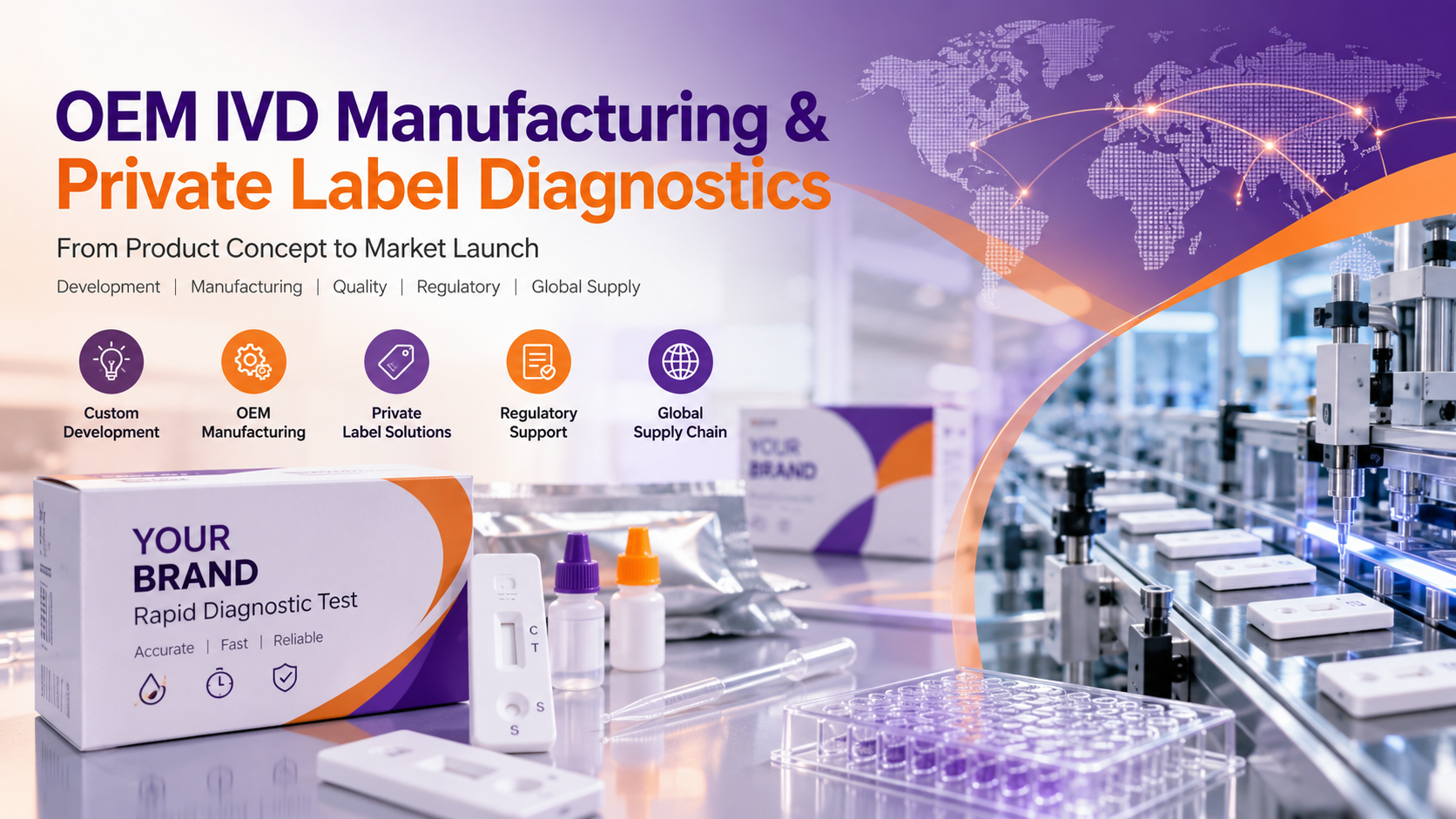
For diagnostic companies seeking to expand their portfolios without building a new manufacturing operation from the ground up, OEM IVD manufacturing and private label diagnostics can provide a practical route from product concept to commercial launch.
But successful IVD outsourcing is not simply a matter of selecting an existing assay, adding a logo, and ordering finished kits.
In vitro diagnostic products operate within tightly controlled quality and regulatory environments. Intended use, analytical performance, specimen type, manufacturing controls, labeling, stability, traceability, regulatory ownership and post-market responsibilities can all affect whether an OEM or private-label product is commercially viable.
The most effective OEM programs therefore begin with a different question:
Not “How quickly can this product be manufactured?” but “What technical, regulatory and quality structure is required to place this product on the target market?”
This guide explains how professional OEM IVD manufacturing, private label diagnostic manufacturing, contract manufacturing and technology-transfer programs should be structured—and what buyers should evaluate before selecting an IVD manufacturing partner.
What Is OEM IVD Manufacturing?
OEM IVD manufacturing is an outsourcing model in which an experienced diagnostic manufacturer produces an in vitro diagnostic product, component or complete system for another company.
Depending on the project, the OEM manufacturer may support:
- assay development;
- reagent formulation;
- raw-material sourcing;
- strip or cartridge manufacturing;
- reagent filling and dispensing;
- instrument integration;
- packaging;
- labeling;
- analytical validation;
- stability studies;
- quality-control testing;
- manufacturing scale-up;
- regulatory documentation support;
- technology transfer;
- and finished-product release.
The commercial customer may subsequently market the product under its own brand, under the manufacturer’s brand, or under another agreed legal and regulatory structure.
The exact arrangement matters.
In regulated diagnostics, OEM, contract manufacturing and private labeling describe commercial relationships—not necessarily regulatory roles.
That distinction should be established before development or manufacturing begins.
OEM IVD Manufacturing vs. Private Label Diagnostics
Although the terms are frequently used interchangeably, they describe different levels of customization.
| Model | Typical Product Status | Customization | Development Requirement | Typical Time to Market |
|---|---|---|---|---|
| Private Label | Existing or established product | Low–Medium | Limited | Relatively fast |
| OEM Manufacturing | Existing platform customized for customer | Medium–High | Moderate | Medium |
| Contract Manufacturing | Customer owns product/specification | Variable | Depends on transfer status | Medium |
| Custom IVD Development | New or substantially modified assay | High | Extensive | Longer |
| Technology Transfer | Existing technology transferred to manufacturing site | High | Process-specific | Project-dependent |
Private Label Diagnostics
A private-label project typically starts with an existing diagnostic product or platform.
Customization may include:
- brand name;
- product name;
- outer carton;
- pouch artwork;
- labels;
- instructions for use;
- kit configuration;
- language localization;
- barcode or UDI requirements;
- and distribution packaging.
This model can reduce development work, but it does not automatically eliminate regulatory work.
Changing branding, labeling, intended use, manufacturing responsibility or the identity of the legal manufacturer may have regulatory consequences depending on the jurisdiction.
OEM IVD Manufacturing
OEM manufacturing usually involves deeper technical cooperation.
For example, a customer may request an existing lateral-flow platform but require:
- a different specimen type;
- modified cutoff;
- alternative antibody pair;
- different cassette design;
- additional control;
- customized buffer;
- different reading time;
- reader compatibility;
- altered packaging configuration;
- or specific performance targets.
At this point, the project is no longer merely a packaging exercise.
Technical feasibility and validation become central.
Which IVD Products Can Be Manufactured Under OEM or Private Label Programs?
OEM arrangements can potentially be applied across a broad range of diagnostic technologies.
Lateral Flow and Rapid Diagnostic Tests
Common projects include:
- infectious disease rapid tests;
- fertility testing;
- cardiac-marker tests;
- inflammation markers;
- drug-of-abuse screening;
- gastrointestinal markers;
- veterinary diagnostics;
- food-safety testing;
- and other immunochromatographic assays.
Private labeling is particularly common where a validated platform already exists and the commercial customer primarily requires market-specific branding and packaging.
Fluorescence Immunoassay — FIA
FIA products can provide quantitative or semi-quantitative measurement using fluorescence readers.
OEM projects may involve both:
Consumables
- test cartridges;
- reagent kits;
- calibrators;
- controls;
- buffers.
Instrumentation
- fluorescence readers;
- software;
- calibration systems;
- connectivity;
- data management.
Because assay performance and reader algorithms may interact, an FIA OEM project should evaluate the complete system rather than treating the test cartridge and analyzer as independent products.
ELISA and Immunoassay Kits
OEM manufacturing may include:
- coated microplates;
- conjugates;
- standards;
- calibrators;
- controls;
- substrates;
- wash solutions;
- sample diluents;
- stopping solutions;
- and complete ELISA kits.
For laboratories and diagnostic brands with established assay designs, contract manufacturing can also provide production scale-up without requiring the customer to establish an internal reagent-manufacturing facility.
Molecular Diagnostics and PCR Kits
Molecular diagnostic manufacturing may cover:
- PCR reagents;
- qPCR assays;
- multiplex panels;
- primers and probes;
- master mixes;
- extraction reagents;
- positive and negative controls;
- lyophilized reagents;
- and complete molecular diagnostic kits.
PCR manufacturing requires particularly careful control of contamination, raw materials, workflow segregation and process validation.
Changes that appear minor from a commercial perspective can materially influence assay performance.
Clinical Chemistry and Other IVD Reagents
Depending on manufacturer capabilities, OEM programs may also cover:
- clinical chemistry reagents;
- immunoturbidimetric assays;
- calibrators and controls;
- hematology reagents;
- coagulation products;
- specimen collection products;
- and specialized diagnostic raw materials.
The critical issue is not simply whether a supplier claims to manufacture a product category.
The buyer should determine whether the relevant product, process and manufacturing site fall within an appropriately controlled quality system.
Private Label Does Not Mean “Just Add Your Logo”
This is one of the most important misconceptions in diagnostic outsourcing.
A commercial buyer may assume:
The manufacturer already produces the test, so we only need new packaging.
That assumption can create regulatory and commercial risk.
A private-label project may change one or more controlled elements:
- trade name;
- manufacturer identity;
- label;
- IFU;
- language;
- catalog number;
- UDI;
- packaging configuration;
- market authorization structure;
- importer information;
- authorized representative;
- claims;
- intended users;
- or target countries.
Each change must be evaluated against the applicable regulatory framework.
For example, under the European IVDR, placing a device on the market under another company’s own name or trademark can, depending on the contractual and labeling structure, cause that company to assume manufacturer obligations.
Therefore, before artwork begins, the parties should document:
Who is the legal manufacturer?
That single decision influences much of the downstream regulatory strategy.
A Professional OEM IVD Manufacturing Process
A robust OEM project can be organized into seven controlled stages.
1. Market and Regulatory Definition
Start with the target market—not the factory.
Define:
- target countries;
- intended use;
- intended users;
- specimen type;
- testing environment;
- product classification;
- regulatory pathway;
- legal manufacturer;
- importer/distributor structure;
- authorized representative requirements where applicable;
- labeling languages;
- and market-specific documentation.
This prevents a common and expensive problem:
developing a commercially attractive product that cannot efficiently enter the intended market.
2. Product Requirement Definition
Create a formal product requirement specification.
Depending on the assay, it may include:
| Requirement | Example Questions |
|---|---|
| Analyte | What exactly must be detected or measured? |
| Intended Use | Screening, diagnosis support, monitoring or another purpose? |
| Specimen | Whole blood, serum, plasma, urine, swab or other? |
| Result | Qualitative, semi-quantitative or quantitative? |
| Performance | Required sensitivity, specificity, precision or measuring range? |
| Test Time | What is the acceptable turnaround time? |
| Format | Cassette, strip, cartridge, microplate or reagent bottle? |
| Instrument | Is a reader or analyzer required? |
| Storage | Ambient, refrigerated or frozen? |
| Shelf Life | What commercial shelf life is required? |
| Packaging | Tests per box and shipping configuration? |
| Languages | Which IFU and label languages are required? |
| Volume | Initial order and annual forecast? |
A detailed specification dramatically reduces ambiguity later in the project.
3. Technical Feasibility Assessment
The manufacturer should determine whether the requested specifications can realistically be achieved.
For an immunoassay, feasibility work may evaluate:
- antibody or antigen selection;
- capture/detection pairing;
- membrane behavior;
- conjugate chemistry;
- sample matrix effects;
- cross-reactivity;
- interference;
- cutoff;
- signal intensity;
- reagent stability;
- and manufacturing reproducibility.
For molecular diagnostics, feasibility may include:
- primer/probe design;
- target conservation;
- analytical sensitivity;
- inclusivity;
- exclusivity;
- multiplex interactions;
- extraction compatibility;
- amplification efficiency;
- and contamination controls.
Not every requested specification is technically compatible with every platform.
A credible OEM manufacturer should be willing to identify these limitations rather than simply promising that every requirement can be achieved.
4. Prototype Development and Verification
Once feasibility is established, prototype lots can be produced.
The objective is not merely to create a working prototype.
The objective is to determine whether the proposed design can eventually become a repeatable manufacturing process.
Prototype evaluation may examine:
- analytical sensitivity;
- specificity;
- precision;
- repeatability;
- reproducibility;
- interference;
- cross-reactivity;
- specimen compatibility;
- reader agreement;
- lot-to-lot variation;
- usability;
- and preliminary stability.
Performance claims should be supported by appropriate evidence rather than marketing assumptions.
5. Design Transfer and Manufacturing Scale-Up
A laboratory process does not automatically become a reliable manufacturing process.
Scale-up may introduce variability through:
- dispensing equipment;
- drying conditions;
- environmental humidity;
- reagent preparation;
- coating processes;
- membrane lots;
- assembly tolerances;
- operator variation;
- equipment differences;
- packaging;
- and storage.
This is why design transfer is one of the most underestimated stages of OEM IVD manufacturing.
Critical process parameters and acceptance criteria should be defined before routine production.
6. Validation, Documentation and Regulatory Support
The required evidence depends on the product and target jurisdiction.
Relevant activities may include:
- analytical performance studies;
- precision studies;
- interference testing;
- cross-reactivity;
- detection capability;
- measuring-range studies;
- method comparison;
- stability studies;
- transport validation;
- usability activities;
- risk management;
- manufacturing validation;
- clinical or performance studies where applicable;
- and technical documentation preparation.
The appropriate program must be determined from the actual device classification, intended purpose and market requirements.
There is no universal validation package suitable for every IVD.
7. Routine Manufacturing and Quality Release
After transfer and validation, the project enters commercial production.
A controlled manufacturing system should address:
- incoming inspection;
- supplier controls;
- raw-material traceability;
- equipment control;
- environmental requirements;
- in-process testing;
- batch records;
- finished-product testing;
- nonconforming product;
- deviation handling;
- CAPA;
- change control;
- release authorization;
- retention samples;
- and complaint handling.
The finished product should be traceable back through its production history.
For diagnostic products, traceability is not an administrative detail. It is a core part of quality and risk management.
Why ISO 13485 Matters in OEM IVD Manufacturing
ISO 13485 is the internationally recognized quality-management-system standard specifically developed for medical devices.
For OEM buyers, however, seeing an ISO 13485 certificate should be the beginning of supplier qualification, not the end.
A buyer should verify:
- Who issued the certificate?
- Is the certificate valid?
- What manufacturing site does it cover?
- What activities are included in its scope?
- Does the scope relate to the requested IVD technology?
- Are critical outsourced processes adequately controlled?
- Does the actual manufacturing location match the proposed OEM project?
A certificate belonging to a corporate group, another factory or an unrelated product scope should not automatically be assumed to cover the proposed project.
FDA Considerations for Private Label IVD Products
Companies targeting the United States should determine the applicable FDA requirements for the specific diagnostic product.
FDA requirements vary according to device type, classification, intended use and applicable regulatory pathway.
IVD labeling requirements can include elements such as:
- product identification;
- intended use;
- warnings and precautions;
- identification of the manufacturer, packer or distributor;
- lot or control information;
- specimen requirements;
- reagent information;
- procedures;
- interpretation;
- limitations;
- and performance information where applicable.
Therefore, changing the label does not eliminate the regulatory identity of the underlying device.
A U.S. private-label strategy should be reviewed in the context of the actual product and its applicable FDA requirements rather than relying on a generic OEM model.
EU IVDR Considerations for Private Label Diagnostics
The European Union presents another important example of why commercial terminology and regulatory terminology must be separated.
Under Regulation (EU) 2017/746, the regulatory consequences of placing an IVD on the market under another company’s name or trademark depend on the specific legal and contractual structure.
This means an agreement between the brand owner and original manufacturer is not merely a purchasing contract.
It may need to clearly address:
- manufacturer identification;
- regulatory responsibility;
- technical documentation;
- quality responsibilities;
- vigilance;
- complaints;
- post-market surveillance;
- change notification;
- traceability;
- labeling;
- and access to relevant documentation.
For buyers entering the European market, legal-manufacturer structure should be decided before private-label artwork is finalized.
How Much Does OEM IVD Manufacturing Cost?
There is no meaningful universal price for an OEM diagnostic project.
The total cost depends on several variables.
Product Maturity
Private-labeling an established product usually requires less development investment than creating a new assay.
Degree of Customization
Changing a carton is fundamentally different from changing:
- antibodies;
- assay chemistry;
- cutoff;
- specimen type;
- analytical claims;
- software;
- reader configuration;
- or intended use.
Validation Requirements
Greater changes generally require more evidence.
Regulatory Market
Documentation and validation expectations differ among jurisdictions.
Manufacturing Volume
Production economics depend on:
- batch size;
- component procurement;
- packaging;
- automation;
- QC requirements;
- yield;
- and annual volume.
Packaging Complexity
Multilingual IFUs, custom cassettes, serialized packaging, UDI implementation and multiple SKU configurations can substantially increase operational complexity.
For this reason, serious OEM quotations should separate:
development cost + validation cost + tooling/setup + regulatory/documentation support + unit manufacturing cost + packaging + logistics.
Comparing only the finished-kit unit price can be misleading.
MOQ: Why the Lowest Minimum Order Is Not Always the Best Deal
Buyers frequently search for low-MOQ private label diagnostic manufacturers.
That is understandable, especially when testing a new market.
But extremely small production quantities can create hidden disadvantages.
IVD manufacturing may involve minimum practical batch sizes for:
- antibody conjugation;
- membrane coating;
- reagent preparation;
- filling;
- lyophilization;
- custom packaging;
- QC;
- and stability monitoring.
A manufacturer willing to produce almost any quantity may simply distribute fixed setup and QC costs across fewer units.
The result can be a very high unit cost.
A better question is:
What is the smallest commercially and technically efficient validated production batch?
That answer is often more useful than asking for the absolute lowest MOQ.
How Long Does an OEM IVD Project Take?
Project timelines depend heavily on customization.
A straightforward private-label project based on an established product may progress relatively quickly once regulatory, artwork and commercial requirements are resolved.
A customized assay can require significantly more time because of:
- feasibility studies;
- sourcing;
- prototype iterations;
- verification;
- manufacturing transfer;
- validation;
- stability work;
- regulatory review;
- and registration.
One particularly important constraint is shelf-life evidence.
Commercial teams may want a long shelf life immediately, but stability claims need appropriate supporting evidence.
This should be incorporated into the launch plan early rather than discovered shortly before commercialization.
How to Choose an OEM IVD Manufacturer
Selecting an IVD OEM partner requires more than comparing quotations.
1. Verify Real Manufacturing Capability
Determine what the supplier actually manufactures internally.
Ask:
- Which processes are performed in-house?
- Which are outsourced?
- Where is the product manufactured?
- Who controls critical raw materials?
- Who releases finished batches?
A trading company, development laboratory and full-scale IVD manufacturer can all present themselves as an “OEM supplier,” while offering very different capabilities.
2. Evaluate the Quality System
Review:
- QMS certification;
- manufacturing scope;
- audit history where available;
- supplier qualification;
- traceability;
- deviation management;
- CAPA;
- complaint procedures;
- change control;
- and document control.
3. Assess Regulatory Experience by Target Market
A supplier experienced in one jurisdiction should not automatically be assumed to understand another.
Ask for experience relevant to your intended markets.
4. Review Technical Depth
For customized products, the supplier should be able to discuss technical issues beyond sales specifications.
You should be able to communicate with people who understand:
- assay development;
- analytical performance;
- raw materials;
- manufacturing;
- QC;
- stability;
- and regulatory documentation.
5. Examine Change-Control Procedures
This is especially important for long-term OEM programs.
Ask what happens if the manufacturer changes:
- a critical raw material;
- antibody supplier;
- membrane;
- packaging material;
- equipment;
- manufacturing location;
- process parameter;
- software;
- or specification.
The OEM agreement should define which changes require customer notification or approval.
The OEM Quality Agreement Is as Important as the Commercial Contract
A purchase agreement establishes commercial terms.
A quality agreement establishes operational responsibility.
Depending on the project, it should address:
- manufacturing responsibilities;
- specifications;
- batch release;
- deviations;
- CAPA;
- complaints;
- recalls;
- vigilance;
- change notification;
- audits;
- documentation;
- record retention;
- regulatory communication;
- stability;
- traceability;
- supplier changes;
- and post-market responsibilities.
Ambiguous responsibility is one of the largest avoidable risks in outsourced diagnostics.
Common OEM IVD Manufacturing Mistakes
Choosing a Supplier Based Only on Unit Price
The cheapest quotation may exclude validation, documentation, custom packaging, regulatory work or important quality controls.
Designing Packaging Before Confirming Regulatory Structure
Artwork should follow the legal-manufacturer and market-access strategy—not determine it.
Changing an Existing Assay Without Evaluating Validation Impact
A different specimen, cutoff, buffer or claim can represent a meaningful technical change.
Ignoring Manufacturing Location
Country of origin and production location can affect registration, tenders, logistics and market access.
Assuming Every ISO 13485 Certificate Covers Every Product
Always verify site and scope.
Failing to Define Change Control
An uncommunicated raw-material change can create performance and regulatory problems months or years after launch.
Treating Regulatory Documentation as a Final-Step Activity
Documentation should develop alongside the product.
Trying to reconstruct design and manufacturing evidence after commercialization is inefficient and risky.
OEM Manufacturing or Custom IVD Development: Which Should You Choose?
Choose an established private-label diagnostic product when:
- an existing assay meets your requirements;
- minimal technical modification is needed;
- speed is important;
- differentiation will primarily come from branding, distribution or service.
Choose OEM customization when:
- an existing technology is suitable;
- some product specifications require modification;
- proprietary packaging or platform integration is needed.
Choose custom IVD development when:
- no suitable product exists;
- proprietary performance is required;
- a new biomarker or assay architecture is involved;
- existing assays cannot satisfy the intended use.
Choose technology transfer or contract manufacturing when:
- you already own the formulation or technology;
- internal production capacity is limited;
- manufacturing needs to be localized;
- or a second manufacturing source is required.
A Practical OEM IVD RFQ Checklist
Before requesting quotations, prepare the following information:
Commercial
- Target country
- Estimated annual demand
- Initial order quantity
- Target launch date
- Distribution model
Product
- Analyte
- Intended use
- Specimen type
- Technology
- Qualitative or quantitative result
- Performance targets
- Test format
- Reading time
- Storage conditions
- Shelf-life target
Branding
- Brand ownership
- Product name
- Packaging format
- Tests per kit
- Label languages
- IFU languages
- Barcode/UDI requirements
Regulatory
- Target jurisdictions
- Product classification if known
- Proposed legal manufacturer
- Existing registrations
- Required manufacturing-site certifications
- Technical documentation requirements
Manufacturing
- Required country of origin
- Preferred manufacturing location
- Forecast volume
- Shipment frequency
- Cold-chain requirements
- Technology-transfer requirements
A detailed RFQ allows qualified manufacturers to evaluate feasibility rather than responding with an unreliable generic quotation.
Frequently Asked Questions
What is OEM IVD manufacturing?
OEM IVD manufacturing is an arrangement in which a specialized manufacturer develops, produces, packages or otherwise manufactures an in vitro diagnostic product for another company according to an agreed technical, quality and commercial specification.
What are private label diagnostics?
Private label diagnostics are IVD products marketed under a customer’s brand or trade name through an agreed manufacturing and regulatory structure. They are commonly based on an established diagnostic platform, although customization levels vary.
Can I put my own brand on an existing IVD test?
Potentially, yes, but branding must be evaluated against the regulatory requirements of the target market. Changing the name on a package is not purely a marketing decision in regulated diagnostics.
Can an OEM manufacturer develop a completely new diagnostic test?
Some IVD manufacturers provide full development services, including feasibility, assay optimization, verification, design transfer, manufacturing validation and scale-up. This should be distinguished from simple private labeling.
What information should I provide to an IVD OEM manufacturer?
At minimum, provide the analyte, intended use, specimen type, technology, target performance, target countries, estimated volume, packaging requirements and desired launch schedule.
Does an OEM IVD manufacturer need ISO 13485?
ISO 13485 is a central internationally recognized quality-management standard for medical devices and is highly relevant to IVD manufacturing. However, buyers should evaluate the applicable regulatory requirements for the specific product and jurisdiction and verify the certificate’s site and scope rather than relying on the certificate alone.
What is the typical MOQ for private label diagnostic tests?
There is no universal MOQ. It depends on technology, manufacturing process, packaging, raw-material purchasing requirements and production economics. Buyers should request both prototype/pilot quantities and commercial batch requirements.
How long does private label IVD manufacturing take?
Timelines vary substantially. An established product requiring limited branding changes can move faster than a customized assay requiring development, validation, stability work and regulatory activities.
Can an OEM manufacturer provide regulatory documentation?
Many manufacturers provide technical and regulatory documentation support, but the available documentation and the party legally responsible for regulatory compliance should be confirmed before the project begins.
What should be included in an OEM IVD manufacturing agreement?
Commercial agreements should normally be complemented by clearly defined quality responsibilities covering specifications, manufacturing, release, changes, complaints, CAPA, traceability, regulatory responsibilities, audits and post-market activities as applicable.
Final Perspective: Treat OEM IVD Manufacturing as a Controlled Product Lifecycle
The strongest OEM IVD manufacturing and private label diagnostics programs are not conventional sourcing projects.
They are controlled product-lifecycle partnerships involving science, manufacturing, quality, regulation, supply chain and commercialization.
A successful program begins by defining:
the product, the intended use, the target market, the legal manufacturer, the required evidence and the manufacturing responsibility.
Only then should the project move into branding, pricing and mass production.
For diagnostic brands, distributors, laboratories and healthcare companies, the right OEM structure can significantly reduce the infrastructure required to bring an IVD product to market. But outsourcing manufacturing does not mean outsourcing due diligence.
The objective should not simply be to find a factory capable of producing a diagnostic kit.
It should be to build a traceable, scalable and regulatory-aligned manufacturing pathway from product concept to commercial supply.
That distinction is what separates a short-term private-label transaction from a sustainable IVD product platform.
Author Profile

- Written by the IVDCDMO technical and regulatory team, with expertise in diagnostic assay development, GMP manufacturing, ISO 13485 systems, and global IVD commercialization for biotech innovators worldwide.
Latest entries
 IVD ManufacturingNovember 2, 2026OEM IVD Manufacturing & Private Label Diagnostics: A Practical Guide from Product Concept to Market Launch
- IVD ManufacturingOctober 29, 2026IVD Manufacturing Company: A Complete Guide to Choosing the Right Diagnostic Manufacturing Partner
- IVD ManufacturingOctober 26, 2026IVD Raw Materials Manufacturing: A Practical Guide to Quality, Scale-Up and Supplier Selection
- IVD ManufacturingOctober 19, 2026In Vitro Diagnostic Contract Manufacturing Buyer Guide