For companies outsourcing the development of an in vitro diagnostic product, one of the first commercial questions is straightforward:
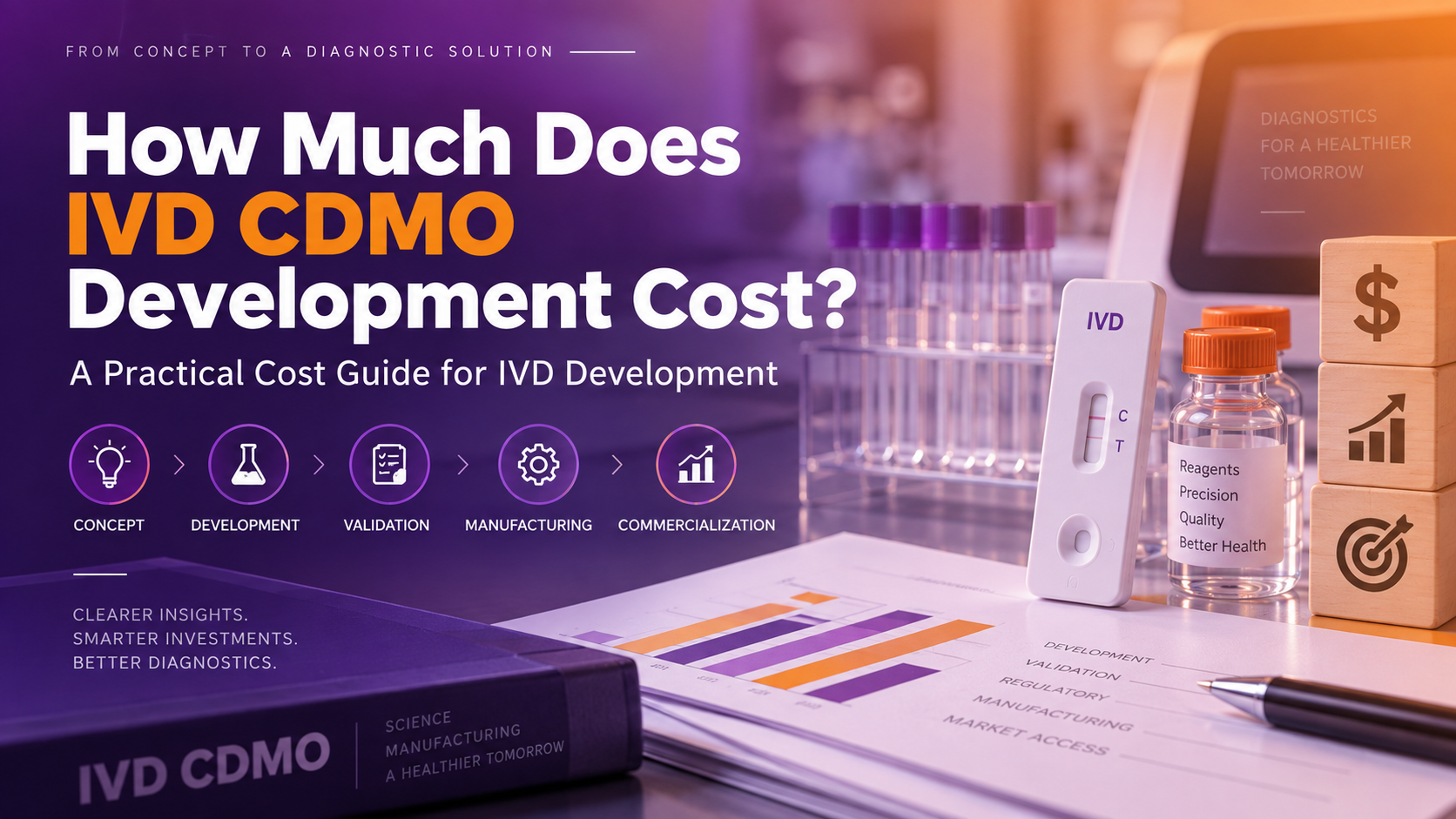
How much does IVD CDMO development cost?
There is no single industry-standard price.
An IVD CDMO project may cost tens of thousands of US dollars for a relatively mature assay requiring limited optimization and transfer, while a new diagnostic platform involving assay development, custom consumables, instrumentation, analytical validation, clinical performance studies, regulatory documentation and manufacturing scale-up can require several hundred thousand dollars to multiple millions of dollars before commercialization.
The reason for this wide range is simple: an IVD CDMO is rarely selling only laboratory development time. Depending on the project scope, the CDMO may be responsible for transforming an early scientific concept into a reproducible, manufacturable and commercially viable diagnostic product.
This guide explains the major cost components, realistic planning ranges and commercial factors that buyers should evaluate when budgeting an IVD CDMO development project.
Important: The figures below are indicative planning ranges rather than fixed market prices. Actual quotations vary substantially according to assay technology, development maturity, intended use, regulatory market, validation requirements, sample availability, manufacturing scale and division of responsibilities between the sponsor and CDMO.
IVD CDMO Development Cost at a Glance
For preliminary budgeting, an IVD development program can be divided into several broad categories.
| Project Type | Indicative Development Budget | Typical Scope |
|---|---|---|
| Feasibility / proof-of-concept project | $10,000–$50,000+ | Initial assay feasibility, reagent screening, basic optimization |
| Optimization of an existing assay | $20,000–$100,000+ | Performance improvement, reagent optimization, preliminary verification |
| Assay development from concept | $50,000–$250,000+ | Assay architecture, reagent selection, optimization, prototype development |
| Assay transfer and manufacturing development | $15,000–$100,000+ | Technology transfer, manufacturing adaptation, engineering work |
| Analytical validation program | $30,000–$200,000+ | Precision, LoD, interference, cross-reactivity, linearity and related studies |
| Stability and transport studies | $20,000–$200,000+ | Real-time/accelerated stability, shipping studies, multiple lots and time points |
| Process and test-method validation | $25,000–$250,000+ | Process validation, test methods, manufacturing controls |
| Custom tooling / fixtures | $10,000–$150,000+ | Dispensing, sealing, alignment, inspection or test fixtures |
| Injection molds / dedicated equipment | $30,000–$500,000+ | Custom plastics, cartridges, automation or dedicated production equipment |
| Clinical performance study | Highly variable | Depends on samples, sites, prevalence, endpoints and study design |
| Full IVD product development | $100,000–$1 million+ | Assay development through manufacturing readiness |
| Complex instrument + assay platform | $500,000–several million+ | Instrument, software, consumables, assays, validation and industrialization |
These ranges should not be added mechanically. A CDMO may combine several activities into a single development package, and some programs do not require every activity listed above.
The correct budget therefore starts with the product’s intended use and development status, not with a generic price-per-project assumption.
What Does an IVD CDMO Development Fee Actually Cover?
An IVD CDMO development cost normally consists of several different cost layers.
A useful commercial model is:
Total IVD Development Cost = Development + Verification/Validation + Engineering + Regulatory Support + Technology Transfer + Manufacturing Readiness + External Study Costs
Understanding these components makes quotations from different IVD CDMO companies much easier to compare.
1. Feasibility and Proof of Concept
Before investing heavily in development, the CDMO normally needs to determine whether the proposed assay architecture can realistically achieve its target performance.
Typical work may include:
- target and biomarker assessment;
- reagent screening;
- antibody or antigen pair evaluation;
- preliminary assay architecture;
- buffer screening;
- reaction-condition optimization;
- preliminary sensitivity and specificity testing;
- interference investigation;
- initial prototype preparation.
For relatively straightforward projects, a feasibility program may fall around $10,000–$50,000 or more.
However, feasibility costs rise quickly when specialized biological materials, difficult matrices, rare samples or extensive reagent screening are required.
This phase can actually reduce total development expenditure.
Discovering that a biomarker, antibody pair or assay architecture is unsuitable during a $20,000 feasibility project is considerably less expensive than discovering the same problem after tooling, validation and manufacturing scale-up.
2. Assay Development and Optimization
Once feasibility has been demonstrated, the development team converts the scientific concept into a controlled assay.
This may involve optimization of:
- capture and detection reagents;
- antibody concentrations;
- conjugation chemistry;
- buffers and blockers;
- membranes;
- reaction times;
- incubation temperatures;
- calibration systems;
- cut-off algorithms;
- controls;
- sample preparation;
- signal detection;
- reader parameters.
A conventional assay-development program might require approximately $50,000–$250,000+, although complexity matters much more than assay format alone.
For example, optimizing an established ELISA using well-characterized reagents can be substantially less expensive than developing a multiplex molecular diagnostic assay or a novel microfluidic cartridge.
3. Raw Materials and Critical Reagent Development
Raw materials are particularly important in IVD development because analytical performance can depend heavily on biological reagent quality.
Development may require:
- recombinant antigens;
- monoclonal or polyclonal antibodies;
- antibody pairing;
- enzyme conjugates;
- primers and probes;
- calibrators;
- quality-control materials;
- blocking reagents;
- buffers;
- reference materials.
A project that can use commercially available, validated reagents will usually have a very different cost structure from one requiring custom antibody development or recombinant protein production.
Buyers should therefore ask:
Are critical raw materials included in the CDMO quotation?
A low assay-development quotation may exclude substantial reagent-development costs.
4. Prototype and Engineering Builds
Laboratory success does not automatically translate into manufacturing success.
A CDMO normally needs to demonstrate that the product can be produced repeatedly under controlled manufacturing conditions.
Engineering and pilot builds may therefore be required to evaluate:
- manufacturing yield;
- dispensing accuracy;
- assembly tolerances;
- lot-to-lot consistency;
- packaging;
- labeling;
- operator variability;
- equipment settings;
- in-process controls;
- release-testing procedures.
Indicative engineering and pilot-build expenditure can range from roughly $10,000 to $100,000+, depending heavily on batch size, material costs and the number of iterations.
5. Analytical Performance Studies
Analytical performance is one of the major cost centers in regulated IVD development.
Depending on the assay and intended use, studies may evaluate characteristics such as:
- analytical sensitivity;
- limit of detection;
- limit of quantitation;
- analytical specificity;
- cross-reactivity;
- interference;
- precision;
- repeatability;
- reproducibility;
- linearity;
- measuring range;
- accuracy;
- carryover;
- specimen stability;
- reagent stability.
For EU-market IVDs, performance evaluation under the IVDR is based on scientific validity, analytical performance and clinical performance. The required evidence therefore cannot be reduced to a single laboratory accuracy experiment.
The actual study matrix can become large.
Consider a precision study involving:
3 reagent lots × 3 instruments × 3 operators × multiple concentrations × multiple days × multiple replicates.
A seemingly simple validation requirement can consequently generate hundreds or thousands of measurements.
Analytical validation budgets can therefore range from tens of thousands to well above $100,000, depending on the assay and evidence requirements.
6. Clinical Performance Studies
Clinical performance is one of the hardest IVD development costs to estimate using a generic price.
The budget depends on factors including:
- intended use;
- target population;
- disease prevalence;
- specimen type;
- required sample number;
- prospective versus retrospective design;
- number of study sites;
- comparator method;
- sample acquisition;
- rare positive specimens;
- ethics requirements;
- laboratory fees;
- investigator fees;
- data management;
- statistical analysis.
For some projects, archived specimens and existing clinical evidence can substantially reduce study requirements.
For others, especially novel or higher-risk IVDs, clinical performance studies can become one of the largest components of the entire commercialization budget.
Under the EU IVDR, manufacturers must establish clinical evidence supporting the intended purpose of the device. The regulation requires performance evaluation covering scientific validity, analytical performance and clinical performance, with clinical performance studies generally expected unless reliance on other clinical-performance data can be justified.
Consequently, buyers should be cautious when a supplier advertises a single low-cost “complete IVD development package” without defining what clinical evidence is included.
7. Stability Testing
Shelf-life claims must be supported by evidence.
An IVD stability program may include:
- real-time stability;
- accelerated stability;
- open-vial stability;
- in-use stability;
- transport simulation;
- freeze-thaw studies;
- temperature excursions;
- multiple reagent lots;
- multiple storage conditions.
Stability programs frequently require $20,000–$200,000+, depending on the product and study design.
There is also a less obvious cost: time.
A product claiming a long shelf life cannot always generate all necessary real-time evidence immediately. Stability planning should therefore begin early rather than after development is nominally complete.
8. Tooling and Product Industrialization
This is where cost differences between assay formats become particularly large.
A simple reagent kit using standard bottles, tubes or microplates may require relatively little dedicated tooling.
A proprietary cartridge-based IVD may require:
- industrial design;
- mechanical engineering;
- injection molds;
- optical components;
- fluidic channels;
- membranes;
- custom packaging;
- automated assembly fixtures;
- leak testing;
- dispensing equipment;
- sealing equipment;
- inspection systems.
Injection molds and dedicated production equipment can cost anywhere from tens of thousands to several hundred thousand dollars, particularly when high cavitation, tight tolerances or automated production are required.
Therefore:
Assay development cost and product-development cost are not necessarily the same thing.
A $100,000 assay can eventually become a $1 million development program when proprietary hardware, software, tooling and manufacturing infrastructure are included.
9. Technology Transfer to Manufacturing
One commonly underestimated expense is transferring the assay from R&D into routine production.
Technology transfer may involve:
- master manufacturing records;
- bills of materials;
- raw-material specifications;
- manufacturing instructions;
- process parameters;
- equipment qualification;
- in-process controls;
- acceptance criteria;
- QC methods;
- lot-release procedures;
- training;
- engineering batches;
- process validation.
For relatively mature products, assay transfer and manufacturing development may require approximately $15,000–$100,000+ before tooling and larger validation programs are considered.
The cheapest development laboratory is therefore not necessarily the lowest-cost commercial solution.
A stronger CDMO should be designing for manufacturability from the beginning.
10. Quality and Regulatory Documentation
Regulatory documentation is another area where quotations can differ dramatically.
A development program may need documentation covering:
- design inputs and outputs;
- design reviews;
- risk management;
- verification and validation;
- traceability;
- supplier controls;
- manufacturing specifications;
- QC specifications;
- stability;
- performance evaluation;
- labeling;
- usability where applicable;
- change control.
This has become particularly relevant for companies targeting the United States.
As of February 2, 2026, FDA’s Quality Management System Regulation (QMSR) is effective. The revised 21 CFR Part 820 incorporates ISO 13485:2016 by reference and aligns the U.S. medical-device quality framework more closely with international quality-management practices.
Companies selecting an IVD CDMO should therefore evaluate the supplier’s quality-system capabilities, not merely its assay-development laboratory.
What Determines the Cost of IVD CDMO Development?
Several variables have a much greater influence on price than geography alone.
Assay Technology
Different technologies create different development burdens.
For example:
| Technology | Typical Cost Drivers |
|---|---|
| ELISA | Antibody pairs, optimization, controls, calibration, stability |
| CLIA | Conjugates, signal chemistry, instrument compatibility |
| Lateral Flow | Membrane selection, conjugate pad, antibodies, strip assembly |
| PCR/qPCR | Primers, probes, extraction, multiplexing, controls |
| Molecular POCT | Cartridge, fluidics, heating, optics, software |
| Immunofluorescence | Fluorescent reagents, optics, reader calibration |
| Multiplex assays | Cross-reactivity, algorithm development, increased validation matrix |
Technology should therefore be evaluated together with intended use rather than treated as a simple product category.
Development Stage Matters
Two companies may ask for quotations for apparently identical IVD products but receive dramatically different prices.
Company A provides:
- validated antibodies;
- established assay protocol;
- complete specifications;
- existing performance data;
- finalized packaging;
- established QC methods.
Company B provides:
- a biomarker concept;
- preliminary research;
- no optimized reagents;
- no manufacturing process;
- no regulatory strategy.
Company B is not purchasing the same CDMO service.
It is effectively outsourcing a significant portion of product creation.
This distinction is one of the most important considerations when comparing IVD CDMO development costs.
Geography: Is IVD Development Cheaper in China?
China has become an important location for IVD development and manufacturing because of its extensive diagnostics supply chain, reagent manufacturing capacity, engineering resources, tooling industry and large-scale manufacturing infrastructure.
Labor and engineering costs may also be lower than in some Western markets.
However, buyers should avoid comparing suppliers purely on hourly engineering rates.
The commercially relevant metric is:
Cost to achieve a validated, transferable and regulatory-ready product.
A $70,000 development program that requires $100,000 of corrective work later is more expensive than a properly executed $120,000 program.
For international buyers evaluating an IVD CDMO in China, supplier qualification should therefore include:
- relevant IVD development experience;
- ISO 13485 quality-system capability where applicable;
- regulatory-market experience;
- documentation quality;
- biological reagent capabilities;
- manufacturing infrastructure;
- analytical testing capability;
- technology-transfer procedures;
- IP protection;
- supply-chain controls;
- communication and project management.
Hidden Costs in an IVD CDMO Quote
When comparing quotations, examine what is excluded as carefully as what is included.
Common exclusions include:
- regulatory authority fees;
- notified-body fees;
- third-party laboratory testing;
- clinical specimens;
- clinical study sites;
- ethics fees;
- reference standards;
- custom antibodies;
- custom antigens;
- tooling;
- injection molds;
- dedicated production equipment;
- software development;
- instrument development;
- shipping;
- customs duties;
- travel;
- packaging qualification;
- translations;
- post-market activities.
A $100,000 quote and a $180,000 quote cannot be meaningfully compared until their scopes and deliverables are normalized.
How Should Buyers Compare IVD CDMO Quotations?
Rather than asking only:
“What is your development price?”
Ask each potential IVD CDMO to provide a milestone-based quotation.
A useful structure is:
Phase 1 — Feasibility
Deliverables, experiments, acceptance criteria and go/no-go decision.
Phase 2 — Assay Development
Optimization plan, prototype specifications and target performance.
Phase 3 — Design Verification
Defined verification studies and acceptance criteria.
Phase 4 — Performance Validation
Analytical and, where included, clinical performance activities.
Phase 5 — Manufacturing Transfer
Process documentation, QC methods and engineering batches.
Phase 6 — Validation and Scale-Up
Process validation, lot validation and commercial manufacturing readiness.
For every phase, request:
- deliverables;
- timeline;
- acceptance criteria;
- assumptions;
- customer responsibilities;
- CDMO responsibilities;
- third-party expenses;
- material costs;
- number of development iterations;
- change-order policy.
This approach makes competing proposals substantially more comparable.
Example IVD CDMO Budget Scenario
Consider a hypothetical company developing a new immunoassay.
Its preliminary budget might look like this:
| Work Package | Example Planning Budget |
|---|---|
| Feasibility | $20,000 |
| Assay development and optimization | $70,000 |
| Prototype / engineering batches | $25,000 |
| Analytical performance studies | $60,000 |
| Stability program | $35,000 |
| Manufacturing transfer | $30,000 |
| Process / method validation | $50,000 |
| Documentation support | $25,000 |
| Subtotal | $315,000 |
This does not mean that $315,000 is the market price for developing an immunoassay.
It is simply an illustration of how an apparently manageable assay-development fee can become a much larger commercialization budget when validation, documentation and manufacturing readiness are included.
Clinical studies, regulatory authority charges, notified-body costs, custom tooling and commercial production could increase the total substantially.
How Can Companies Reduce IVD Development Cost?
The most effective strategy is usually not negotiating the lowest hourly rate.
It is reducing uncertainty.
A well-prepared sponsor can reduce unnecessary development cycles by defining:
- intended use;
- target population;
- specimen type;
- target markets;
- assay format;
- required performance;
- regulatory pathway;
- target manufacturing cost;
- annual volume forecast;
- packaging requirements;
- shelf-life target.
Another important strategy is to establish go/no-go milestones.
Instead of committing the entire commercialization budget immediately, companies can progressively fund:
Feasibility → Optimization → Verification → Validation → Manufacturing Transfer → Scale-Up
If the technology fails an important milestone, the project can be stopped before substantially larger costs are incurred.
CDMO Cost vs. Unit Manufacturing Cost
Buyers should also distinguish development cost from commercial unit cost.
Development expenditure is largely non-recurring.
Commercial manufacturing costs recur with every product manufactured.
The total commercial equation is therefore better expressed as:
Total Program Cost = NRE + Development + Validation + Tooling + Regulatory + Commercial Manufacturing
A CDMO offering inexpensive development but expensive commercial production may be unattractive over the product lifecycle.
Conversely, investing more in manufacturing engineering or automation during development may reduce:
- labor;
- scrap;
- QC failures;
- reagent consumption;
- cycle time;
- assembly cost;
- unit manufacturing cost.
For products expected to sell at significant volume, design for manufacturing can matter more financially than the initial CDMO development quotation.
Frequently Asked Questions About IVD CDMO Development Cost
How much does it cost to develop an IVD assay?
A relatively limited feasibility or optimization project may cost tens of thousands of dollars, while complete development of a new assay commonly requires a substantially larger six-figure budget. Complex systems combining instruments, proprietary consumables, software and multiple assays can require investments reaching seven figures or more.
The appropriate budget depends on what already exists and what still needs to be developed.
Why are IVD CDMO quotations so different?
Different CDMOs may quote different scopes.
One proposal may cover only assay optimization, while another includes analytical validation, stability studies, manufacturing transfer and quality documentation.
Compare deliverables and exclusions, not just the headline price.
Does an IVD CDMO fee include regulatory approval?
Not necessarily.
Regulatory strategy and technical-documentation support may be included, while authority fees, notified-body fees, clinical studies and third-party testing are frequently separate.
The contract should define these responsibilities explicitly.
How much does IVD contract manufacturing cost?
Commercial manufacturing is normally quoted separately from development. Unit economics depend on assay format, materials, batch volume, automation, packaging, QC requirements and yield.
One-time costs such as NRE, tooling, transfer and process validation should also be separated from recurring unit manufacturing costs.
Is China a cost-effective location for IVD CDMO development?
It can be, particularly when development requires close integration with reagent suppliers, plastics, tooling, electronics and manufacturing. However, procurement decisions should consider regulatory experience, quality systems, documentation, technical capability and lifecycle manufacturing economics rather than development price alone.
Conclusion: What Is a Realistic IVD CDMO Development Budget?
There is no universal answer to how much IVD CDMO development costs.
A practical planning framework is:
- $10,000–$50,000+ for limited feasibility work;
- $50,000–$250,000+ for substantial assay development;
- $100,000–$1 million+ for broader product development and commercialization activities;
- $500,000 to several million dollars or more for complex systems combining assays, proprietary consumables, instruments, software, extensive validation and clinical evidence.
These figures are planning ranges—not standard prices.
The most important procurement question is therefore not:
“Which IVD CDMO has the lowest development fee?”
It is:
“What technical, regulatory and manufacturing milestones will this budget achieve?”
A credible IVD CDMO development quotation should clearly define scope, deliverables, assumptions, exclusions, acceptance criteria, ownership of intellectual property, regulatory responsibilities and the path from feasibility to commercial manufacturing.
For diagnostic companies, this level of transparency makes it possible to compare CDMO partners on total development risk and lifecycle economics, rather than on an isolated headline price.
Author Profile

- Written by the IVDCDMO technical and regulatory team, with expertise in diagnostic assay development, GMP manufacturing, ISO 13485 systems, and global IVD commercialization for biotech innovators worldwide.
Latest entries
 IVD ManufacturingNovember 2, 2026OEM IVD Manufacturing & Private Label Diagnostics: A Practical Guide from Product Concept to Market Launch
- IVD ManufacturingOctober 29, 2026IVD Manufacturing Company: A Complete Guide to Choosing the Right Diagnostic Manufacturing Partner
- IVD ManufacturingOctober 26, 2026IVD Raw Materials Manufacturing: A Practical Guide to Quality, Scale-Up and Supplier Selection
- IVD ManufacturingOctober 19, 2026In Vitro Diagnostic Contract Manufacturing Buyer Guide