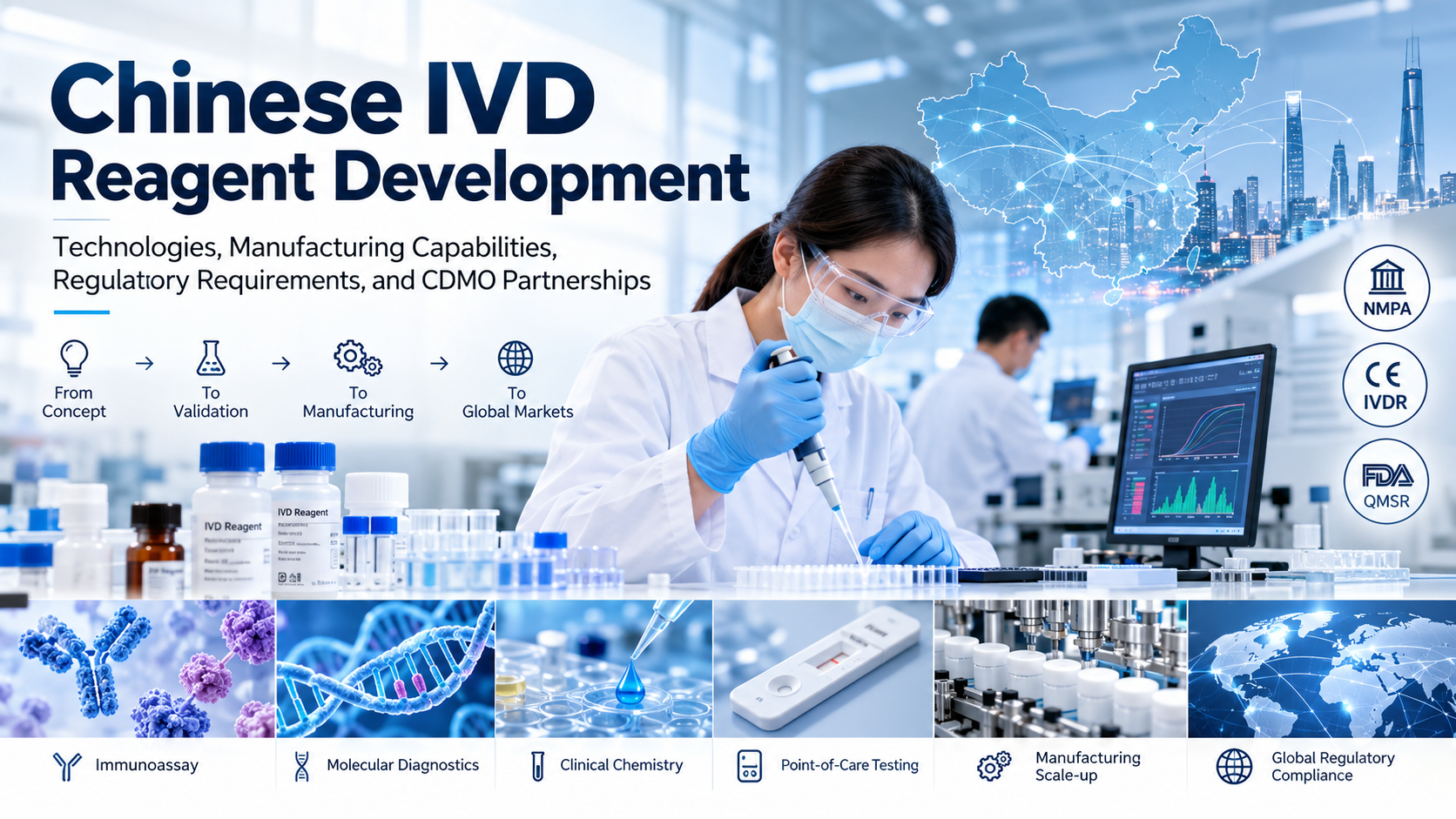
China has become an important global center for in vitro diagnostic (IVD) reagent development, combining capabilities in molecular diagnostics, immunoassays, clinical chemistry, raw-material engineering, and industrial-scale manufacturing. For international diagnostic companies, Chinese IVD reagent development offers opportunities to access specialized technical expertise, shorten selected development and manufacturing activities, and establish more flexible supply chains.
However, developing a reliable diagnostic reagent requires far more than identifying a capable manufacturer or achieving an attractive unit price. Successful commercialization depends on analytical performance, clinical evidence, reagent stability, manufacturing reproducibility, regulatory compliance, and effective technology transfer.
For overseas IVD companies considering Chinese development partners, the critical question is not simply whether a supplier can manufacture diagnostic reagents. It is whether that supplier can consistently translate an assay concept into a validated, scalable, and market-ready diagnostic product.
This guide examines the technical foundations, development workflows, manufacturing capabilities, regulatory considerations, and outsourcing strategies that define professional IVD reagent development in China.
1. Understanding the Chinese IVD Reagent Development Industry
In vitro diagnostic reagents are biological, chemical, or molecular materials used to examine specimens derived from the human body. They support clinical decisions in areas such as infectious disease diagnosis, oncology, cardiovascular medicine, endocrinology, reproductive health, and chronic disease management.
China’s IVD industry encompasses several interconnected segments:
- Diagnostic reagent research and formulation
- Antibody, antigen, enzyme, and oligonucleotide development
- Assay design and analytical optimization
- Diagnostic instrument and reagent integration
- Manufacturing process development and scale-up
- OEM and private-label manufacturing
- Contract development and manufacturing services
- Quality management and regulatory documentation
These capabilities support both domestic diagnostic companies and international organizations seeking external development or manufacturing resources.
Why China Has Become an Important IVD Development Location
China’s competitive position is supported by its combination of scientific expertise, manufacturing infrastructure, laboratory equipment suppliers, and specialized component producers.
One important advantage is the concentration of complementary capabilities. A diagnostic reagent developer may be able to source antibodies, enzymes, buffers, plastic consumables, packaging materials, and analytical instruments from domestic supply networks.
This can facilitate iterative prototyping and coordination between assay development and manufacturing teams.
Nevertheless, geographical proximity alone does not guarantee superior quality, lower total cost, or faster commercialization. Actual project performance depends on supplier qualification, technical maturity, regulatory expectations, and the complexity of the diagnostic assay.
For international customers, the strongest Chinese IVD development partners are those that combine cost-effective engineering with disciplined design controls, traceable materials, validated manufacturing processes, and transparent technical documentation.
2. Major Technologies Used in Chinese IVD Reagent Development
IVD reagent development is not a single technical discipline. Different diagnostic technologies require distinct raw materials, formulation strategies, manufacturing controls, and performance verification methods.
2.1 Immunoassay Reagent Development
Immunoassays use antigen–antibody recognition to detect or quantify biological analytes.
Common platforms include:
- Enzyme-linked immunosorbent assays (ELISA)
- Chemiluminescence immunoassays (CLIA)
- Electrochemiluminescence immunoassays (ECLIA)
- Fluorescence immunoassays (FIA)
- Lateral flow immunoassays (LFIA)
- Latex-enhanced immunoturbidimetric assays
Chinese IVD reagent developers participate in multiple stages of immunoassay development, including antibody screening, antigen preparation, assay configuration, signal chemistry, and formulation optimization.
For quantitative immunoassays, analytical performance is strongly influenced by antibody affinity and specificity, calibration architecture, matrix effects, signal-to-noise ratio, and reagent stability.
For example, a quantitative cardiac troponin assay requires substantially different development and validation strategies from a qualitative infectious disease lateral flow test.
Even when both rely on immunological recognition, their performance objectives, calibration requirements, and clinical evidence needs differ considerably.
2.2 Molecular Diagnostic Reagent Development
Molecular diagnostics identify nucleic acid sequences associated with pathogens, genetic variations, or disease-related biomarkers.
Common technologies include:
- Real-time polymerase chain reaction (qPCR)
- Reverse transcription PCR (RT-PCR)
- Multiplex PCR
- Isothermal nucleic acid amplification
- Digital PCR
- Nucleic acid extraction and purification
- CRISPR-associated molecular detection systems
A molecular diagnostic reagent development project typically involves target sequence selection, primer and probe design, amplification chemistry, reaction optimization, contamination control, and analytical validation.
Critical technical parameters include analytical sensitivity, inclusivity, cross-reactivity, inhibition tolerance, and reproducibility across reagent lots and compatible instruments.
For multiplex assays, developers must additionally address interactions among primers, probes, targets, and fluorescent detection channels.
Chinese molecular diagnostic manufacturers may provide services ranging from reagent formulation to complete assay-and-instrument development. The actual scope should be verified for each supplier rather than assumed from its product catalog.
2.3 Clinical Chemistry Reagent Development
Clinical chemistry reagents are widely used to measure biochemical analytes in serum, plasma, urine, and other specimen types.
Typical applications include liver function, renal function, lipid metabolism, glucose monitoring, and enzyme activity testing.
Development activities may involve enzyme selection, reaction kinetics, buffer optimization, chromogenic substrates, stabilizers, preservatives, and compatibility with automated chemistry analyzers.
An important consideration is the distinction between a chemically functional reagent and a commercially robust assay.
A formulation that produces acceptable results under controlled laboratory conditions may still fail when exposed to variations in temperature, instrument dispensing accuracy, sample matrix, or manufacturing batch.
Professional reagent development must therefore establish acceptable performance across the intended operating conditions.
2.4 Point-of-Care Testing Reagent Development
Point-of-care testing (POCT) places additional demands on reagent design because testing often occurs outside centralized laboratories.
Development priorities may include:
- Short turnaround time
- Minimal sample preparation
- Small specimen volumes
- Simplified user operation
- Portable reader compatibility
- Ambient-temperature stability
- Reliable performance under variable environmental conditions
POCT development can involve lateral flow strips, microfluidic cartridges, dry chemistry systems, fluorescence readers, and compact molecular diagnostic platforms.
The integration of reagents, disposable cartridges, reader hardware, and software is particularly important.
A technically successful reagent cannot automatically be considered a successful POCT product if the sampling mechanism, fluidic architecture, reader algorithms, or user workflow is unreliable.
3. IVD Reagent Development: From Concept to Commercial Manufacturing
ILLUSTRATIVE DEVELOPMENT WORKFLOW
01
Product requirements
Intended use and target performance
02
Feasibility
Raw materials and assay architecture
03
Assay optimization
Formulation and prototype design
04
Verification
Analytical performance and stability
05
Transfer and validation
Manufacturing controls and scale-up
06
Commercialization
Clinical evidence, regulatory approval and release
Activities often overlap, and clinical performance evaluation and regulatory planning should begin well before final manufacturing transfer.
Step 1: Define Intended Use and Product Requirements
Every development project should begin with a clearly defined intended purpose.
The development team must establish the target analyte, specimen type, target population, clinical application, user environment, and reporting format.
The intended purpose influences the entire development strategy, including the required analytical performance, clinical evidence, risk management, labeling, and regulatory pathway.
For instance, a screening assay and a confirmatory diagnostic assay may target the same analyte but require different performance characteristics.
A formal product requirements document should establish measurable acceptance criteria before extensive formulation work begins.
Step 2: Conduct Technical Feasibility Studies
Feasibility studies evaluate whether the proposed assay architecture can achieve the required performance.
Depending on the technology, activities may include antibody-pair screening, antigen characterization, primer and probe evaluation, enzyme selection, or reaction chemistry assessment.
Early feasibility work should identify significant technical risks before substantial investment in tooling, manufacturing infrastructure, or clinical studies.
A structured feasibility report should document experimental methods, materials, results, limitations, and recommendations.
Step 3: Optimize Reagent Formulation
Once feasibility is demonstrated, the development team optimizes the reagent system.
For immunoassays, this may include adjusting antibody concentrations, buffer composition, blocking agents, conjugation chemistry, and signal-generation conditions.
For molecular assays, optimization may focus on primer and probe concentrations, magnesium concentration, enzyme activity, amplification conditions, and internal controls.
The objective is not merely to maximize analytical signal. It is to establish a robust operating window that maintains acceptable performance across expected sources of variation.
Step 4: Verify Analytical Performance
Analytical verification evaluates whether the assay meets its predefined performance requirements.
The required studies depend on the assay technology, intended purpose, applicable regulations, and relevant standards.
| Performance characteristic | Primary development objective |
|---|---|
| Precision | Establish repeatability and intermediate precision |
| Analytical sensitivity | Determine detection or quantitation capability |
| Analytical specificity | Evaluate interference and cross-reactivity |
| Accuracy or trueness | Evaluate agreement with appropriate reference values or methods |
| Linearity | Assess proportional response across the measuring interval |
| Measuring range | Establish the validated reportable interval |
| Lot-to-lot consistency | Evaluate manufacturing reproducibility |
| Stability | Establish supported storage and use conditions |
| Carryover | Evaluate contamination between sequential measurements, where applicable |
| Matrix effects | Assess the influence of specimen composition |
Relevant CLSI documents can provide methodological guidance. Examples include EP05 for precision evaluation, EP07 for interference testing, EP17 for detection capability, and EP09 for method comparison and bias estimation.
The applicable editions, study designs, and acceptance criteria should be determined according to the product and target market.
Step 5: Establish Reagent Stability
Stability is one of the most commercially significant aspects of IVD reagent development.
A reagent must retain acceptable performance throughout its claimed shelf life under defined storage conditions.
Stability studies may include real-time storage, accelerated studies, open-vial stability, onboard stability, and transport-related stress testing.
Accelerated studies can support formulation decisions and stability modeling, but they should not automatically replace real-time evidence supporting a labeled shelf life.
For export-oriented manufacturers, distribution conditions deserve particular attention. Temperature excursions, humidity, freezing, and repeated handling may affect product performance.
Step 6: Transfer the Assay to Manufacturing
Manufacturing transfer converts a laboratory formulation into a controlled production process.
Activities may include defining critical process parameters, qualifying equipment, establishing material specifications, documenting manufacturing instructions, and validating processes where required.
The development team should establish appropriate controls for mixing, filling, dispensing, drying, sealing, packaging, labeling, and environmental conditions.
Process validation is especially important when product quality cannot be fully confirmed through subsequent inspection or testing.
Step 7: Complete Clinical and Regulatory Activities
Analytical verification alone does not necessarily demonstrate clinical suitability.
Depending on the intended use and regulatory pathway, clinical performance studies may be required to establish diagnostic sensitivity, diagnostic specificity, clinical agreement, or other relevant performance measures.
Regulatory submissions, technical documentation, risk management, and quality-system evidence must be prepared according to the applicable jurisdiction.
Commercial release should occur only after the required conformity assessment, authorization, registration, or clearance has been completed.
4. Regulatory Compliance for Chinese IVD Reagent Development
Regulatory compliance must be integrated into product development rather than treated as a final administrative activity.
A diagnostic reagent intended for China, the European Union, or the United States may require different classification decisions, technical documentation, performance evidence, and conformity assessment procedures.
4.1 China: NMPA Registration and Filing
In China, IVD reagents regulated as medical devices are subject to requirements administered by the National Medical Products Administration (NMPA).
Under China’s Provisions for In-vitro Diagnostic Reagent Registration and Filing, Class I reagents are generally subject to filing, while Class II and Class III reagents require registration.
The competent registration authority depends on the product’s classification and whether it is domestically manufactured or imported.
Product development must incorporate risk management, technical requirements, and appropriate performance evidence.

english.nmpa.gov.cn
+1
A Chinese manufacturer’s NMPA registration is useful evidence of regulatory experience. However, it does not automatically authorize that product for sale in another jurisdiction.
4.2 European Union: IVDR Requirements
Regulation (EU) 2017/746, commonly known as the In Vitro Diagnostic Medical Devices Regulation (IVDR), establishes the European regulatory framework for IVD medical devices.
The IVDR uses a risk-based classification system comprising Classes A, B, C, and D.
Depending on the device, compliance activities may involve:
- Scientific validity assessment
- Analytical performance studies
- Clinical performance studies
- Performance evaluation reports
- Risk management and technical documentation
- Quality management system implementation
- Notified body conformity assessment, where required
- Post-market performance follow-up
- Vigilance and post-market surveillance
International buyers should verify whether a Chinese supplier has experience preparing technical documentation suitable for IVDR requirements.
ISO 13485 certification, while valuable, is not equivalent to IVDR conformity assessment or CE marking.
Regulatory reference: Regulation (EU) 2017/746 — EUR-Lex.
4.3 United States: FDA Requirements and the 2026 QMSR
For the United States, the regulatory pathway depends on the IVD product’s classification and intended use.
Depending on the device, FDA marketing authorization may involve a 510(k), De Novo request, or premarket approval application. Certain devices may qualify for exemptions.
An important development for international IVD manufacturers is the FDA’s Quality Management System Regulation (QMSR), which became effective on February 2, 2026.
The QMSR incorporates ISO 13485:2016 by reference into the revised requirements of 21 CFR Part 820, with additional FDA-specific provisions.
Chinese manufacturers serving the US market should evaluate their quality systems against the applicable QMSR requirements rather than assuming that ISO 13485 certification alone establishes full FDA compliance.
4.4 International Standards Relevant to IVD Development
| Standard | Relevance to IVD development |
|---|---|
| ISO 13485 | Medical device quality management systems |
| ISO 14971 | Risk management for medical devices |
| ISO 20916 | Clinical performance studies using human specimens |
| ISO 18113 series | Information supplied by manufacturers of IVD medical devices |
| ISO 23640 | Stability evaluation of IVD reagents |
| ISO 17511 | Metrological traceability of values assigned to calibrators and control materials |
| ISO 15189 | Quality and competence of medical laboratories |
| CLSI EP series | Analytical performance evaluation methodologies |
Not every standard applies to every product. Applicability must be determined according to the intended purpose, device characteristics, and relevant regulatory framework.
5. Critical Raw Materials in IVD Reagent Development
Raw-material quality is a fundamental determinant of diagnostic reagent performance.
A well-designed assay can still experience unacceptable variation if its critical raw materials are poorly characterized or inconsistently manufactured.
Antibodies and Antigens
Antibodies and antigens are central to immunoassay development.
Important qualification parameters include binding specificity, affinity, purity, biological activity, cross-reactivity, and batch consistency.
Antibody selection must reflect the intended assay architecture.
For example, antibodies suitable for a sandwich immunoassay may not perform adequately in a competitive assay, even when they recognize the same analyte.
Enzymes and Molecular Biology Materials
Molecular diagnostic reagents depend on enzymes and other biochemical components with tightly controlled functional properties.
Examples include DNA polymerases, reverse transcriptases, nucleases, nucleotides, and reaction buffers.
Manufacturers should evaluate enzyme activity, contaminating nuclease activity, lot consistency, and stability under the intended storage and operating conditions.
Calibrators and Quality Controls
Quantitative diagnostic assays require appropriate calibration and quality-control strategies.
Where applicable, developers should establish metrological traceability and assess commutability.
The assignment of calibrator values, measurement uncertainty, and suitability of reference materials can directly influence the comparability of patient results.
Supplier Qualification and Traceability
An effective raw-material control program should include supplier qualification, incoming acceptance criteria, material traceability, change notification requirements, and contingency planning.
For critical components, relying exclusively on a single unqualified supplier can create significant commercial and regulatory risks.
6. Chinese IVD Reagent CDMO vs. OEM Manufacturing
International diagnostic companies frequently encounter the terms OEM, ODM, and CDMO when evaluating Chinese suppliers.
Although these business models overlap, their responsibilities are not identical.
| Cooperation model | Typical scope | Suitable customers |
|---|---|---|
| OEM | Manufacture an established product according to agreed specifications | Brands with completed product designs |
| ODM | Develop and manufacture a product under a customer’s brand or commercial arrangement | Companies seeking supplier-led product development |
| CDMO | Contract development, process development, technology transfer, and manufacturing | Companies requiring integrated technical and production support |
| Specialized R&D services | Feasibility studies, assay optimization, or defined development activities | Companies addressing specific technical challenges |
When Is a Chinese IVD CDMO the Better Choice?
A CDMO model may be particularly valuable when the customer has a diagnostic concept but lacks sufficient internal assay development, process engineering, or manufacturing infrastructure.
For example, a company developing a new hormone immunoassay may require antibody screening, quantitative assay optimization, calibrator development, analytical verification, and manufacturing transfer.
An experienced CDMO can coordinate these activities under an agreed technical development plan.
However, the division of responsibilities must be contractually defined.
Key issues include intellectual property ownership, access to development data, regulatory responsibilities, manufacturing rights, confidentiality, technology transfer, and change control.
The most important distinction is that CDMO cooperation should provide documented development capability—not merely private-label access to an existing reagent catalog.
7. How to Evaluate a Chinese IVD Reagent Development Partner
Selecting a development partner should be based on technical evidence and operational capability rather than marketing claims.
A structured supplier assessment should address five dimensions.
Technical Competence
Evaluate whether the supplier has demonstrated experience with the relevant assay technology, analyte class, specimen type, and detection platform.
Request representative development reports, validation summaries, or suitably anonymized technical case studies.
Quality Management
Verify the supplier’s quality management certification, including the certification scope, covered manufacturing sites, and validity.
Where appropriate, conduct an onsite or remote quality audit.
Regulatory Experience
Determine whether the supplier understands the requirements of the intended destination market.
Experience preparing NMPA documentation does not necessarily establish competence in EU IVDR or FDA submissions.
Manufacturing Capability
Review equipment, manufacturing controls, production capacity, process validation practices, environmental monitoring, and lot-release procedures.
Commercial and Contractual Transparency
Confirm ownership of formulations, specifications, analytical methods, development records, and tooling.
Assess the supplier’s ability to support manufacturing transfer or second-source qualification if the commercial relationship changes.
Interactive IVD supplier evaluation checklist
Use these criteria during technical qualification or a supplier audit.
Assessment progress
0 of 8Relevant assay development experienceDocumented feasibility and verification studiesAppropriate ISO 13485 certification scopeTarget-market regulatory competenceRaw-material traceability and supplier controlsStability and lot-consistency evidenceManufacturing scale-up and change controlClear IP ownership and technology-transfer terms
Copy assessment checklist
8. Cost Considerations in Chinese IVD Reagent Development
The total cost of IVD reagent development depends on assay complexity, raw-material requirements, performance objectives, regulatory evidence, and manufacturing scale.
A simple adaptation of an established reagent formulation may require substantially less development work than a novel quantitative assay involving new antibodies, a custom reader, and extensive clinical validation.
The principal cost categories include:
- Feasibility research and experimental design
- Raw-material sourcing and characterization
- Assay optimization and prototype iterations
- Analytical verification and stability studies
- Clinical performance studies, where required
- Manufacturing process development and validation
- Regulatory documentation and conformity assessment
- Commercial production, packaging, and logistics
A quotation covering only reagent manufacturing should not be compared directly with a comprehensive CDMO proposal that includes development, validation, and regulatory support.
Buyers should request milestone-based quotations with explicit deliverables, acceptance criteria, assumptions, and change-order mechanisms.
The lowest initial quotation does not necessarily represent the lowest total commercialization cost.
9. Common Risks in Cross-Border IVD Reagent Development
Incomplete Technical Specifications
Ambiguous requirements can cause repeated development iterations and disagreements over project completion.
The solution is to establish measurable performance specifications and a documented acceptance process.
Insufficient Access to Development Data
Some suppliers may provide prototype samples without complete experimental records.
For regulated products, limited access to design and verification evidence can create serious downstream problems.
Contracts should specify which reports, protocols, raw data, and manufacturing documents must be delivered.
Weak Intellectual Property Protection
Before transferring proprietary formulations, antibody sequences, assay designs, or confidential clinical information, parties should establish appropriate confidentiality and intellectual property agreements.
Ownership of newly developed intellectual property should be defined explicitly.
Uncontrolled Manufacturing Changes
Changes to antibodies, enzymes, suppliers, manufacturing equipment, or critical process parameters can affect analytical performance.
A formal change-control agreement should specify notification, evaluation, approval, and revalidation responsibilities.
Misaligned Regulatory Expectations
A product designed solely around domestic requirements may need additional development or evidence to enter another market.
International regulatory requirements should therefore be considered at the earliest development stages.
10. Emerging Opportunities in China’s IVD Reagent Development Sector
Several technological directions are creating opportunities for Chinese IVD developers and international partners.
Multiplex Diagnostic Assays
Multiplex assays can detect multiple analytes from a single specimen, potentially improving workflow efficiency and information density.
Their development requires careful management of analytical cross-reactivity, signal separation, calibration, and interpretation.
Advanced Point-of-Care Diagnostics
Portable instruments, microfluidic systems, and integrated reagent cartridges are enabling new testing workflows outside centralized laboratories.
Development opportunities exist in rapid quantitative testing, simplified sample handling, and improved reagent stability.
Integrated Reagent–Instrument Systems
As diagnostic platforms become more automated, reagent development increasingly requires collaboration among biochemists, mechanical engineers, electronics specialists, and software developers.
Instrument compatibility should be evaluated throughout development rather than only during final verification.
Automation and Data-Driven Assay Optimization
Automated liquid handling, experimental design methods, and statistical analysis can improve development efficiency.
Machine learning may support formulation screening, image interpretation, or experimental prioritization.
Nevertheless, computational predictions require experimental confirmation, and AI-assisted development does not replace analytical validation or regulatory evidence.
More Resilient Global Supply Chains
International diagnostic companies are increasingly interested in supplier qualification, manufacturing redundancy, and reliable access to critical raw materials.
Chinese development and manufacturing partners may contribute to these strategies when appropriate quality, regulatory, and contractual controls are established.
11. Frequently Asked Questions About Chinese IVD Reagent Development
What is Chinese IVD reagent development?
Chinese IVD reagent development refers to the research, formulation, optimization, verification, and manufacturing development of in vitro diagnostic reagents conducted by companies or research organizations in China. It includes immunoassays, molecular diagnostics, clinical chemistry reagents, and point-of-care diagnostic technologies.
Can Chinese manufacturers develop customized IVD reagents?
Yes. Qualified Chinese development organizations may offer custom assay development, formulation optimization, reagent–instrument integration, and manufacturing services. Capabilities vary significantly by supplier, so relevant technical experience and documented evidence should be verified.
Are Chinese IVD reagents compliant with EU and US regulations?
They can be, provided the specific products and responsible manufacturers meet applicable requirements. Compliance is product- and market-specific. NMPA registration or ISO 13485 certification alone does not establish EU IVDR conformity or FDA marketing authorization.
What is the difference between IVD reagent OEM and CDMO services?
OEM generally focuses on manufacturing products according to agreed specifications. CDMO services may additionally include assay development, analytical optimization, process engineering, manufacturing transfer, and validation support.
How long does IVD reagent development take in China?
Development time varies according to technical complexity, availability of critical raw materials, performance objectives, and regulatory requirements. Established formulations may progress more quickly than novel assays requiring extensive optimization and clinical evidence. A reliable schedule should be based on a project-specific feasibility assessment.
What information should I provide when requesting an IVD development quotation?
A useful request should include the target analyte, intended purpose, specimen type, assay technology, qualitative or quantitative reporting requirements, target performance, compatible instruments, destination markets, expected production volume, and required development deliverables.
How can international companies protect their intellectual property?
They should establish appropriate confidentiality agreements, define ownership of background and newly developed intellectual property, control access to sensitive information, and specify technology-transfer and termination rights in the development contract.
Conclusion: Building Successful Chinese IVD Reagent Development Partnerships
Chinese IVD reagent development offers international diagnostic companies access to a broad ecosystem of assay development, biochemical raw materials, engineering expertise, and manufacturing capabilities.
Its commercial value, however, depends on more than production capacity or pricing.
Successful partnerships require clearly defined product requirements, rigorous analytical verification, appropriate clinical evidence, reliable quality management, transparent documentation, and a regulatory strategy aligned with the intended market.
For organizations considering Chinese IVD reagent manufacturers, OEM suppliers, or CDMO partners, the most effective approach is to evaluate technical competence and lifecycle responsibilities before making a sourcing decision.
A well-structured Chinese IVD reagent development partnership should deliver not only a functioning diagnostic assay, but also the documented evidence, reproducible manufacturing process, and quality controls needed for sustainable commercialization.
Author Profile

- Written by the IVDCDMO technical and regulatory team, with expertise in diagnostic assay development, GMP manufacturing, ISO 13485 systems, and global IVD commercialization for biotech innovators worldwide.
Latest entries
 IVD ManufacturingNovember 2, 2026OEM IVD Manufacturing & Private Label Diagnostics: A Practical Guide from Product Concept to Market Launch
- IVD ManufacturingOctober 29, 2026IVD Manufacturing Company: A Complete Guide to Choosing the Right Diagnostic Manufacturing Partner
- IVD ManufacturingOctober 26, 2026IVD Raw Materials Manufacturing: A Practical Guide to Quality, Scale-Up and Supplier Selection
- IVD ManufacturingOctober 19, 2026In Vitro Diagnostic Contract Manufacturing Buyer Guide