The performance of an in vitro diagnostic assay often begins long before the test kit reaches the manufacturing line. It begins with its IVD raw materials.
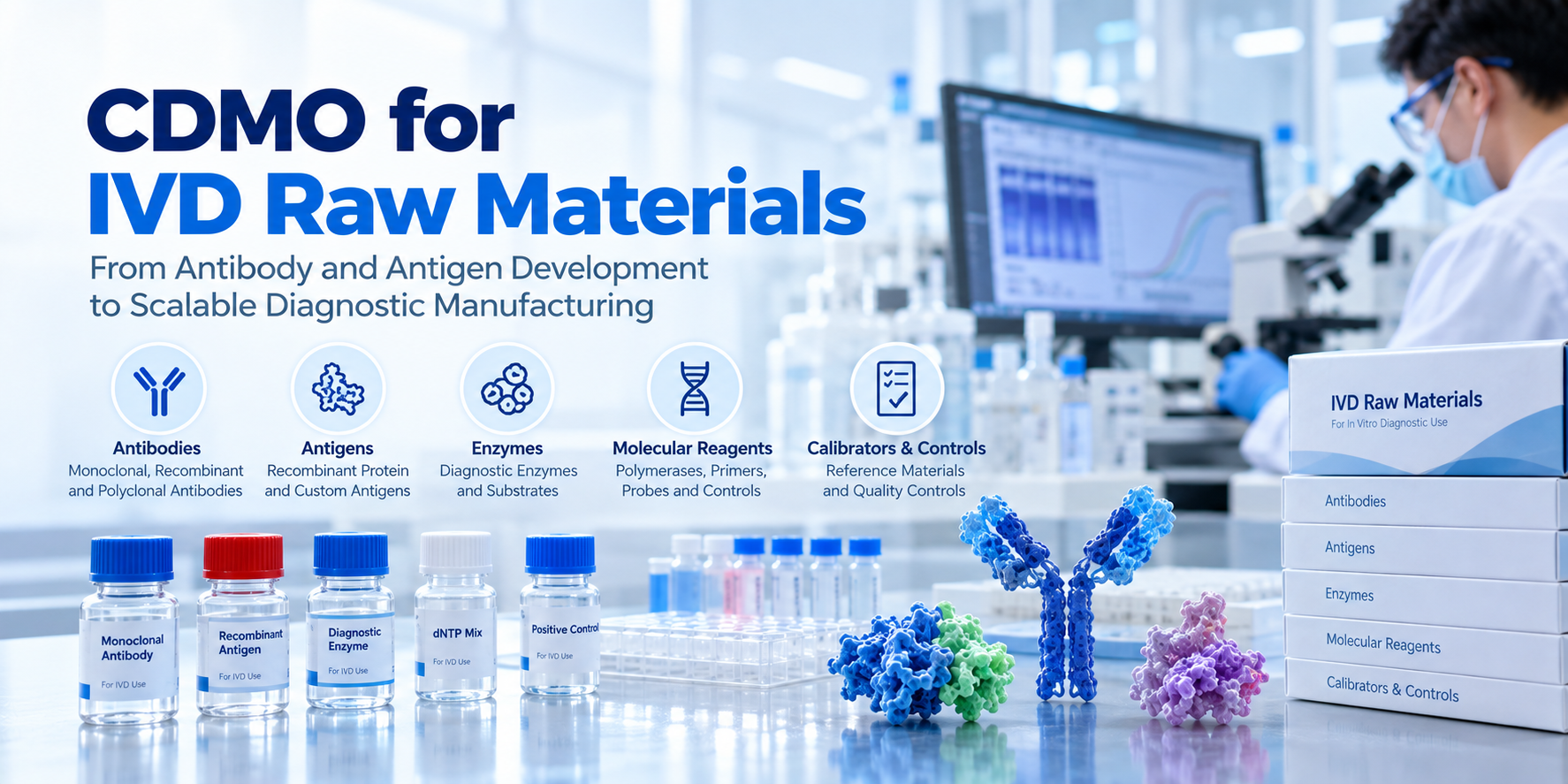
Antibodies determine molecular recognition. Antigens influence specificity and immune reactivity. Enzymes drive amplification and signal generation. Primers and probes determine molecular target recognition. Calibrators and controls help establish and monitor measurement performance.
For this reason, CDMO for IVD raw materials is not simply a sourcing service for biological reagents. A mature CDMO program should help convert a biological molecule or assay requirement into a characterized, reproducible and scalable raw material suitable for integration into a commercial diagnostic system.
This distinction becomes increasingly important as diagnostic companies move from research prototypes to regulated commercial products.
A material that performs well in an early experiment may still fail commercially because of poor lot-to-lot reproducibility, inadequate stability, matrix interference, scale-up effects or an unreliable supply chain.
This guide examines how professional IVD raw material CDMO programs address these challenges and what diagnostic developers should evaluate when selecting a development and manufacturing partner.
What Does CDMO for IVD Raw Materials Mean?
A CDMO for IVD raw materials provides contract development and manufacturing services for biological and chemical components used in in vitro diagnostic products.
Depending on the project, the scope may extend from early-stage molecule development through commercial-scale manufacturing.
Typical activities can include:
- Target and sequence evaluation
- Recombinant protein development
- Antigen expression and purification
- Monoclonal antibody development
- Recombinant antibody production
- Antibody pairing and screening
- Antibody affinity optimization
- Enzyme development and production
- Molecular diagnostic reagent development
- Conjugation and labeling
- Buffer and formulation development
- Analytical characterization
- Functional assay evaluation
- Stability studies
- Process development
- Scale-up
- Lot-to-lot consistency control
- Technology transfer
- Commercial manufacturing
The exact development pathway depends on the biological material and its intended function in the diagnostic assay.
A critical principle should guide the entire process:
An IVD raw material should be developed according to its function in the final diagnostic system—not only according to its isolated biochemical characteristics.
That difference separates research-grade material development from a commercially oriented IVD raw-material strategy.
Why IVD Raw Materials Are Critical to Diagnostic Performance
An IVD test is a system of interacting components.
Consider a sandwich immunoassay.
Its performance may depend simultaneously on:
Capture antibody + detection antibody + antigen structure + label chemistry + buffer + blocking system + solid phase + specimen matrix + analyzer settings.
Changing only one component can alter the behavior of the entire assay.
For example, a new antibody lot may meet concentration and purity specifications while producing a different signal-to-background ratio in the finished assay.
Similarly, a recombinant antigen can show excellent purity by analytical testing but perform poorly if its expression system does not preserve the epitopes required by the diagnostic assay.
Therefore, effective IVD raw material development requires two levels of evaluation:
Material-Level Characterization
Does the material meet appropriate biochemical and physical specifications?
Assay-Level Functional Evaluation
Does the material perform as intended inside the actual or representative diagnostic system?
Both are important.
Neither should automatically substitute for the other.
Major Raw Materials Supported by IVD CDMO Programs
1. Custom Antibody Development and Manufacturing
Antibodies are among the most important recognition reagents used in immunodiagnostics.
They may serve as:
- Capture antibodies
- Detection antibodies
- Secondary antibodies
- Neutralizing antibodies
- Conjugated antibodies
- Calibrator or control components
Depending on the project, a CDMO for IVD antibodies may support conventional monoclonal antibody development, recombinant antibodies, polyclonal antibodies, antibody fragments or other engineered binding molecules.
Important Development Considerations
An antibody should not be selected solely according to apparent affinity.
For diagnostic applications, developers may need to evaluate:
- Specificity
- Affinity
- Epitope recognition
- Cross-reactivity
- Pairing compatibility
- Matrix effects
- Nonspecific binding
- Conjugation behavior
- Stability
- Reproducibility
- Manufacturing scalability
For sandwich assays, antibody pairing is especially important.
Two individually strong antibodies do not necessarily form an effective capture-detection pair.
Epitope accessibility, steric interference and assay architecture can substantially affect the final result.
2. Recombinant Antigen Development
Recombinant antigens are widely used in infectious disease diagnostics, immunology, serology, controls, calibrators and antibody-development programs.
A CDMO for IVD antigens may use different expression systems according to the characteristics of the target protein.
Common platforms include:
| Expression Platform | Potential Advantages | Important Considerations |
|---|---|---|
| E. coli | Fast, scalable, economical | Folding and post-translational modification limitations |
| Yeast | Scalable eukaryotic expression | Glycosylation differences |
| Insect/Baculovirus | Useful for complex proteins | Process complexity and expression optimization |
| Mammalian Cells | Complex folding and mammalian PTMs | Higher production complexity and cost |
There is no universally superior expression platform.
The appropriate system depends on protein structure, required post-translational modifications, epitope presentation, intended assay and manufacturing economics.
Purity Is Not Enough
One of the most common misconceptions in antigen sourcing is:
Higher purity automatically means better diagnostic performance.
Not necessarily.
For IVD applications, developers may also need to consider:
- Correct folding
- Epitope accessibility
- Aggregation
- Oligomeric state
- Tag position
- Glycosylation
- Stability
- Matrix behavior
- Lot reproducibility
A 95% pure protein that preserves the diagnostically important epitope may outperform a nominally purer protein with an unsuitable conformation.
The final assay—not the specification sheet alone—should help determine suitability.
3. Diagnostic Enzyme Development
Enzymes are another critical class of IVD raw materials.
They may function as:
- Reaction enzymes
- Signal-generation enzymes
- Enzyme labels
- Amplification enzymes
- Sample-processing enzymes
- Interference-removal enzymes
Applications extend across clinical chemistry, immunodiagnostics and molecular diagnostics.
Important enzyme characteristics can include:
- Specific activity
- Substrate specificity
- Side activities
- Purity
- Cofactor requirements
- pH profile
- Temperature profile
- Formulation compatibility
- Storage stability
- Lot consistency
One important technical detail is frequently overlooked:
Enzyme activity values are method-dependent.
An activity value is meaningful only when the measurement conditions and unit definition are understood.
Two suppliers may report different activity values for similar materials simply because their analytical methods differ.
For commercial qualification, activity specifications should therefore be interpreted together with the underlying test method.
4. Molecular Diagnostic Raw Materials
Molecular diagnostics introduce another group of critical components.
These may include:
- DNA polymerases
- Reverse transcriptases
- RNases
- Nucleases
- Primers
- Probes
- dNTPs
- Buffers
- Reference materials
- Internal controls
For PCR and qPCR systems, seemingly small differences in enzyme characteristics or formulation can affect amplification efficiency, Ct values, inhibitor tolerance and detection limits.
A molecular diagnostic CDMO program should therefore consider the complete reaction architecture.
Important questions include:
How does the enzyme perform in the intended sample matrix?
How tolerant is the system to common inhibitors?
Does the reagent remain stable after the intended storage and shipping conditions?
Can performance be reproduced when enzyme production is scaled up?
These questions become more important as a molecular assay moves from R&D into routine manufacturing.
5. Calibrators and Control Materials
Calibrators and controls are sometimes treated as secondary materials.
For quantitative diagnostics, they can be central to the measurement system.
A calibrator may influence:
- Calibration curves
- Assigned values
- Measurement traceability
- Bias
- Lot harmonization
Control materials help monitor whether an analytical system continues to operate within expected limits.
Depending on the intended application, development considerations can include:
- Matrix selection
- Analyte concentration
- Homogeneity
- Stability
- Commutability
- Value assignment
- Concentration range
- Packaging
- Reconstitution behavior
For these materials, producing the biological component is only part of the challenge.
The material must also behave appropriately within the intended measurement procedure.
From Technology-Grade to IVD-Oriented Raw Materials
This distinction deserves particular attention.
A research-grade antibody or protein may be perfectly suitable for exploratory experiments.
Commercial diagnostics impose different requirements.
| Technology-Oriented Material | Commercial IVD-Oriented Material |
|---|---|
| Experimental performance | Defined intended function |
| Small production volume | Scalable manufacturing |
| Limited lot requirements | Controlled lot-to-lot consistency |
| Basic characterization | Fit-for-purpose characterization |
| Short-term availability | Long-term supply planning |
| Flexible formulation | Controlled formulation |
| Technology documentation | Controlled production documentation |
| Supplier change may be acceptable | Change may require assessment |
The objective is not to suggest that every IVD raw material requires identical controls.
Controls should be proportionate to the material’s impact on the final diagnostic product.
A critical antibody affecting clinical sensitivity warrants different scrutiny from a low-risk packaging component.
This is a risk-based raw material strategy.
A Professional CDMO Workflow for IVD Raw Materials
A well-designed project generally progresses through defined development stages.
Stage 1: Define the Intended Function
Before selecting an expression platform or antibody-development strategy, define what the material must accomplish.
Questions may include:
- Which assay platform will use it?
- What analyte will it recognize?
- What sample matrix is involved?
- Is it a capture or detection reagent?
- Will it be conjugated?
- What sensitivity is required?
- What storage conditions are expected?
- What annual volume may eventually be required?
These requirements influence almost every downstream technical decision.
Stage 2: Feasibility and Development Strategy
The CDMO evaluates possible technical routes.
For recombinant proteins, this may involve:
Sequence design → Expression system selection → Construct development → Small-scale expression → Purification screening
For monoclonal antibodies:
Immunogen design → Immunization → Screening → Clone selection → Functional evaluation → Recombinant conversion where appropriate
The objective is to identify a technically and commercially realistic pathway.
Stage 3: Candidate Screening
Candidate molecules should be evaluated according to their intended diagnostic function.
For antibodies, this may include screening for:
- Binding
- Specificity
- Cross-reactivity
- Pairing
- Signal intensity
- Background
- Matrix performance
For antigens:
- Antibody recognition
- Specificity
- Conformation
- Stability
- Assay response
Early functional screening can prevent significant development resources from being invested in a biologically impressive but diagnostically unsuitable candidate.
Stage 4: Characterization
Selected candidates undergo more detailed characterization.
Depending on the material, relevant techniques may include:
- SDS-PAGE
- SEC
- HPLC
- Western blotting
- ELISA
- Mass spectrometry
- Binding analysis
- Protein concentration assays
- Enzyme activity assays
- Functional diagnostic assays
The appropriate analytical package should be determined by material risk and intended application.
More testing does not automatically mean better control.
The goal is to measure characteristics that matter to product performance.
Stage 5: Process Development
Once a candidate has been selected, development shifts from:
Can we produce this material?
to:
Can we produce it repeatedly?
This transition is fundamental.
Process development may address:
- Cell culture
- Fermentation
- Expression conditions
- Harvest
- Purification
- Filtration
- Concentration
- Buffer exchange
- Formulation
- Filling
- Storage
Critical process parameters should be identified where variation can materially influence the finished raw material.
Stage 6: Scale-Up
Scaling biological production is not simply multiplying every laboratory parameter.
Changes in:
- Oxygen transfer
- Mixing
- Temperature gradients
- Nutrient availability
- Cell density
- Harvest timing
- Purification loading
- Hold times
can alter yield or product quality.
This is why a strong CDMO for IVD raw materials should possess both biological development expertise and process-engineering capability.
The real objective of scale-up is not maximum yield.
It is:
Reproducible output at an economically viable scale without unacceptable changes in critical quality or functional performance.
Stage 7: Lot-to-Lot Consistency
For commercial diagnostics, lot consistency is one of the most important indicators of raw-material maturity.
Consider an antibody used in a quantitative assay.
If successive antibody lots shift assay response, the downstream manufacturer may need to:
- Re-optimize concentrations
- Adjust calibration
- Repeat verification
- Investigate QC failures
The real cost of raw-material inconsistency can therefore greatly exceed the purchase price of the reagent.
Lot qualification should consider both material-level specifications and relevant functional performance.
Stage 8: Stability and Formulation Development
A biologically active material is not commercially useful if it rapidly loses activity during storage.
Stability can be affected by:
- Temperature
- pH
- Oxidation
- Light
- Freeze-thaw cycles
- Aggregation
- Proteolysis
- Adsorption to containers
- Microbial contamination
Formulation development may therefore evaluate buffers, salts, stabilizers, preservatives, surfactants and storage formats.
Stability studies should ultimately support realistic manufacturing, transportation and storage conditions.
Why Functional Specifications Matter
Traditional raw-material specifications often emphasize:
Purity, concentration, appearance and biochemical identity.
These remain useful.
But for critical IVD materials, they may not be sufficient.
Consider two antibody lots.
Both may satisfy:
- ≥95% purity
- Identical concentration
- Correct molecular weight
- Acceptable appearance
Yet one may generate substantially higher background in the final immunoassay.
From a conventional biochemical specification, both lots pass.
From the perspective of the diagnostic system, they are not equivalent.
This illustrates an important principle:
Critical IVD raw materials should, where appropriate, be controlled by specifications connected to their functional role in the assay.
Change Control: An Underestimated CDMO Requirement
Commercial diagnostic products may remain on the market for many years.
During that period, raw-material manufacturing inevitably changes.
Possible changes include:
- Cell bank
- Fermentation equipment
- Culture medium
- Purification resin
- Raw-material supplier
- Manufacturing site
- Formulation
- Container
- Analytical method
A professional CDMO relationship should therefore establish how significant changes are:
Identified → Assessed → Documented → Verified → Communicated
For diagnostic manufacturers, an uncontrolled upstream change can create downstream regulatory and product-performance consequences.
This makes change management an important part of long-term supplier qualification.
Supply Continuity Is Part of Raw-Material Quality
Quality is traditionally associated with molecular characteristics.
For commercial IVD manufacturing, however, availability is also important.
An antibody with excellent analytical performance but unpredictable supply can become a significant business risk.
Diagnostic companies should therefore consider:
- Manufacturing capacity
- Lead time
- Safety stock
- Cell-bank management
- Backup production capability
- Critical supplier dependencies
- Business continuity
- Long-term availability
For strategic materials, the objective is not simply:
“Can the supplier deliver this month?”
It is:
“Can this material remain technically consistent and commercially available throughout the expected lifecycle of our diagnostic product?”
CDMO vs. Catalog Raw Materials: When Is Custom Development Necessary?
Not every diagnostic project requires custom CDMO development.
Existing catalog materials can be highly effective when suitable reagents are already available.
Custom development becomes more valuable when:
- No suitable commercial material exists
- Existing antibodies lack specificity
- A proprietary biomarker is involved
- Higher sensitivity is required
- Supply continuity is strategically important
- A unique assay architecture requires specific properties
- Existing materials cannot be manufactured at sufficient scale
- Intellectual-property control is important
The decision should therefore be based on technical and commercial requirements rather than an assumption that custom development is always superior.
How to Evaluate a CDMO for IVD Raw Materials
When selecting an IVD raw materials CDMO, diagnostic companies should evaluate more than a product catalog.
Important questions include:
Technical Capability
Does the provider have relevant expertise in the specific molecule and assay technology?
Development Capability
Can it move beyond catalog supply and develop new antibodies, antigens, enzymes or molecular reagents?
Functional Testing
Can materials be evaluated in relevant diagnostic formats?
Manufacturing Scale
Can the process progress from milligram-scale development to sustained commercial supply?
Quality System
Are manufacturing and quality activities appropriately documented and controlled?
Lot Consistency
How are new production lots compared with qualified material?
Stability
What evidence supports recommended storage conditions and shelf life?
Change Control
How are significant manufacturing changes evaluated and communicated?
Supply Continuity
Can the provider support the expected commercial lifecycle of the diagnostic product?
A strong CDMO should be able to explain not only what it can manufacture, but also how it controls the material as production scales and evolves over time.
The Role of IVD CDMO in Raw-Material Development and Supplier Matching
The global IVD supply chain is highly specialized.
A company with excellent monoclonal antibody capability may not be the ideal partner for recombinant enzyme development. A protein-expression specialist may not have sufficient expertise in lateral flow optimization. A molecular-reagent manufacturer may be better suited to polymerase development than immunodiagnostic raw materials.
This creates a practical challenge for diagnostic developers:
Finding a supplier is easy. Finding the right technical capability for a specific project is much harder.
IVD CDMO provides a specialized industry platform connecting diagnostic companies and project owners with appropriate IVD development, raw-material and manufacturing capabilities.
Projects may include:
- Custom antibody development
- Recombinant antibody manufacturing
- Antigen development and production
- Recombinant protein expression
- Diagnostic enzyme development
- Molecular diagnostic raw materials
- Antibody pairing
- Conjugation and labeling
- Calibrators and controls
- Raw-material scale-up
- OEM/ODM manufacturing
- Test kit development
- Technology transfer
- Commercial IVD manufacturing
The objective is not simply to locate a company selling a particular reagent.
It is to match the biological requirement, assay platform, development stage, quality expectations, manufacturing scale and commercial objective with appropriate technical resources.
Frequently Asked Questions About CDMO for IVD Raw Materials
What are the most important raw materials used in IVD products?
Major categories include antibodies, antigens, enzymes, substrates, primers, probes, calibrators, controls, buffers and other functional reagents. Their importance varies according to the diagnostic platform.
What does an IVD raw materials CDMO do?
An IVD raw-material CDMO can support development, characterization, process optimization, scale-up and manufacturing of critical components used in diagnostic assays.
Can a CDMO develop custom antibodies for diagnostic assays?
Yes, depending on its capabilities. Programs may include immunogen development, immunization, clone screening, antibody pairing, functional evaluation, recombinant conversion and scale-up.
Which expression system is best for recombinant IVD antigens?
There is no universally best expression system. E. coli, yeast, insect and mammalian systems each offer advantages and limitations. Selection should be based on protein structure, required post-translational modifications, functional performance, scale and economics.
Is protein purity enough to qualify an IVD raw material?
No. Purity is important but does not by itself establish diagnostic suitability. Identity, biological activity, specificity, stability, matrix compatibility, lot consistency and functional assay performance may also be important.
Why is lot-to-lot consistency important for IVD raw materials?
Changes between raw-material lots can alter assay signal, background, sensitivity, calibration or specificity. Consistent commercial diagnostics therefore require appropriate controls over critical material variation.
When should an IVD company choose custom CDMO development instead of catalog materials?
Custom development is particularly useful when commercially available materials cannot meet required specificity, sensitivity, scalability, intellectual-property, supply-continuity or assay-design requirements.
Conclusion: IVD Raw Materials Should Be Developed as Part of the Diagnostic System
The value of CDMO for IVD raw materials extends far beyond producing antibodies, antigens, enzymes or proteins.
The more difficult task is converting biological materials into controlled, reproducible and scalable components of a diagnostic measurement system.
That requires understanding the relationship between molecular characteristics and final assay performance.
A commercially mature raw-material strategy therefore connects:
Molecule Design → Development → Functional Screening → Characterization → Process Development → Scale-Up → Lot Control → Stability → Change Management → Commercial Supply
For diagnostic companies, this lifecycle perspective can reduce one of the most significant sources of product risk: discovering too late that a promising research reagent cannot support reliable commercial manufacturing.
The right IVD raw materials CDMO should therefore be evaluated not only by what it can develop today, but by whether it can maintain the required performance, consistency, documentation and supply continuity over the commercial lifecycle of the diagnostic product.
For international IVD projects requiring specialized antibody, antigen, enzyme, molecular reagent or other diagnostic raw-material capabilities, IVD CDMO provides a platform for connecting project requirements with appropriate development and manufacturing resources.
Author Profile

- Written by the IVDCDMO technical and regulatory team, with expertise in diagnostic assay development, GMP manufacturing, ISO 13485 systems, and global IVD commercialization for biotech innovators worldwide.
Latest entries
 IVD ManufacturingNovember 2, 2026OEM IVD Manufacturing & Private Label Diagnostics: A Practical Guide from Product Concept to Market Launch
- IVD ManufacturingOctober 29, 2026IVD Manufacturing Company: A Complete Guide to Choosing the Right Diagnostic Manufacturing Partner
- IVD ManufacturingOctober 26, 2026IVD Raw Materials Manufacturing: A Practical Guide to Quality, Scale-Up and Supplier Selection
- IVD ManufacturingOctober 19, 2026In Vitro Diagnostic Contract Manufacturing Buyer Guide