How End-to-End IVD CDMO Services Reduce Development Costs, Accelerate Regulatory Approval, and Improve Market Success
The global in vitro diagnostics (IVD) industry is undergoing rapid transformation. As healthcare systems demand faster innovation, shorter development cycles, and stricter regulatory compliance, many diagnostic companies are rethinking how new products are brought to market.
Traditionally, diagnostic manufacturers built their own research teams, established production facilities, developed quality systems, conducted clinical studies, and managed regulatory submissions independently. While this vertically integrated model provides full control, it also requires significant capital investment, long development timelines, and extensive regulatory expertise.
Today, an increasing number of IVD companies are turning to specialized IVD CDMO (Contract Development and Manufacturing Organization) partners to accelerate product commercialization while reducing both financial and operational risks.
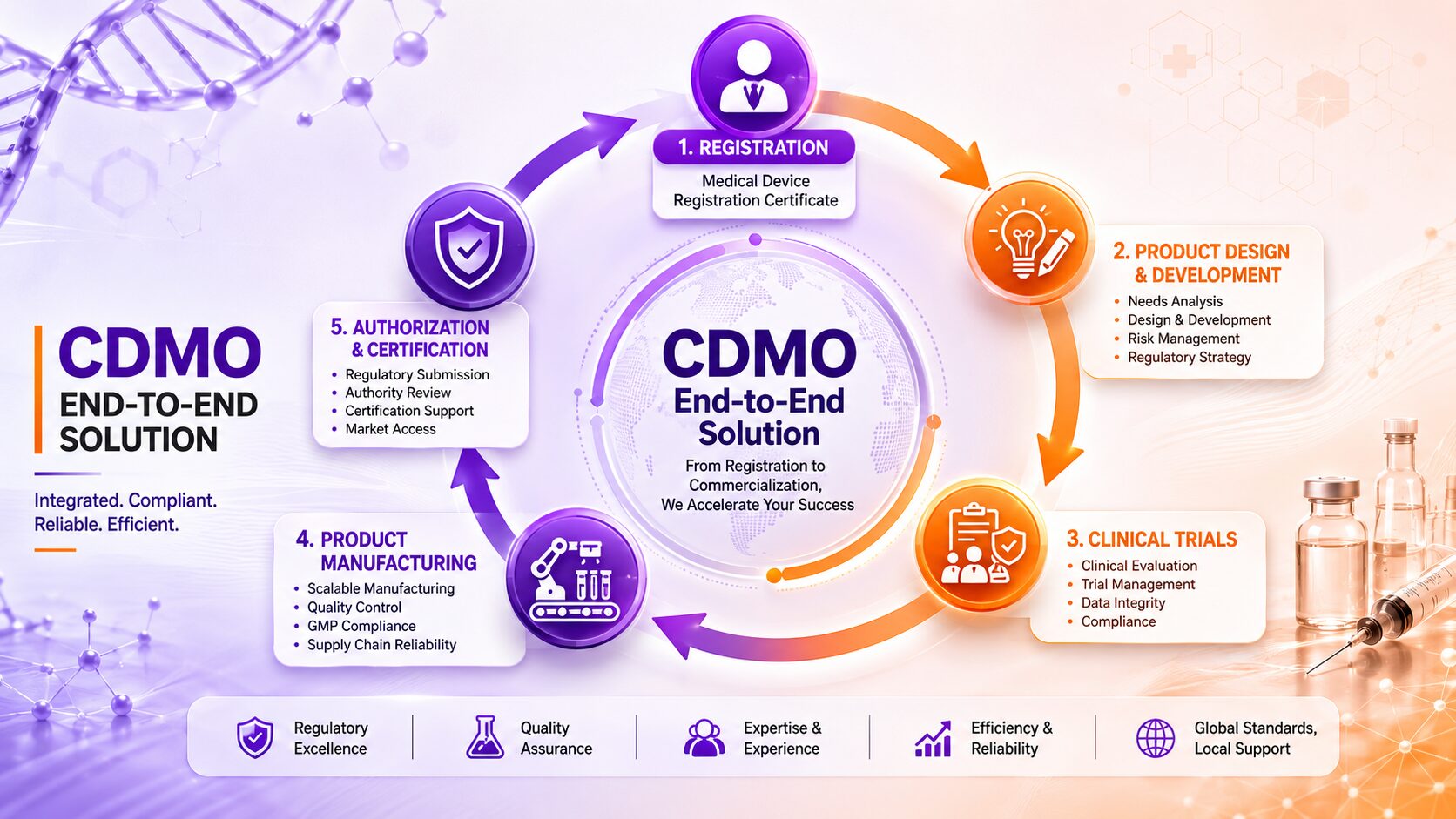
Rather than functioning as a simple outsourcing provider, a modern IVD CDMO serves as an integrated commercialization platform, offering end-to-end support from concept development through commercial manufacturing and lifecycle management.
What Is an IVD CDMO?
An IVD CDMO is a specialized organization that provides comprehensive services covering the entire lifecycle of diagnostic product development and commercialization.
Unlike traditional OEM manufacturers that primarily focus on production, an IVD CDMO combines multiple disciplines under one quality and regulatory framework:
- Product concept evaluation
- Assay development
- Reagent formulation optimization
- Analytical validation
- Clinical evaluation
- Regulatory strategy
- Quality management system support
- GMP manufacturing
- Scale-up production
- Registration dossier preparation
- Commercial supply chain management
The objective is simple:
Transform innovative diagnostic concepts into commercially successful products with lower risk, lower cost, and faster time-to-market.
The Traditional Development Model: Challenges and Limitations
Many emerging diagnostic companies begin with strong scientific concepts but encounter significant barriers during commercialization.
Building an internal development and manufacturing infrastructure often requires:
Significant Capital Investment
Establishing a compliant IVD manufacturing facility involves:
- Cleanroom construction
- Automated production equipment
- Quality control laboratories
- Environmental monitoring systems
- Validation programs
- Regulatory documentation systems
Depending on product complexity and regulatory classification, investments frequently reach millions of dollars before a single product enters the market.
Long Development Cycles
Developing a regulated diagnostic product requires coordination among multiple departments:
- R&D
- Clinical Affairs
- Regulatory Affairs
- Quality Assurance
- Manufacturing Operations
Without prior experience, delays commonly occur during:
- Design verification
- Performance validation
- Clinical studies
- Regulatory submissions
Regulatory Complexity
Modern IVD regulations continue to become more demanding globally.
Manufacturers must comply with frameworks such as:
- FDA 21 CFR Part 820
- ISO 13485
- IVDR (European Union)
- MDR
- Health Canada requirements
- TGA Australia requirements
- NMPA China regulations
Failure to meet regulatory expectations can delay product launch by years.
The IVD CDMO Commercialization Model
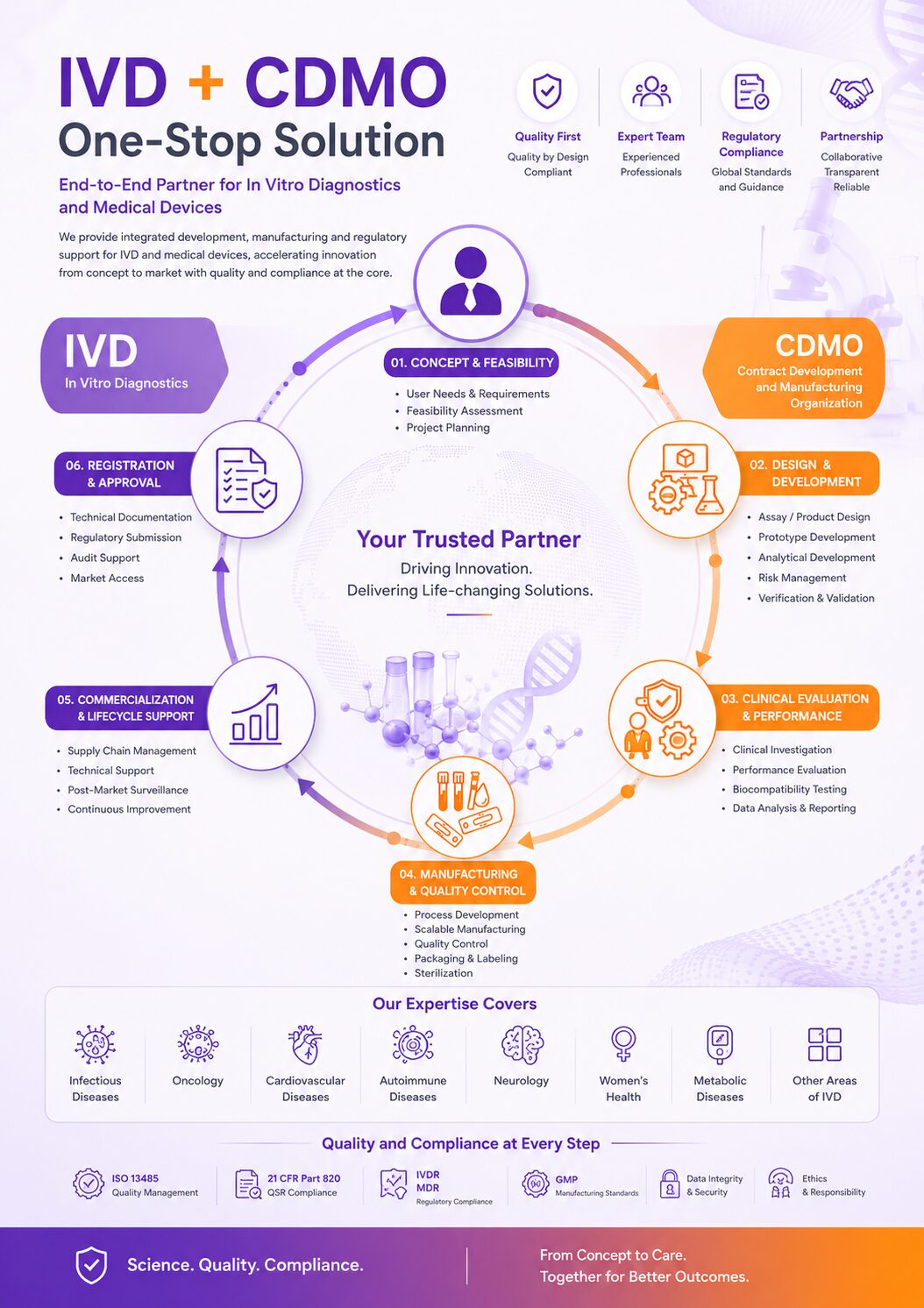
A mature IVD CDMO platform integrates every critical stage into a unified development pathway.
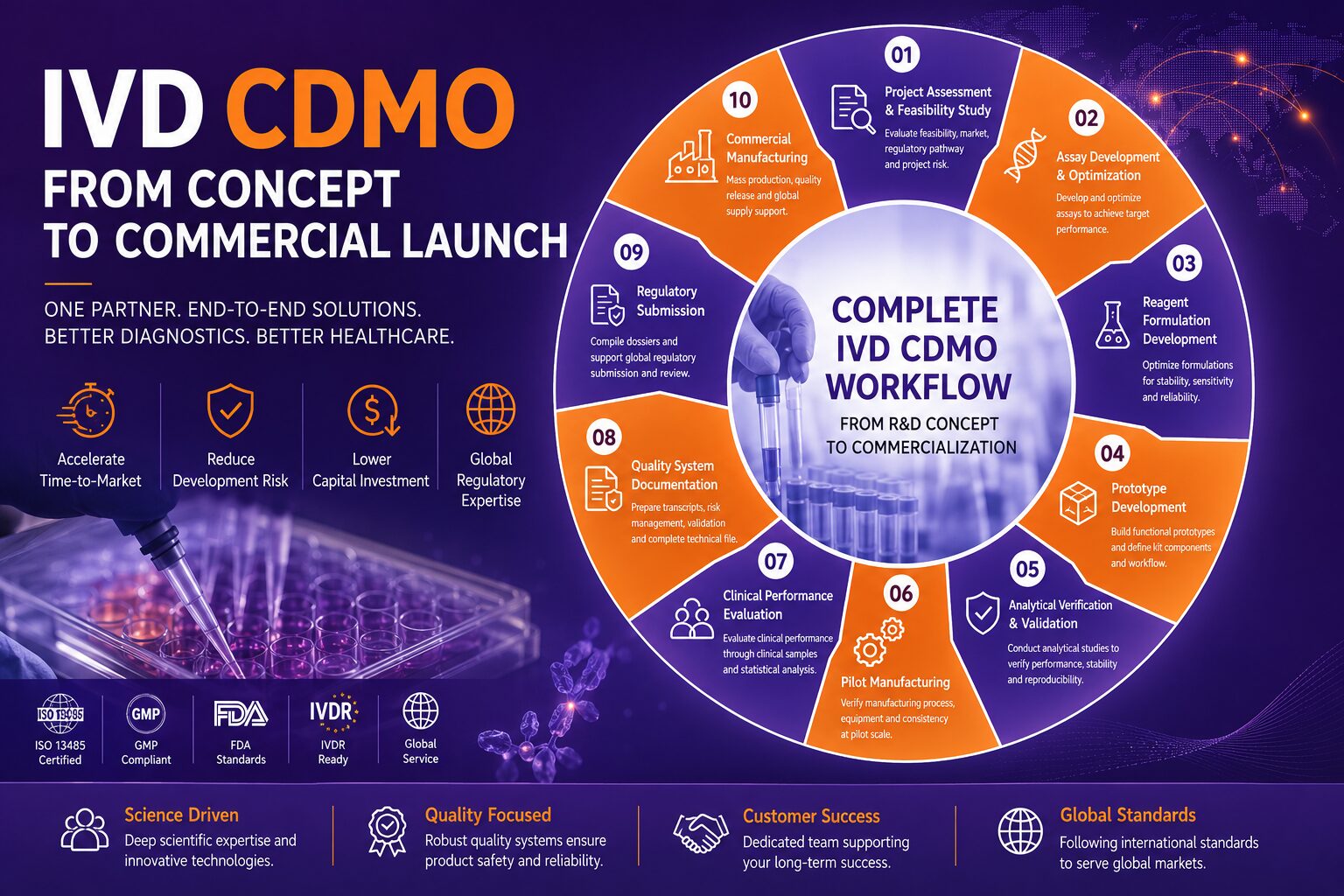
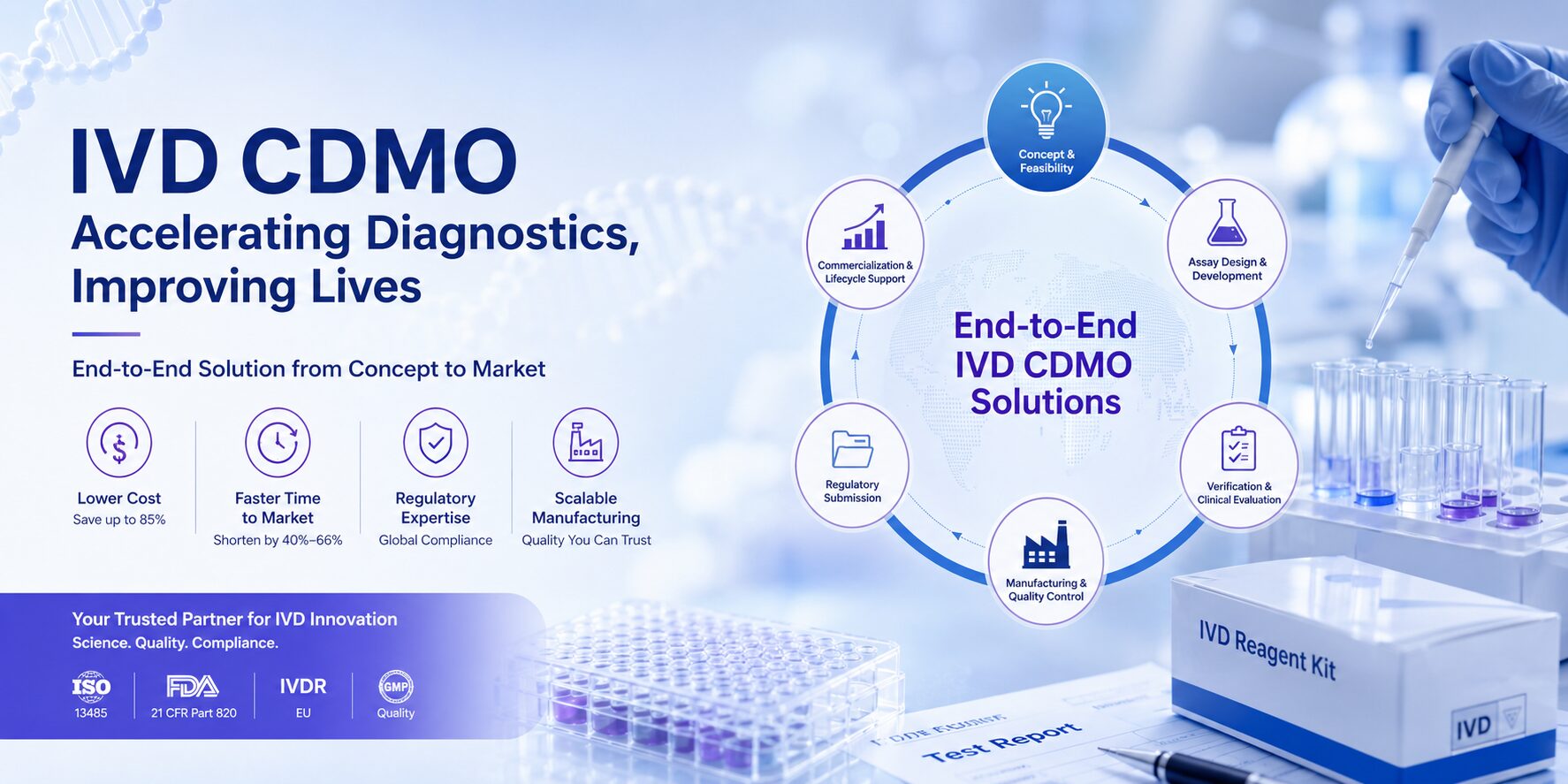
Stage 1: Concept and Feasibility Assessment
The commercialization process begins with evaluating:
- Clinical needs
- Intended use
- Competitive landscape
- Technical feasibility
- Regulatory pathway
Early-stage feasibility studies identify risks before significant investments are made.
Stage 2: Assay and Product Development
Scientific development activities may include:
- Antibody screening
- Antigen development
- Molecular assay optimization
- Buffer formulation
- Stability studies
- Platform adaptation
At this stage, experienced development teams can significantly improve product performance while minimizing future manufacturing challenges.
Stage 3: Verification and Clinical Evaluation
Before regulatory submission, diagnostic products must demonstrate:
- Analytical sensitivity
- Analytical specificity
- Precision
- Reproducibility
- Stability
- Clinical performance
A qualified CDMO coordinates:
- Study design
- Protocol development
- Site management
- Data collection
- Statistical analysis
This reduces the burden on product owners while ensuring regulatory compliance.
Stage 4: GMP Manufacturing and Scale-Up
One of the most challenging transitions occurs when moving from laboratory-scale development to commercial production.
An experienced CDMO provides:
- GMP production facilities
- Process validation
- Lot consistency verification
- Packaging and labeling
- Sterilization management (where applicable)
- Supply chain coordination
This eliminates the need for customers to invest heavily in production infrastructure.
Stage 5: Regulatory Registration and Approval
Regulatory approval often determines whether a diagnostic product succeeds commercially.
Professional IVD CDMO teams assist with:
- Technical documentation
- Risk management files
- Design history files
- Clinical evidence compilation
- Regulatory submissions
- Agency communication support
A well-prepared submission can dramatically improve approval efficiency.
Stage 6: Commercialization and Lifecycle Management
The product journey does not end after approval.
Successful commercialization requires:
- Supply chain stability
- Market support
- Post-market surveillance
- Complaint handling systems
- Continuous product improvement
Long-term CDMO partnerships provide ongoing support throughout the product lifecycle.
Quantifying the Benefits of IVD CDMO Partnerships
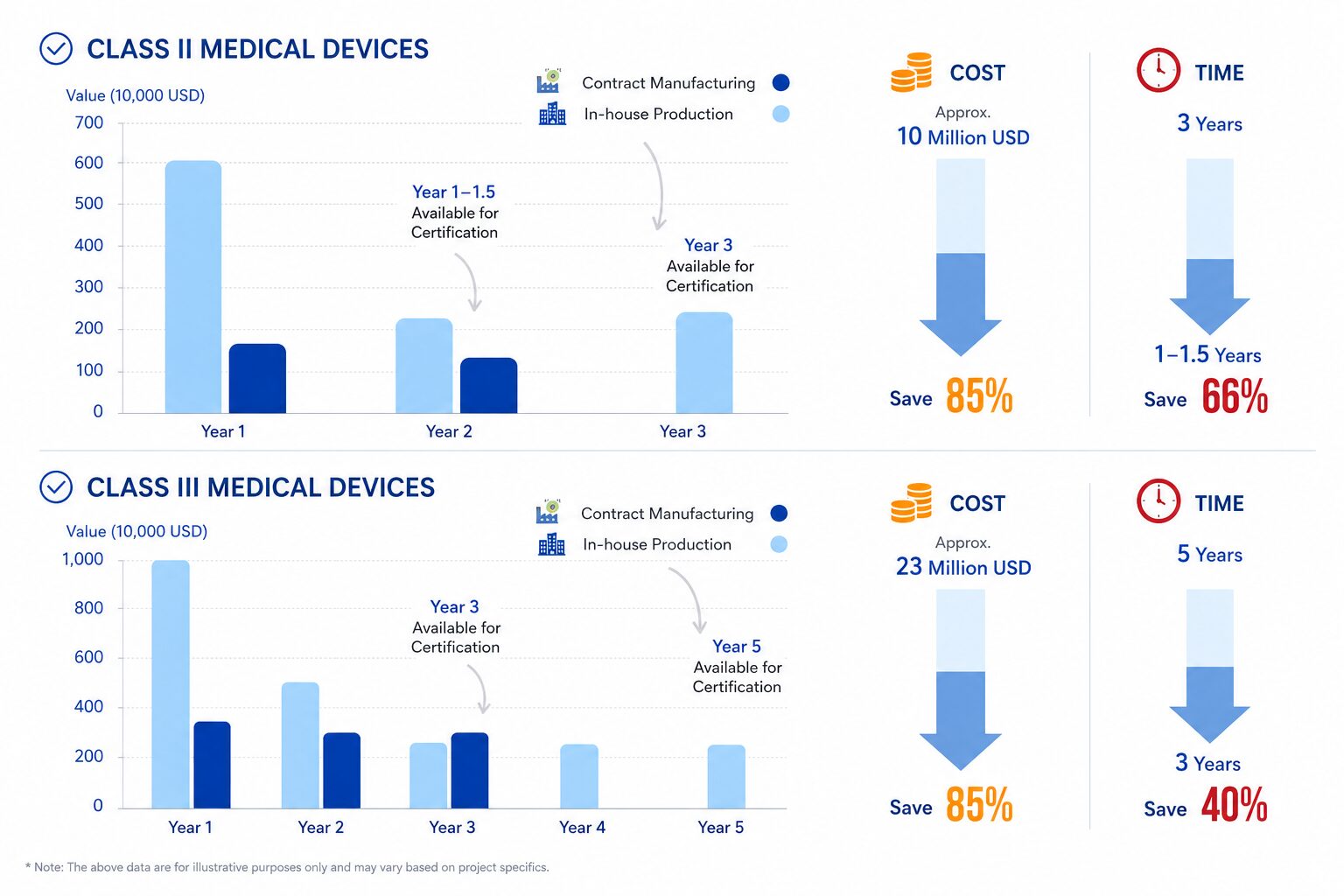
One of the most compelling advantages of the CDMO model is measurable business impact.
Significant Cost Reduction
Industry experience shows that partnering with an established CDMO can reduce infrastructure and development expenditures dramatically compared with building internal capabilities from scratch.
Organizations avoid investments in:
- Facility construction
- Equipment procurement
- Manufacturing validation
- Quality system implementation
- Specialized staffing
For many diagnostic projects, total commercialization costs can be reduced by more than 70%, while preserving product quality and regulatory compliance.
Faster Regulatory Approval
Time-to-market directly influences commercial success.
A delayed launch can result in:
- Lost market share
- Competitive disadvantages
- Delayed revenue generation
- Reduced investor confidence
Because CDMOs possess established systems, validated processes, and experienced regulatory teams, development timelines can often be shortened substantially compared with first-time internal programs.
In highly competitive diagnostic markets, accelerating approval by even one year can represent millions of dollars in additional revenue opportunity.
Reduced Technical Risk
Diagnostic development involves numerous technical uncertainties.
Common failure points include:
- Poor assay robustness
- Manufacturing inconsistency
- Stability failures
- Clinical performance issues
- Regulatory deficiencies
An experienced CDMO leverages prior project knowledge to identify and mitigate risks before they become costly delays.
Access to Specialized Expertise
Building internal expertise across every discipline is rarely practical.
IVD CDMO organizations provide immediate access to:
- Scientists
- Clinical specialists
- Regulatory professionals
- Quality engineers
- Manufacturing experts
This multidisciplinary approach improves decision-making throughout development.
Why the Future of IVD Commercialization Is CDMO-Driven
The diagnostic industry is becoming increasingly specialized.
Emerging technologies such as:
- Molecular diagnostics
- Companion diagnostics
- Multiplex immunoassays
- Point-of-care testing
- AI-assisted diagnostics
- Precision medicine platforms
require expertise that extends beyond traditional manufacturing capabilities.
As regulatory expectations continue to increase worldwide, the ability to integrate scientific innovation, regulatory strategy, quality compliance, and scalable manufacturing becomes a critical competitive advantage.
This is precisely where modern IVD CDMO organizations create value.
Rather than investing years building internal infrastructure, innovative diagnostic companies can focus on their core scientific strengths while leveraging experienced CDMO partners to accelerate commercialization.
Conclusion
The evolution of the global diagnostics industry is shifting commercialization from isolated, self-built development models toward integrated partnership ecosystems.
An experienced IVD CDMO does more than manufacture products. It provides a structured pathway that transforms innovative concepts into regulatory-approved, commercially successful diagnostic solutions.
By integrating development, clinical evaluation, regulatory affairs, quality systems, manufacturing, and lifecycle support within a single platform, IVD CDMOs help companies:
- Reduce commercialization costs
- Accelerate regulatory approval
- Improve development efficiency
- Mitigate technical risks
- Scale manufacturing confidently
- Achieve faster market entry
As competition intensifies and regulatory requirements continue to evolve, the strategic value of partnering with a specialized IVD CDMO will only become more important for companies seeking sustainable growth in the global diagnostics market.
Frequently Asked Questions (FAQ)
What is the difference between an IVD CDMO and an OEM manufacturer?
An OEM manufacturer primarily focuses on production. An IVD CDMO provides integrated services including development, clinical evaluation, regulatory support, quality management, manufacturing, and commercialization.
Can an IVD CDMO help with FDA and IVDR submissions?
Yes. Many IVD CDMOs provide regulatory strategy, technical documentation preparation, submission support, and agency communication assistance.
How much can a company save by working with an IVD CDMO?
Savings vary by project, but companies can significantly reduce infrastructure investments, staffing requirements, and development risks compared with building internal capabilities.
What types of IVD products can be developed through a CDMO?
Common categories include immunoassays, ELISA kits, CLIA reagents, molecular diagnostics, rapid tests, POCT products, companion diagnostics, and customized diagnostic platforms.
When should a diagnostic company engage an IVD CDMO?
Ideally, a CDMO should be involved during the early feasibility stage to optimize development strategy, reduce risk, and improve commercialization efficiency.
Author Profile

- Written by the IVDCDMO technical and regulatory team, with expertise in diagnostic assay development, GMP manufacturing, ISO 13485 systems, and global IVD commercialization for biotech innovators worldwide.
Latest entries
 Assay DevelopmentSeptember 23, 2026CDMO Custom Development of Test Kits: From Assay Concept to Scalable IVD Manufacturing
- IVD ManufacturingJuly 24, 2026Manufacturing for IVD Products: From Assay Transfer to Reliable Commercial Supply
- IVD ManufacturingJuly 13, 2026IVD Contract Manufacturing Cost: NRE, Tooling, Validation, MOQ and Unit Economics
- KnowledgeJuly 6, 2026IVD CDMO vs CRO vs CMO: Which Partner Do You Need at Each Development Stage?