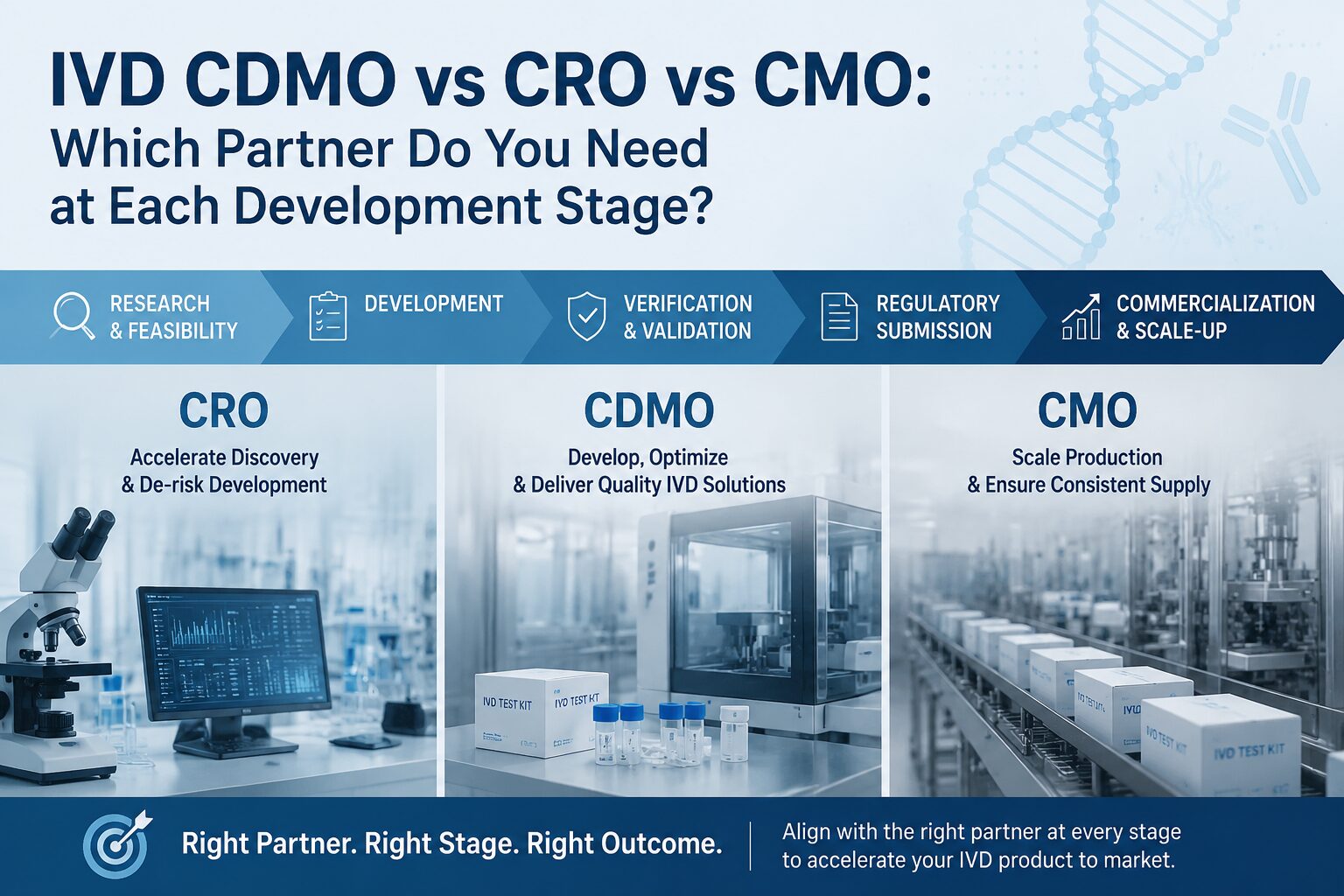
The difference between an IVD CDMO, CRO and CMO is not simply the range of services listed on a supplier’s website. Each type of partner is designed to remove a different category of program risk.
An IVD CDMO is most valuable when the product or manufacturing process is still being developed. A CRO becomes critical when the remaining uncertainty concerns specimens, study execution, clinical evidence or statistical validity. A CMO is usually the right choice when the design is sufficiently mature and the main objective is repeatable, compliant and economical production.
Most regulated in vitro diagnostic programs eventually need all three capabilities. The real decision is not which acronym is “best,” but which organization should lead at a particular stage—and how the technical, clinical and manufacturing work should connect.
The shortest practical answer is:
- Choose an IVD CDMO when the assay, cartridge, instrument, software, packaging or manufacturing process still requires development.
- Choose an IVD CRO when you need qualified specimens, study sites, clinical operations, data management, biostatistics or a regulatory-grade performance study.
- Choose an IVD CMO when the design and production specifications are substantially established and you need routine manufacturing capacity.
- Use an integrated or hybrid model when product development, evidence generation and manufacturing scale-up must progress in parallel.
The wrong partner may still complete the assigned tasks. The failure appears later, when the data do not support the intended claim, the clinical lot cannot be reproduced at scale, or a contract manufacturer discovers that the “finished” transfer package is not actually manufacturable.
What Do CDMO, CRO and CMO Mean in the IVD Industry?
These terms are commercial descriptions, not universal regulatory classifications. Two suppliers using the same label may have very different facilities, quality systems and technical capabilities.
The scope must therefore be defined by deliverables—not by the acronym.
What Is an IVD CDMO?
An IVD contract development and manufacturing organization combines product development with manufacturing services. Depending on its technical platform, an IVD CDMO may support:
- Intended-use and product-requirement definition
- Assay feasibility and optimization
- Reagent formulation and conjugation
- Primer, probe or antibody system development
- Calibrator and control development
- Lateral-flow strip or microfluidic cartridge development
- Instrument, firmware and software integration
- Design for manufacturability
- Risk management and design documentation
- Analytical performance studies
- Design transfer
- Pilot and engineering builds
- Process validation
- Stability programs
- Packaging and labeling development
- Regulatory submission support
- Commercial manufacturing
A CDMO is especially useful when the product design and the production process must evolve together. In IVD development, this is often unavoidable. A reagent formulation that performs well at bench scale may react differently after bulk preparation, automated dispensing, drying, sealing, shipping or prolonged storage.
A capable CDMO does not merely reproduce a laboratory protocol. It converts that protocol into a controlled product and a reproducible manufacturing process.
What Is an IVD CRO?
An IVD contract research organization focuses primarily on research execution and evidence generation. Its work may include:
- Clinical performance study design
- Protocol and statistical analysis plan development
- Study site identification and qualification
- Ethics committee or institutional review board coordination
- Specimen acquisition and management
- Central laboratory services
- Investigator and site training
- Electronic data capture
- Study monitoring
- Data management and biostatistics
- Medical or scientific writing
- Clinical study reports
- Regulatory submission support
- Post-market performance studies
A diagnostics CRO may also conduct certain analytical studies, particularly when specialized specimens, independent laboratories or multi-site testing are required. However, analytical performance testing alone does not automatically make a laboratory a CRO. The relevant question is whether the organization has the quality, study-governance, data-integrity and regulatory capabilities needed for the intended evidence package.
For clinical performance studies using specimens from human subjects, ISO 20916:2019 defines good study practices for planning, conducting, recording and reporting the study. The standard also distinguishes clinical performance studies from analytical performance studies, an important boundary when assigning responsibilities.
What Is an IVD CMO?
An IVD contract manufacturing organization manufactures a product according to an established design and specification set. Typical services include:
- Raw-material procurement
- Incoming inspection
- Reagent preparation
- Dispensing, filling, drying or lyophilization
- Strip, cartridge or kit assembly
- Instrument assembly
- In-process inspection
- Final quality control
- Packaging and labeling
- Batch release support
- Inventory management
- Commercial-scale production
- Distribution or logistics support
A CMO is most effective when the sponsor can provide a controlled and sufficiently complete manufacturing package. If formulations, tolerances, test methods, acceptance criteria or supplier specifications remain unresolved, the assignment is no longer pure contract manufacturing. It becomes a development and transfer program, whether or not the supplier calls itself a CDMO.
In the United States, FDA defines a contract manufacturer as an establishment that manufactures a finished device to another establishment’s specifications. Depending on the activities performed, contract manufacturers may also have their own establishment registration, device-listing and quality-system obligations.
IVD CDMO vs CRO vs CMO: The Core Differences
| Decision area | IVD CDMO | IVD CRO | IVD CMO |
|---|---|---|---|
| Primary purpose | Develop the product and manufacturing process | Generate reliable research or clinical evidence | Manufacture an established product |
| Best entry point | Concept, feasibility or formal development | Evidence planning and study preparation | Late development, transfer or commercial production |
| Main uncertainty addressed | Whether the product can be made to meet its requirements | Whether the evidence supports the intended claims | Whether the product can be produced consistently at the required scale |
| Typical scientific role | Assay optimization, system integration and analytical development | Protocol execution, specimen operations, data management and statistics | In-process and final product testing |
| Typical manufacturing role | Pilot builds, scale-up, process development and commercial production | Study-lot handling or central-lab activities; usually limited manufacturing | Routine production and supply |
| Clinical study capability | Sometimes available, but must be verified | Usually a central capability | Rarely a core capability |
| Design-transfer capability | Core capability for a full-service CDMO | Limited | Strong only when the incoming package is mature |
| Most suitable product state | Evolving | Sufficiently defined for the planned study | Stable and controlled |
| Common commercial model | Milestones, development fees, NRE and manufacturing | Project fees, per-site fees, per-specimen fees and pass-through costs | Tooling, setup, MOQ and per-unit pricing |
| Major selection risk | Broad claims without deep platform expertise | Strong clinical operations but weak device-specific understanding | Attractive unit pricing based on an incomplete transfer package |
These boundaries are not absolute. Some large organizations combine all three service models. Others specialize in a narrow platform, such as molecular diagnostics, immunoassays, clinical chemistry, digital pathology or point-of-care cartridges.
Capability overlap is useful, but it should never be assumed.
The Better Decision Rule: Follow the Unresolved Risk
A practical way to choose between an IVD CDMO, CRO and CMO is to identify the next uncertainty that could stop the program.
Ask three questions:
- Is the device design or manufacturing process still uncertain?
If yes, the program needs CDMO capability. - Is the critical uncertainty related to specimens, study operations, clinical evidence or statistical conclusions?
If yes, the program needs CRO capability. - Is the product already defined, with the remaining challenge being repeatable supply, capacity, yield or cost?
If yes, a CMO may be sufficient.
This approach is more reliable than selecting a supplier from a generic service list. It also prevents a common mistake: appointing a manufacturing organization before the product has reached a transferable state.
Which Partner Do You Need at Each IVD Development Stage?
| Development stage | Primary risk | Recommended lead partner | Important supporting capability |
|---|---|---|---|
| Intended use and product strategy | Developing the wrong product or claim | Sponsor with regulatory support; CDMO input | Market access and clinical expertise |
| Technical feasibility | Assay principle may not meet performance targets | IVD CDMO | Specimen access or specialist laboratory |
| Formal design and development | Prototype may not become a controlled product | IVD CDMO | Regulatory and quality assurance |
| Analytical performance evaluation | Data may not represent the final device | CDMO plus qualified internal or external laboratory | Biostatistics and specimen management |
| Clinical performance study | Evidence may not support the intended use | IVD CRO | CDMO-supplied representative study lots |
| Design transfer and process validation | Laboratory design may fail in production | IVD CDMO | Receiving CMO, if different |
| Regulatory submission | Evidence and manufacturing records may not form a coherent dossier | Legal manufacturer or submission owner | CDMO, CRO and regulatory specialists |
| Routine commercial production | Yield, quality, capacity or supply continuity may fail | CMO or commercial CDMO | Sponsor quality and supplier management |
| Post-market lifecycle management | Complaints, changes or new evidence may alter the risk-benefit profile | Depends on activity | CDMO, CRO and CMO may all participate |
Stage 1: Intended Use, Claims and Development Strategy
Before selecting any development partner, the sponsor should define what the test is expected to do.
This includes:
- Target condition or analyte
- Intended population
- Intended user
- Specimen type
- Testing environment
- Qualitative, semi-quantitative or quantitative output
- Proposed clinical claims
- Expected regulatory classification and pathway
- Target markets
- Required turnaround time
- Expected throughput
- Preliminary cost and shelf-life targets
At this stage, the most important work still belongs to the product owner. A CDMO can test technical feasibility and challenge unrealistic requirements, but it should not independently decide the commercial or clinical purpose of the product.
A CRO may contribute early if specimen availability, recruitment feasibility or clinical workflow could determine whether the concept is viable. For example, a proposed claim may require a patient population that is difficult to recruit, or a reference method that is not routinely available at likely study sites.
A CMO normally should not lead this stage. It can, however, provide early feedback on likely production cost, raw-material availability and manufacturing constraints.
The main deliverable should be a preliminary target product profile or equivalent set of product requirements—not merely a list of desired assay characteristics.
Stage 2: Feasibility and Assay Development
Feasibility asks whether the proposed biological and technical principle can achieve the required performance.
This may involve:
- Analyte and matrix characterization
- Antibody, antigen, primer or probe screening
- Reaction-condition optimization
- Signal-system selection
- Preliminary cut-off development
- Interference and cross-reactivity exploration
- Material compatibility
- Prototype cartridge or strip construction
- Instrument detection testing
- Preliminary precision and sensitivity studies
An IVD CDMO is usually the best lead partner because decisions made during feasibility affect both product performance and future manufacturability.
A useful feasibility program does more than produce a favorable data set. It identifies the operating window and the likely failure mechanisms. A prototype that works under one carefully controlled condition is not yet a robust product.
Before moving into formal development, the sponsor should understand:
- Which raw-material characteristics are critical
- How much variation the assay can tolerate
- Which process steps are likely to influence performance
- Whether the available clinical matrix behaves like the development material
- Whether the proposed format is compatible with automation
- Whether preliminary stability supports the commercial concept
- Whether target cost and scale remain plausible
A CRO may support specimen sourcing or specialized testing, but it rarely replaces the need for integrated assay and process development.
Stage 3: Formal Design and Development
Once feasibility has been demonstrated, the project moves from scientific exploration into controlled product development.
The work now needs to connect:
- Design inputs
- Design outputs
- Risk controls
- Verification activities
- Clinical and analytical claims
- Manufacturing specifications
- Software or algorithm requirements
- Packaging and labeling
- Traceability between requirements and evidence
This is the stage where a full-service IVD CDMO provides the greatest value. It can develop the assay and the manufacturing process under the same quality framework, reducing the risk that manufacturing assumptions are introduced after the design is substantially frozen.
Risk management should also influence development decisions rather than being written retrospectively. ISO 14971:2019 provides the widely used lifecycle framework for identifying, evaluating, controlling and monitoring medical-device risks, including risks associated with IVDs.
The CDMO should begin defining critical material attributes and critical process parameters during this stage. Examples include:
- Antibody or oligonucleotide identity and activity
- Buffer pH and conductivity
- Conjugation ratios
- Dispense volume and positional accuracy
- Membrane characteristics
- Drying time and humidity
- Lyophilization cycle parameters
- Seal integrity
- Calibration relationships
- Optical or electronic tolerances
- Software version and algorithm configuration
Waiting until design transfer to identify these variables turns transfer into another development program.
Stage 4: Analytical Performance Evaluation
Analytical performance determines how reliably the IVD measures or detects the target under defined conditions.
Depending on the technology and intended use, the study program may address:
- Precision and reproducibility
- Limit of blank
- Limit of detection
- Limit of quantitation
- Measuring range
- Linearity
- Analytical specificity
- Interference
- Cross-reactivity
- High-dose hook effect
- Carryover
- Method comparison
- Specimen-type equivalence
- Reagent and calibration stability
- Usability-related performance
- Flex studies for point-of-care or self-test products
The development CDMO often leads analytical verification because it understands the device design, failure modes and manufacturing variables. External laboratories or diagnostics CROs may be appropriate when the study requires independent execution, rare specimens, specialized equipment, multiple operators or multiple sites.
The most important issue is not who performs the study. It is whether the tested device is representative of the product that will be submitted and manufactured.
Analytical studies become vulnerable when they rely on:
- Hand-built units that do not represent the intended process
- A single unusually favorable reagent lot
- Technology-grade materials that will not be used commercially
- Uncontrolled software or algorithm versions
- Non-final packaging
- Artificial samples without adequate commutability justification
- Acceptance criteria written after the results are known
Under the EU IVDR, performance evaluation is a lifecycle process built on scientific validity, analytical performance and clinical performance. The European Commission’s MDCG 2022-2 guidance emphasizes that the evidence must be collected, assessed and updated throughout the device lifecycle.
This means analytical development cannot be separated from intended use, clinical claims and risk management.
Stage 5: Clinical Performance Studies
A CRO usually becomes the operational lead when the program moves into a formal clinical performance study.
Typical CRO responsibilities include:
- Study design consultation
- Protocol development
- Statistical analysis planning
- Site feasibility and selection
- Ethics or IRB coordination
- Investigator agreements
- Site initiation and training
- Specimen accountability
- Study monitoring
- Data management
- Deviation management
- Database lock
- Statistical analysis
- Clinical study reporting
The CDMO still plays an important role. It must supply representative, traceable study lots; support device training; investigate technical complaints; control changes; and explain product-related deviations.
The study should not begin until the design is stable enough for the resulting evidence to remain relevant. If a later change affects the specimen pathway, reagent formulation, cut-off, instrument, algorithm or user workflow, the sponsor may need bridging data or additional performance studies.
For the United States, it is important not to assume that every IVD requires a prospective clinical trial. FDA states in its overview of IVD regulation that prospective clinical studies are rarely required for IVDs, but clinical samples with sufficient laboratory or clinical characterization are regularly needed to assess clinical validity or agreement.
The appropriate design depends on the device, claim, risk, specimen source, reference method and regulatory pathway.
Human-specimen governance must be addressed early. FDA’s IVD Good Clinical Practice guidance page notes that clinical investigations involving human specimens—including deidentified specimens—are subject to human-subject protection and IRB requirements, although specific informed-consent enforcement policies may apply in limited circumstances.
A CRO without deep IVD experience may underestimate these specimen-specific requirements. Pharmaceutical trial experience alone does not guarantee competence in diagnostic performance studies.
Stage 6: Design Transfer and Manufacturing Scale-Up
Design transfer is where a product stops being primarily an R&D object and becomes a controlled manufacturing system.
A credible transfer package may include:
- Approved bill of materials
- Raw-material specifications
- Approved supplier requirements
- Formulations and master preparation instructions
- Drawings and component tolerances
- Equipment and tooling requirements
- Assembly procedures
- In-process controls
- Final release methods
- Sampling plans
- Acceptance criteria
- Software and firmware configuration
- Packaging and labeling specifications
- Stability requirements
- Storage and shipping conditions
- Training requirements
- Device history or batch-record templates
- Known process risks and troubleshooting guidance
If these elements are incomplete, the receiving organization must perform development work. A CDMO is generally better equipped to close those gaps.
A conventional CMO can be appropriate when the sponsor already has a mature transfer package, validated methods and enough internal technical depth to manage the receiving site. It may also be suitable for a second-source transfer of an established product.
The transfer should include more than document delivery. Engineering batches, operator training, method transfer, equipment qualification, process characterization and acceptance criteria are needed to demonstrate that the receiving site can reproduce the intended product.
The most dangerous transfer is one that appears successful because a few pilot lots passed. A transfer is not robust until the process has been challenged across meaningful sources of variation.
Stage 7: Process Validation and Launch Readiness
At launch, the question changes from “Can we make acceptable product?” to “Can the defined process repeatedly produce acceptable product under routine conditions?”
The manufacturing partner may need to complete or support:
- Equipment qualification
- Process validation
- Test-method validation or verification
- Cleaning validation, where applicable
- Packaging validation
- Shipping validation
- Operator qualification
- Computerized-system validation
- Reagent stability studies
- Lot-to-lot comparability
- Supplier qualification
- Production capacity planning
- Batch-release procedures
- Traceability and record-retention controls
A commercial CDMO can carry the product from development into validated production with fewer handoffs. A CMO may offer lower unit costs or greater capacity, but only if the transfer and validation burden has been realistically included in the program.
In the United States, FDA’s Quality Management System Regulation became effective on February 2, 2026, incorporating ISO 13485:2016 by reference into 21 CFR Part 820. FDA explains the updated framework on its QMSR information page.
A supplier’s ISO 13485 certificate is therefore relevant, but it is not sufficient evidence of project fit. The sponsor should still evaluate the certification scope, audit history, technical competence, facility controls and experience with the specific IVD platform.
Stage 8: Routine Commercial Manufacturing
A CMO is often the logical lead when:
- The device design is stable
- Manufacturing documentation is complete
- Test methods are established
- Critical suppliers are qualified
- Process parameters are known
- Change frequency is low
- Forecasts and service levels can be defined
- The sponsor has sufficient supplier-quality oversight
At this point, procurement, capacity, yield, release timing and continuity of supply become dominant concerns.
A CDMO may remain preferable when:
- The assay is unusually sensitive to biological raw-material variation
- Frequent formulation or supplier changes are expected
- Multiple regional versions are being introduced
- The instrument, software and reagent system are tightly coupled
- Post-market data are likely to drive further development
- The sponsor lacks an internal technical operations team
- Manufacturing problems require continuing development support
The lowest quoted unit price should not be treated as the lowest total cost. A cheaper CMO can become expensive if it requires a second technical team to investigate deviations, maintain the device history, manage changes or recover lost process knowledge.
Stage 9: Post-Market and Lifecycle Management
Commercial launch does not end development. It changes the source of information.
Post-market activities may identify:
- New interference patterns
- Population-specific performance differences
- User-error trends
- Raw-material drift
- Stability limitations
- Packaging or transport failures
- Software defects
- New safety signals
- Opportunities for broader claims
- Requirements for a new specimen type or instrument platform
The CMO or commercial CDMO provides manufacturing records, complaint-investigation support and trend data. The development CDMO may investigate root causes or implement design changes. A CRO may conduct post-market performance follow-up or additional evidence-generation studies.
Under the EU IVDR, performance evaluation and post-market performance follow-up are continuous lifecycle activities rather than one-time submission exercises. The partner model should therefore preserve access to development knowledge, raw data and manufacturing history after launch.
Three Baselines Must Stay Synchronized
IVD programs usually operate with three evolving baselines:
- The design baseline: what the device is and how it is built.
- The manufacturing baseline: how routine production controls the device.
- The evidence baseline: which device version and claims are supported by the analytical and clinical data.
Many outsourcing failures are synchronization failures.
A CRO may test a device version that is no longer commercially relevant. A CMO may introduce a process change that has not been assessed against the clinical evidence. A CDMO may optimize the assay without updating labeling, risk analysis or validation requirements.
Every significant change should therefore be evaluated against all three baselines.
The change-control process should answer:
- Does the change affect design inputs or intended use?
- Could it alter analytical or clinical performance?
- Does it affect a risk control?
- Are existing verification or validation results still applicable?
- Is bridging evidence required?
- Does the change affect labeling or regulatory submissions?
- Must study sites, distributors or authorities be notified?
- Which party approves implementation?
This is one reason an integrated CDMO can reduce interface risk during development. It is also why an independent sponsor quality function remains necessary even when most execution is outsourced.
Outsourcing Does Not Transfer the Sponsor’s Regulatory Responsibility
A CDMO, CRO or CMO can perform regulated activities, but outsourcing does not automatically transfer the legal manufacturer’s obligations.
The legal manufacturer or submission owner generally remains responsible for ensuring that:
- The device meets applicable regulatory requirements
- The quality system covers outsourced activities
- Suppliers are appropriately selected and controlled
- Technical documentation is complete
- Performance evidence supports the claims
- Changes are assessed and approved
- Complaints and reportable events are handled correctly
- Post-market obligations are fulfilled
In the United States, a specification developer may use a contract manufacturer while remaining the party that submits the 510(k). FDA explicitly distinguishes the specification developer from the contract manufacturer in its 510(k) guidance.
A contract should assign tasks, authority and communication routes. It cannot make the sponsor indifferent to how the work is performed.
When One Integrated Partner Makes Sense
A single CDMO with development, clinical and commercial capabilities may be advantageous when:
- The platform is technically complex
- The sponsor has a small internal team
- Speed depends on parallel development and scale-up
- Clinical study devices must closely represent commercial production
- The program requires tight coordination between reagents, instrument and software
- Technology transfer would create significant delay or knowledge loss
- The same organization can genuinely meet all quality and geographic requirements
Integration reduces the number of interfaces, but it also creates concentration risk. The sponsor should still evaluate whether the partner has real depth in every claimed function.
A useful test is to request separate capability reviews for:
- Assay development
- Manufacturing engineering
- Quality systems
- Clinical operations
- Data management and statistics
- Regulatory documentation
- Commercial supply
If the same small group appears in every review, the organization may be offering a broad service menu without the specialized personnel required to execute it.
When Multiple Specialized Partners Are Better
A multi-partner model may be preferable when:
- The assay requires a specialist development laboratory
- Clinical studies require access to rare populations or geographic regions
- Commercial volumes exceed the development partner’s capacity
- The sponsor wants independent analytical or clinical evidence
- A particular CMO has superior automation or unit economics
- The product combines several technologies that no single supplier can support
- Business continuity requires a qualified second source
The disadvantage is interface risk. Someone must own the integrated schedule, requirements, version control, change assessment and technical decisions.
When several suppliers are used, the sponsor needs a clear responsibility matrix covering:
- Protocol ownership
- Device and software versions
- Study-lot manufacture and release
- Specimen chain of custody
- Raw-data ownership
- Deviation investigation
- Statistical programming
- Manufacturing changes
- Regulatory communications
- Final report approval
- Record retention
Without this governance, each supplier can complete its assigned scope while the overall evidence package remains inconsistent.
Questions to Ask an IVD CDMO
A serious CDMO evaluation should go beyond facility size and certification status.
Ask:
- Which IVD platforms have you developed from feasibility through commercial production?
- Which development activities are performed internally?
- How do you connect design inputs, risk controls and verification plans?
- How do you identify critical material attributes and process parameters?
- Can you develop and validate QC methods?
- How do you control biological raw-material variation?
- Can you manufacture representative verification and clinical study lots?
- Who owns formulations, methods, drawings, software and improvements?
- What records will be transferred if the product moves to another manufacturer?
- How are deviations and failed experiments documented?
- What commercial volumes and batch sizes can you support?
- How do you manage scale-up when the commercial process differs from the development process?
- Which regulatory submissions have your teams supported?
- Can your quality system support the intended markets?
- What happens if a critical supplier changes or discontinues a material?
The partner should be able to describe not only successful programs, but also how it handled a difficult transfer, unstable raw material, failed validation or unexpected performance result.
Questions to Ask an IVD CRO
For a CRO, focus on evidence integrity and IVD-specific execution:
- How many IVD performance studies have you managed?
- Which analytes, technologies and specimen types are within your experience?
- Can you support prospective, retrospective and leftover-specimen study designs?
- How do you qualify sites and reference methods?
- How do you verify specimen provenance and eligibility?
- How are preanalytical variables controlled?
- Who develops the statistical analysis plan?
- How are missing data, invalid results and discordant results handled?
- How do you control instrument, software and reagent-lot versions?
- What electronic data capture and audit-trail systems are used?
- How are protocol deviations classified and investigated?
- Can you support IRB, ethics committee and competent-authority submissions?
- Does the team work to ISO 20916 where applicable?
- Who owns the database, statistical code and raw data?
- How are study records retained and transferred?
A CRO should also explain how it would respond if device performance changed between study lots. That answer reveals whether the team understands IVD development or merely clinical project administration.
Questions to Ask an IVD CMO
For a CMO, evaluate the maturity of its manufacturing controls:
- Is the proposed facility included within the relevant quality-system certification scope?
- Has the site manufactured similar assay formats or biological materials?
- Which operations are manual, semi-automated or automated?
- What are the realistic minimum and maximum batch sizes?
- Which process yields support the quoted unit price?
- What incoming tests are performed on critical materials?
- How are supplier and material changes communicated?
- Can the CMO perform method transfer and test-method validation?
- How are nonconforming materials and out-of-specification results investigated?
- What are the batch-review and release timelines?
- How are electronic records, software and equipment maintained?
- What capacity is reserved, and what happens during demand surges?
- What business-continuity plans cover equipment or supplier failure?
- Can the CMO support regulatory inspections and technical-file questions?
- What transition assistance is provided if manufacturing moves elsewhere?
A low unit price based on aggressive yield, insufficient testing or unrealistic forecasts is not a manufacturing advantage. It is an unpriced risk.
Contract Terms That Matter More Than the Acronym
The quality agreement and commercial agreement should clearly address:
- Background and project-generated intellectual property
- Ownership of formulations, methods and process improvements
- Access to raw data and statistical code
- Ownership of tooling and custom equipment
- Audit rights
- Regulatory inspection support
- Supplier qualification
- Change-notification periods
- Deviation and CAPA responsibilities
- Out-of-specification investigations
- Complaint handling
- Adverse-event and vigilance communication
- Batch disposition authority
- Record retention
- Data-security requirements
- Forecasting and capacity commitments
- Minimum order quantities
- Obsolescence and discontinuation
- Technology-transfer assistance
- Termination rights and transition support
The contract should also distinguish between commercially reasonable effort and a defined acceptance criterion. Development work contains uncertainty, but uncertainty should not make deliverables impossible to evaluate.
Common Partner-Selection Mistakes
Selecting a CMO Before the Product Is Transferable
The sponsor expects manufacturing, but the supplier discovers that methods, acceptance criteria and process tolerances are incomplete. Development work then appears as change orders, delays or unexpectedly high non-recurring engineering costs.
Starting Clinical Work Before the Device Is Stable
The CRO begins on schedule, but later design changes undermine the relevance of the data. The immediate schedule gain creates a larger regulatory delay.
Assuming the CDMO Can Perform Every Study Internally
Internal capability may improve coordination, but independence, site diversity, specialized specimens or qualified reference methods may still require an external laboratory or CRO.
Choosing by ISO Certificate Alone
ISO 13485 certification is important, but it does not demonstrate expertise in a specific assay technology, specimen type, manufacturing process or regulatory pathway.
Failing to Secure Data and Technology-Transfer Rights
The sponsor receives summary reports but cannot obtain editable methods, raw data, source files, process knowledge or supplier details. Switching manufacturers then becomes a partial redevelopment program.
Optimizing Unit Cost Before Stabilizing Yield
Early quotations often assume target yield rather than demonstrated yield. Until the process is characterized, the apparent unit cost may exclude scrap, failed batches, additional QC and long release cycles.
Practical Partner Choices for Common IVD Scenarios
A Startup Has a Biomarker Concept but No Product Design
Start with an IVD CDMO or specialized assay-development organization. Add a CRO when specimen strategy and clinical evidence planning become critical. A CMO is premature.
An RUO Assay Must Become a Regulated IVD
Use a CDMO for gap assessment, controlled redevelopment, design documentation, analytical verification and process development. The fact that an RUO assay works in expert hands does not prove that it can meet regulated product requirements.
A CRO may later support clinical performance evidence. A CMO should receive the program only after the regulated design and transfer package are sufficiently mature.
The Sponsor Has Strong Internal R&D but No Clinical Operations Team
The sponsor may retain assay development internally and appoint a CRO for protocol execution, sites, specimens, data management and biostatistics. A CDMO may still be needed for representative study-lot manufacture and scale-up.
A Mature IVD Needs a Second Manufacturing Source
A qualified CMO may be the best fit if the sponsor has complete documentation, validated methods and adequate internal transfer resources. Bridging, comparability and change assessment should be planned before transfer.
A Commercial Assay Requires a Major Reagent or Instrument Change
This is no longer a routine CMO assignment. A CDMO or internal development team should lead the technical change, with CRO support if new clinical evidence is required.
A Point-of-Care System Combines Assay, Cartridge, Reader and Software
An integrated CDMO is usually preferable during development because the components cannot be optimized independently. Specialized CRO support may be needed for intended-user studies and clinical performance evaluation.
Final Decision: CDMO, CRO or CMO?
Choose the organization that is equipped to resolve the next material program risk.
- If the unresolved question is whether the assay and product can be developed into a manufacturable device, choose an IVD CDMO.
- If the unresolved question is whether the evidence will support the intended clinical claim, choose an IVD CRO.
- If the unresolved question is whether an established product can be manufactured consistently, economically and at the required scale, choose an IVD CMO.
Do not wait until the end of development to consider manufacturing. Do not start a clinical study simply because a prototype works. And do not assume that outsourcing execution transfers regulatory accountability.
The strongest IVD outsourcing strategy is usually a planned sequence: development with commercial manufacturing in mind, evidence generation using representative product, and production under a controlled process that preserves the validity of the supporting data.
That sequence—not the supplier’s acronym—is what turns an assay concept into a reliable commercial IVD.
Frequently Asked Questions
Is an IVD CDMO better than a CRO or CMO?
No. An IVD CDMO, CRO and CMO solve different problems. A CDMO is strongest in product and process development, a CRO in evidence generation and study execution, and a CMO in repeatable commercial manufacturing.
Can an IVD CDMO conduct clinical performance studies?
Some CDMOs can support or manage clinical studies, but the capability should be verified separately. Confirm access to qualified sites, specimen governance, study monitoring, data management, biostatistics and ISO 20916 experience where applicable.
Can a CRO perform analytical validation?
Some diagnostics CROs and central laboratories can conduct analytical performance studies. The appropriate provider depends on the test system, specimen requirements, equipment, regulatory purpose and required level of independence.
When should an IVD company select its commercial manufacturer?
Commercial manufacturing requirements should be considered during early development. The final manufacturer should ideally participate before design freeze so that equipment, process capability, QC methods, sourcing and scale constraints can influence the design.
When is a CMO sufficient for an IVD project?
A CMO may be sufficient when the product design, manufacturing documentation, test methods, acceptance criteria, suppliers and process controls are substantially established. If significant technical questions remain, CDMO capability is still required.
Does outsourcing manufacturing transfer regulatory responsibility?
No. The legal manufacturer or submission owner generally retains responsibility for device compliance, supplier controls, technical documentation, performance evidence, change control and post-market obligations.
Can one organization act as CDMO, CRO and CMO?
Yes, but the sponsor should audit each capability independently. A broad service portfolio does not guarantee equal depth in development science, clinical operations, data management and commercial manufacturing.
Should analytical and clinical studies use commercial-scale lots?
The lots should be sufficiently representative of the final device and intended manufacturing process. If earlier or pilot lots are used, the sponsor should document why the resulting data remain applicable and whether bridging studies are necessary.
When should a company move from a CDMO to a CMO?
The transition usually makes sense when the design and manufacturing process are stable, documentation is complete, methods are transferable, production economics justify the move and the sponsor has enough technical capacity to manage the transfer.
What is the most important factor when comparing IVD outsourcing partners?
The most important factor is alignment between the partner’s verified capabilities and the program’s unresolved risk. Certifications, facility size and quoted price matter, but none can compensate for choosing the wrong operating model at the wrong development stage.
Author Profile

- Written by the IVDCDMO technical and regulatory team, with expertise in diagnostic assay development, GMP manufacturing, ISO 13485 systems, and global IVD commercialization for biotech innovators worldwide.
Latest entries
 Assay DevelopmentSeptember 23, 2026CDMO Custom Development of Test Kits: From Assay Concept to Scalable IVD Manufacturing
- IVD ManufacturingJuly 24, 2026Manufacturing for IVD Products: From Assay Transfer to Reliable Commercial Supply
- IVD ManufacturingJuly 13, 2026IVD Contract Manufacturing Cost: NRE, Tooling, Validation, MOQ and Unit Economics
- KnowledgeJuly 6, 2026IVD CDMO vs CRO vs CMO: Which Partner Do You Need at Each Development Stage?