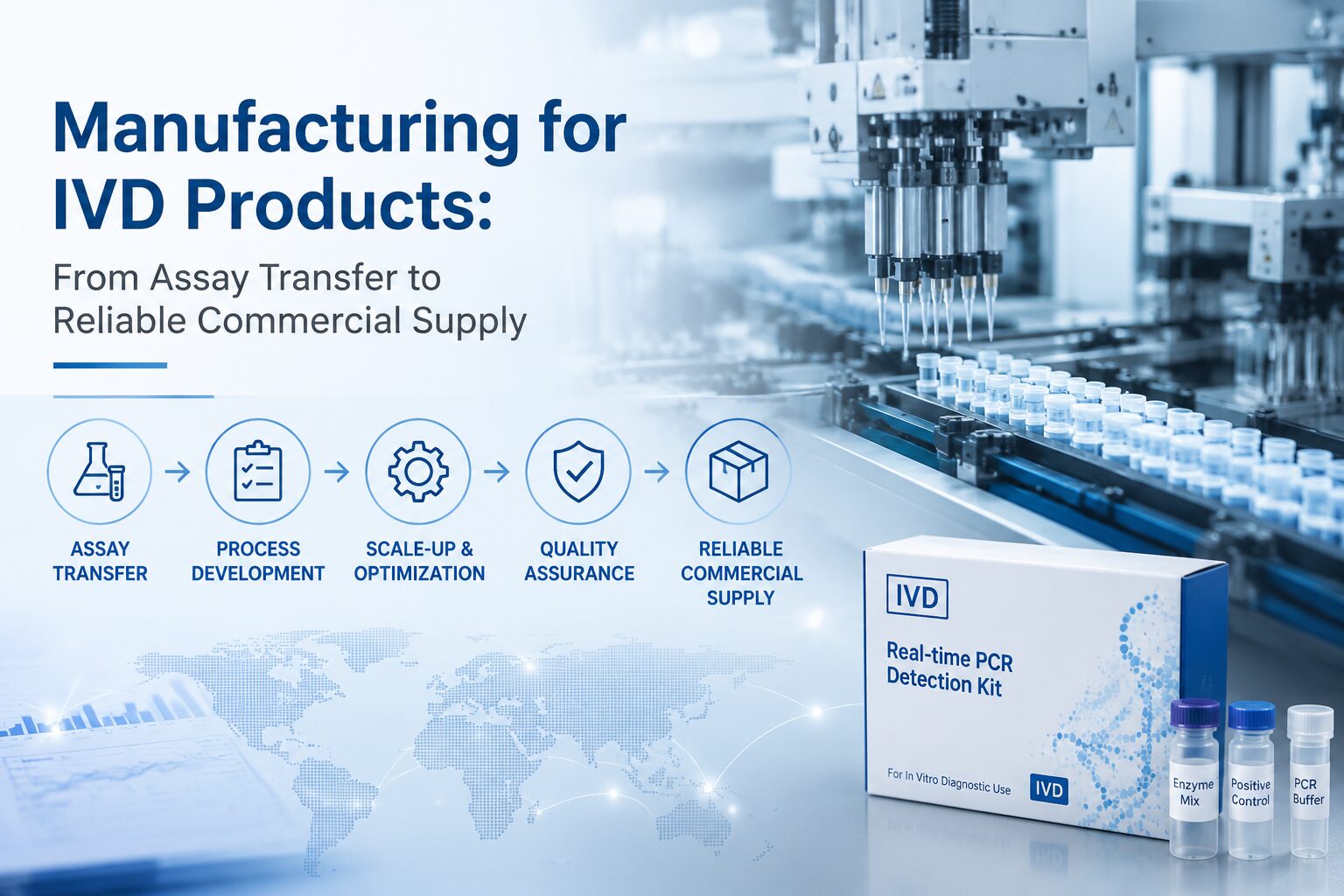
A diagnostic assay can perform beautifully in the development laboratory and still fail as a commercial product.
The reason is simple: an experiment is judged by whether it works today, in the hands of the development team. A manufactured IVD product must work across operators, equipment, raw-material lots, production sites, shipping routes and months of storage—without drifting beyond its validated performance claims.
That is the real purpose of manufacturing for IVD products. It is not merely the production of reagents, test strips, cartridges or instruments at a larger scale. It is the conversion of an analytical design into a controlled measurement system that produces clinically reliable results repeatedly.
This distinction matters. In vitro diagnostic products include reagents, instruments and systems used to examine specimens collected from the human body. Their output may influence diagnosis, treatment selection, disease monitoring or other medical decisions. A manufacturing deviation that appears minor—a membrane change, a different plastic resin or an altered drying profile—can change the result reported to the user.
Successful IVD commercialization therefore depends on a disciplined connection between intended use, assay design, raw materials, process controls, product release and post-market evidence.
Why IVD Manufacturing Is Different

Most manufactured goods can be inspected directly. Dimensions can be measured, surfaces examined and mechanical functions tested.
An IVD product presents a more difficult problem. Its most important property is not always visible: the ability to generate a correct result from a biological specimen.
Several characteristics make IVD manufacturing unusually demanding.
Biological materials are inherently variable
Antibodies, antigens, enzymes, primers, probes, serum-based controls and other biological materials may vary between production lots. Two batches can meet a supplier’s basic certificate of analysis while behaving differently in the finished assay.
Binding affinity, enzymatic activity, nonspecific reactivity, purity and matrix compatibility may all influence product performance. Supplier documentation alone cannot establish that a new material lot is interchangeable within a specific diagnostic system.
The product is often a system, not a single component
An IVD kit may combine:
- Biological reagents
- Calibrators and control materials
- Buffers and diluents
- Membranes, pads or microfluidic components
- Plastic consumables
- An analyzer or reader
- Firmware and analytical software
- Packaging and humidity protection
- Instructions for use
A component can meet its individual specification and still be incompatible with the rest of the system. Manufacturing controls must therefore protect system-level performance, not merely component conformity.
Small process shifts can create large analytical effects
A modest change in pH, coating density, conjugation efficiency, dispense volume, drying temperature or residual moisture can alter sensitivity or background signal. In quantitative assays, the same change may affect calibration slope, bias or reportable range.
The relationship between a process parameter and clinical performance is rarely linear. A process may appear stable near its nominal setting while becoming highly sensitive near the edge of its operating window.
Performance must survive time and distribution
An assay that passes release testing can still fail after exposure to humidity, vibration, freezing, elevated temperatures or repeated opening during use. Stability and packaging are therefore part of the product design—not administrative work completed after manufacturing has been established.
Begin With the Intended Use, Not the Production Line
A reliable manufacturing strategy begins with a precise intended use. This statement defines what the product is expected to measure, for whom, from which specimen, in what setting and for what medical purpose.
Before process development begins, the manufacturing team should understand:
- The target analyte or measurand
- Qualitative, semi-quantitative or quantitative output
- Specimen type and acceptable anticoagulants
- Intended patient population
- Professional, laboratory, near-patient or self-testing use
- Required analytical sensitivity and specificity
- Clinical decision points or cut-offs
- Instrument and software dependencies
- Storage and distribution conditions
- Expected shelf life
- Geographic markets and applicable regulations
These are not merely regulatory details. They determine the manufacturing control strategy.
For example, a professional laboratory assay with automated sample preparation may tolerate a workflow that would be unacceptable for home use. A quantitative assay supporting a clinical decision threshold requires tighter calibration and lot-to-lot consistency than a low-risk qualitative accessory.
A useful rule is that no production specification should exist without a traceable reason. That reason may come from intended use, risk management, design verification, performance evaluation, usability, stability or another documented requirement.
Converting Product Requirements Into Critical Quality Attributes
Once intended use and design requirements are established, they must be translated into measurable product characteristics.
These characteristics are often described as critical quality attributes: properties that must remain within an appropriate range to protect safety and performance.
| IVD component or process | Potential critical quality attributes | Possible consequence of poor control |
|---|---|---|
| Antibody or antigen | Identity, activity, affinity, purity and cross-reactivity | Reduced sensitivity, false positives or lot-to-lot bias |
| Primers and probes | Sequence identity, purity, concentration and amplification efficiency | Loss of detection, nonspecific amplification or altered limit of detection |
| Lateral-flow membrane | Capillary flow, thickness, surfactant content and protein-binding behavior | Uneven migration, background signal or invalid test lines |
| Calibrator | Assigned value, homogeneity, commutability and stability | Systematic bias across patient results |
| Lyophilized reagent | Residual moisture, cake integrity and reconstitution time | Activity loss or inconsistent concentration |
| Plastic consumable | Dimensions, optical properties, surface treatment and extractables | Flow failure, optical interference or reagent instability |
| Instrument or reader | Optical alignment, temperature control, calibration and software version | Incorrect signal interpretation or result calculation |
| Packaging system | Seal strength, moisture barrier and desiccant capacity | Premature degradation during storage or distribution |
Not every attribute can or should be tested on every finished unit. The manufacturer must determine which characteristics can be controlled through incoming inspection, process monitoring, equipment qualification, in-process testing or finished-product release.
This becomes the foundation of the manufacturing control strategy.
IVD Technology Transfer Is an Evidence-Generating Process
Technology transfer is often treated as the movement of a formulation, bill of materials and work instructions from research and development to production. That definition is too narrow.
A successful IVD technology transfer demonstrates that the receiving manufacturing process can reproduce the design output under controlled, scalable conditions.
A robust transfer normally progresses through several stages.
1. Transfer-readiness assessment
Before production trials begin, the development package should be reviewed for gaps. The manufacturer needs more than a research protocol. The package should define:
- Product and component specifications
- Approved raw materials and suppliers
- Formulations and allowable preparation ranges
- Process flow and sequence
- Critical process parameters
- In-process controls
- Test methods and acceptance criteria
- Reference materials
- Packaging configuration
- Storage and handling conditions
- Known failure modes
- Design and process risks
- Stability data
- Applicable software and firmware versions
A procedure that says “mix until homogeneous” is not ready for transfer unless homogeneity has a defined meaning and a practical method of confirmation.
2. Engineering batches
Engineering batches determine whether the proposed process can be executed with production equipment, production personnel and commercially available materials.
These batches are used to study questions such as:
- Does mixing time change with vessel geometry?
- Does a larger batch create temperature or concentration gradients?
- Can dispensing equipment maintain the required accuracy?
- Does drying remain uniform across different rack positions?
- Does line speed affect reagent deposition or strip assembly?
- Does the packaging process provide adequate seal integrity?
- Are in-process measurements sufficiently sensitive to detect failure?
Engineering batches should be designed to learn, not merely to pass. Results that expose process weakness are valuable if they are investigated before formal validation.
3. Pilot production
Pilot lots should approximate the intended commercial process closely enough to reveal scale-related risks. Production personnel, approved equipment, controlled documentation and representative materials should be used whenever possible.
Pilot manufacturing also provides material for:
- Analytical performance studies
- Usability evaluation
- Shipping studies
- Stability programs
- Packaging verification
- Method correlation
- Clinical performance studies, where applicable
- Training and process refinement
Using nonrepresentative development material for decisive performance studies creates a future comparability problem. If the product used to establish performance is materially different from the commercial product, additional bridging work may be required.
4. Process validation
Process validation establishes objective evidence that the manufacturing process can consistently produce conforming output.
It is not simply the completion of a predetermined number of successful lots. The appropriate validation approach depends on process risk, variability, manufacturing scale, available data and the ability to verify the output later.
For IVD manufacturing, validation frequently applies to processes such as:
- Reagent formulation and mixing
- Antibody conjugation
- Membrane coating and dispensing
- Drying and lyophilization
- Strip cutting and lamination
- Cartridge bonding or sealing
- Filling and capping
- Instrument calibration
- Software installation and configuration
- Automated result transfer
- Packaging and pouch sealing
A useful validation sequence includes equipment installation qualification, operational qualification and performance qualification. The names matter less than the evidence: the equipment must be installed appropriately, the process must operate throughout its justified range and the complete process must perform reproducibly under routine conditions.
Validation should challenge the proposed operating window. Running several batches at nominal settings only demonstrates that the nominal recipe can work. It does not establish what will happen when temperature, time, operator, equipment position or material characteristics vary within their permitted limits.
5. Commercial launch and continued monitoring
Validation is not the end of process understanding. Early commercial lots should receive enhanced review because low-frequency problems may not appear during limited pilot production.
Useful indicators include:
- Raw-material acceptance trends
- In-process yield
- Dispensing or filling variation
- Environmental monitoring results
- Invalid test rates
- Control-line or calibration response
- Release-test distributions
- Stability trends
- Nonconformities and deviations
- Complaints by product lot
- Field failure patterns
A process can remain inside specification while moving steadily toward failure. Trend analysis is therefore more informative than a simple pass-or-fail history.
Raw-Material Control: Where Many IVD Failures Begin
Raw materials are among the most important sources of IVD variability. The risk is particularly high when the material interacts directly with the analyte, sample matrix or signal-generation system.
A sound supplier-control program goes beyond collecting certificates and conducting periodic audits.
Define function-based specifications
A chemical purity specification may not predict performance in the assay. Where appropriate, raw-material qualification should include functional tests that reflect how the material is used.
For an antibody, this might include binding response, cross-reactivity and performance in a representative assay format. For nitrocellulose membrane, the relevant tests may include capillary flow and finished-strip signal characteristics. For a plastic reaction vessel, optical clarity or surface interaction may matter more than a generic dimensional certificate.
Qualify new lots before routine use
New critical material lots should be compared against a qualified reference or current production material. The comparison should use samples that can reveal meaningful differences, including specimens near medical decision points where relevant.
A strong positive sample alone is usually a poor detector of raw-material deterioration. It may remain positive even after a significant loss of analytical sensitivity.
Control sub-tier changes
A supplier may change its source material, manufacturing site, purification process, stabilizer, packaging or test method without changing the commercial part number.
Quality agreements should establish notification requirements for changes that could affect product performance. Where the direct supplier relies on sub-tier manufacturers, visibility into those dependencies may be necessary.
Treat second sourcing as a product change
Dual sourcing can improve supply resilience, but an alternative material is not automatically equivalent. The manufacturer should define comparability requirements before introducing the second source.
Depending on the material and its function, the assessment may include:
- Analytical sensitivity
- Precision
- Bias
- Cross-reactivity
- Interference
- Cut-off behavior
- Stability
- Manufacturing yield
- Packaging compatibility
The objective is not to prove that two materials are identical. It is to demonstrate that the finished product continues to meet its requirements.
Designing an Effective IVD Lot-Release Strategy
Finished-product testing cannot compensate for a poorly controlled process. At the same time, process control cannot eliminate the need to confirm that each released lot performs as intended.
The release strategy should connect raw-material controls, in-process controls and final-product testing.
Release testing should detect clinically meaningful failure
A release panel should be selected according to product risk and known sources of variation. Depending on the assay, it may contain:
- True negative samples
- Low-positive samples near the detection limit
- Samples around a clinical cut-off
- Moderate and high-positive samples
- Relevant interfering substances
- Multiple analyte levels for quantitative assays
- Internal and external controls
- Invalid-result challenges
Testing only high-positive and negative controls can miss a substantial deterioration in sensitivity. The high-positive sample may continue to generate a convincing result long after low-positive specimens have begun to fail.
Reference systems must be stable and characterized
Reference materials used for release are themselves part of the measurement system. Their assignment, homogeneity, stability, storage and replacement must be controlled.
For quantitative IVDs, metrological traceability deserves particular attention. ISO 17511:2020 addresses the technical requirements and documentation for traceability of values assigned to calibrators, trueness control materials and human samples. Traceability should extend to the highest available reference system component appropriate to the measurand. ISO 17511:2020
When a reference lot is nearing depletion, replacement material should be bridged before the old lot is exhausted. Otherwise, the manufacturer may lose the ability to distinguish product drift from a change in the reference system.
Release specifications should be supported by evidence
Specifications should not be based solely on what previous pilot lots happened to achieve. They should account for:
- Clinical and analytical performance requirements
- Risk-control needs
- Measurement uncertainty
- Method variability
- Process capability
- Stability-related change
- Relevant regulatory commitments
A very wide specification may fail to protect product performance. An unnecessarily narrow specification may create avoidable rejection without improving patient safety. The justified range lies between those extremes.
Batch release is a quality decision
Final release should include more than laboratory results. Quality review may cover:
- Manufacturing records
- Material and component status
- Deviations and nonconformities
- In-process results
- Equipment and calibration status
- Environmental records, where applicable
- Label and packaging reconciliation
- Final-product testing
- Required investigations
- Approval of any documented concessions
A certificate of analysis summarizes selected results. It does not replace the underlying batch review.
Manufacturing Environment and Contamination Control
Not every IVD product requires a classified cleanroom. The appropriate manufacturing environment should be based on the product, process, contamination risks and applicable requirements.
For molecular diagnostic products, contamination control may require separation of pre-amplification and post-amplification activities, controlled material and personnel flow, dedicated equipment, aerosol management and routine environmental checks.
Protein-based assays may be sensitive to microbial contamination, proteases, cleaning residues or cross-contact with other antibodies and antigens. Instruments and plastic consumables may introduce particulate, optical or chemical contamination.
A risk-based contamination-control plan can address:
- Facility zoning
- Personnel and material flow
- Gowning and hygiene
- Cleaning agents and residues
- Equipment cleaning validation
- Nuclease or amplicon control
- Environmental monitoring
- Temperature and humidity
- Water quality
- Pest control
- Waste movement
- Campaign manufacturing and line clearance
The appearance of a clean facility is not evidence of contamination control. The manufacturer should be able to explain what is being controlled, why it matters and how the effectiveness of the controls is verified.
Stability Is a Manufacturing Requirement
Shelf life is not a marketing number added to the label. It is a performance claim that must be supported for the final product in its commercial configuration.
A complete stability strategy may include:
- Real-time stability
- Accelerated stability
- In-use or open-vial stability
- Reconstituted reagent stability
- On-board instrument stability
- Freeze-thaw studies
- Shipping and temperature-excursion studies
- Humidity and light exposure
- Specimen or prepared-sample stability
- Calibration stability
- Kit-component compatibility
ISO 23640 applies to stability evaluation of IVD reagents, including calibrators, control materials, diluents, buffers and reagent kits. ISO 23640:2011
Accelerated studies can support development decisions and early estimates, but they should not be treated as an automatic substitute for real-time evidence. Biological degradation may not follow a simple predictive model, and different components can fail through different mechanisms.
The stability program should use representative production material and final packaging. If pouch material, desiccant, fill volume, container closure or manufacturing process changes, the effect on stability must be assessed.
Packaging and Distribution Must Protect Assay Performance
IVD packaging is part of the product’s protective system. It may need to control moisture, light, oxygen, physical damage, contamination and component mix-ups.
Packaging qualification should consider actual distribution conditions rather than an idealized warehouse-to-laboratory journey.
Potential challenges include:
- Air and sea freight
- Repeated loading and unloading
- Vibration and shock
- High-altitude pressure changes
- Customs delays
- Tropical humidity
- Sub-zero temperatures
- Last-mile delivery without active temperature control
- Repeated opening by end users
Distribution simulation should be connected to functional assay testing. An undamaged box does not prove that the diagnostic performance survived transportation.
Temperature excursions also need predefined assessment procedures. A manufacturer should be able to determine whether affected products remain suitable for use based on data—not commercial urgency.
Labeling Is a Controlled Manufacturing Output
Labels, instructions for use, software screens and result reports are part of the device. They must remain aligned with the manufactured configuration and validated performance.
For products marketed in the United States, 21 CFR 809.10 contains IVD-specific labeling requirements. FDA identifies information such as intended use, warnings, manufacturer details and a lot or control number traceable to production history among the required elements, as applicable. FDA IVD labeling requirements
Label control should prevent:
- Use of an obsolete revision
- Incorrect reagent or component labels
- Mismatched kit components
- Unsupported performance claims
- Incorrect storage conditions
- Translation errors
- Missing warnings
- Incorrect software instructions
- Lot-number duplication
- Uncontrolled electronic instructions for use
When a process or component changes, the labeling impact should be evaluated. Conversely, a labeling change may require design review, risk assessment, usability evaluation or regulatory assessment.
Quality Systems for IVD Manufacturing
ISO 13485:2016 is the internationally recognized quality-management standard for organizations involved in medical-device design and manufacturing. It provides a framework for controlled production, supplier management, documentation, risk-based decision-making and corrective action. ISO 13485:2016
Certification is valuable, but the certificate alone does not demonstrate that a manufacturer can make a particular IVD successfully. The practical questions are more specific:
- Has the facility manufactured this assay format before?
- Can it control the critical biological materials?
- Are its test methods suitable for the product?
- Can it investigate atypical analytical results?
- Does it understand lot-to-lot comparability?
- Can it maintain traceability across kits, components and bulk reagents?
- Does its change-control system evaluate analytical and regulatory impact?
In the United States, FDA’s Quality Management System Regulation became effective on February 2, 2026. The QMSR amended 21 CFR Part 820 and incorporates ISO 13485:2016 by reference, while retaining applicable FDA-specific requirements. FDA Quality Management System Regulation
In the European Union, Regulation (EU) 2017/746—the IVDR—has applied since May 26, 2022. It requires manufacturers to maintain a quality management system and links conformity to scientific validity, analytical performance and clinical performance. Regulation (EU) 2017/746
Risk management must also continue throughout the product life cycle. ISO 14971:2019 provides the established framework for identifying hazards, evaluating risks, implementing controls and monitoring their effectiveness, including for IVD medical devices. ISO 14971:2019
The regulatory pathway, product classification and required evidence vary by market and intended use. Manufacturing plans should therefore be developed with regulatory strategy—not after it.
The Legal Manufacturer–CDMO Relationship
Outsourcing production does not outsource regulatory accountability.
The legal manufacturer remains responsible for ensuring that the finished product complies with applicable requirements. The contract development and manufacturing organization, or CDMO, operates within the responsibilities assigned through technical agreements, quality agreements and controlled procedures.
The division of responsibility should be explicit for:
- Design authority
- Technology transfer
- Supplier qualification
- Raw-material approval
- Equipment and process validation
- Test-method validation
- Batch-record approval
- Product release
- Deviations and out-of-specification results
- Nonconforming products
- Change notification
- CAPA
- Complaints and vigilance
- Stability monitoring
- Regulatory submissions
- Record retention
- Subcontractor management
- Audit access
- Product discontinuation and transfer-out
Ambiguous responsibility creates gaps. If both parties assume the other is monitoring a critical supplier change or reviewing complaint trends, the activity may not occur at all.
Change notification deserves particular attention. The agreement should define which changes require notification, the information that must be provided, who evaluates regulatory impact and whether prior written approval is required.
Common IVD Manufacturing Failures
Many commercialization problems originate before the first formal production lot.
Transferring a laboratory recipe instead of a manufacturing process
Technology instructions often depend on tacit knowledge. Experienced scientists adjust mixing, timing or handling based on observation. A commercial process must convert that judgment into defined parameters, acceptance criteria and training.
Setting specifications around historical results
Pilot-lot performance does not automatically define an appropriate specification. Limits should be connected to product requirements and risk, with measurement variability understood.
Relying on supplier certificates for critical materials
A certificate may confirm identity or purity without showing how the material performs in the final assay. Functional qualification is often necessary.
Testing only ideal samples
Strong positive and clear negative controls rarely reveal marginal deterioration. Samples near the limit of detection, cut-off or medical decision point provide greater sensitivity to manufacturing drift.
Treating packaging as a late-stage purchasing decision
Changing foil, desiccant, bottle resin or closure configuration can alter product stability. Packaging should be evaluated as part of the product system.
Ignoring software configuration
Analyzer parameters, calibration algorithms, result interpretation rules and firmware versions must remain controlled. A correctly manufactured reagent can still produce an incorrect result if the associated software configuration is wrong.
Assuming a second source is equivalent
Materials with the same commercial description may differ in ways that affect analytical performance. Alternative-source qualification should be based on finished-product comparability.
Using accelerated stability as the entire shelf-life strategy
Accelerated studies are useful, but biological reagents may degrade through mechanisms that do not extrapolate reliably. Real-time stability remains essential.
Validating only nominal settings
This produces evidence that the process works under preferred conditions, not that it remains capable throughout the permitted operating range.
How to Evaluate an IVD Manufacturing Partner
A capable IVD manufacturing partner should be assessed through evidence rather than general claims.
Useful questions include:
- Which IVD technologies and product formats have you transferred and manufactured?
- How do you identify critical quality attributes and process parameters?
- How are critical biological raw materials qualified?
- Can you show anonymized examples of lot-to-lot trend analysis?
- How are reference materials established, controlled and replaced?
- Which processes require validation, and how are operating ranges challenged?
- How do you manage molecular contamination or product cross-contact?
- How are deviations and atypical analytical results investigated?
- How are material, supplier, equipment and software changes assessed?
- What release testing is performed on each production lot?
- Can the stability program cover real-time, accelerated, in-use and shipping conditions?
- How is traceability maintained between bulk materials, components and finished kits?
- Which activities are performed by subcontractors?
- How early must the CDMO be involved in design transfer?
- What happens to methods, tooling, documentation and materials if the product is transferred elsewhere?
The strongest partner is not necessarily the company with the largest facility. It is the one whose technical capabilities, quality system, analytical methods and capacity match the product’s actual risk profile.
What Determines IVD Manufacturing Cost and Timeline?
There is no meaningful universal price per kit or standard commercialization timeline. The largest cost and schedule drivers usually include:
- Assay format and complexity
- Qualitative versus quantitative output
- Availability and maturity of the design
- Number of kit components
- Biological raw-material risk
- Manual versus automated processing
- Required production volume
- Tooling and custom equipment
- Instrument and software integration
- Cleanliness and environmental requirements
- Test-method development
- Process validation
- Stability duration
- Packaging configuration
- Market-specific labeling
- Regulatory classification and evidence requirements
- Need for clinical or performance-study material
- Supply-chain resilience requirements
An incomplete design may appear inexpensive to transfer because many activities have not yet been identified. Those costs reappear later as engineering changes, rejected batches, repeated validation or delayed regulatory submissions.
A realistic quotation should therefore state its assumptions, exclusions, responsibilities and required client inputs. A low unit price has limited value if the process cannot achieve acceptable yield or if each material change triggers extensive rework.
A Practical Manufacturing Readiness Checklist
Before formal transfer, an IVD developer should be able to answer the following questions:
- Is the intended use stable and clearly documented?
- Are product requirements linked to analytical and clinical needs?
- Are critical components and suppliers identified?
- Are raw-material specifications functionally relevant?
- Is the commercial formulation defined?
- Are critical process parameters understood?
- Are test methods documented and suitable for transfer?
- Is representative reference material available?
- Have product and process risks been reviewed?
- Is the final packaging configuration selected?
- Are software and instrument versions controlled?
- Is the stability strategy defined?
- Are pilot and validation lots planned?
- Are market-specific regulatory requirements understood?
- Are legal-manufacturer and CDMO responsibilities documented?
- Is there a procedure for evaluating future changes?
If several answers remain uncertain, the project may still be in development rather than ready for commercial manufacturing. Recognizing that distinction early is less costly than discovering it during validation.
Conclusion: IVD Manufacturing Is the Industrialization of Measurement
Manufacturing for IVD products is ultimately the industrialization of a measurement procedure.
The objective is not merely to reproduce the physical contents of a diagnostic kit. It is to preserve the relationship between the specimen, the analytical reaction, the reported result and the product’s intended medical use.
That requires more than an ISO 13485 certificate or a production line. It requires control of biological materials, a disciplined technology-transfer process, meaningful specifications, validated manufacturing operations, representative lot-release testing, defensible stability evidence and rigorous change management.
The most successful IVD programs establish these connections early. Development, manufacturing, quality and regulatory teams work from the same intended use and the same definition of acceptable performance.
When that discipline is present, manufacturing becomes more than a downstream service. It becomes part of the evidence that every commercial lot can be trusted to perform as the product was designed, validated and represented to users.
Frequently Asked Questions
What is manufacturing for IVD products?
Manufacturing for IVD products is the controlled production of diagnostic reagents, consumables, instruments, calibrators, controls, software-associated components and finished test systems. It includes technology transfer, supplier control, process validation, lot-release testing, packaging, stability monitoring and production traceability.
Is ISO 13485 certification enough to qualify an IVD manufacturer?
No. ISO 13485 certification provides evidence that a quality management system has been assessed, but it does not establish technical capability for every IVD format. Product-specific experience, analytical testing capability, contamination control, process validation and biological-material management must also be evaluated.
What is the difference between IVD contract manufacturing and an IVD CDMO?
A contract manufacturer may focus primarily on production according to an established specification. An IVD CDMO generally provides broader development and commercialization support, which may include assay optimization, design transfer, process development, pilot manufacturing, validation, stability studies, packaging and regulatory-support activities. Actual capabilities vary by provider and should be confirmed in the contract.
How many validation lots are required for an IVD product?
There is no universally appropriate number for every product and process. The validation plan should be justified according to process risk, variability, production scale, available development evidence and the ability to verify the finished output. Repeating several nominal batches without challenging the process range may provide weak evidence regardless of the number produced.
Can an IVD manufacturer change raw-material suppliers after validation?
A supplier or material change may be possible, but it should be managed through formal change control. The manufacturer must evaluate the effect on product performance, process validation, stability, labeling and regulatory submissions. Critical materials may require functional comparability or bridging studies before implementation.
Why is lot-to-lot consistency particularly important for IVD products?
IVD results depend on the combined behavior of reagents, materials, instruments and analytical algorithms. Variability between lots can change sensitivity, specificity, calibration, bias or cut-off behavior. Lot-to-lot control helps ensure that users receive equivalent diagnostic performance throughout the commercial life of the product.
What documents are normally needed for IVD technology transfer?
A transfer package commonly includes product specifications, bills of materials, formulations, manufacturing procedures, process parameters, raw-material specifications, supplier information, analytical methods, acceptance criteria, reference-material information, risk documents, stability data, packaging requirements, labeling and applicable software configuration. The exact package depends on the product and assigned responsibilities.
When should an IVD CDMO become involved?
Ideally, the manufacturing partner should be involved before the design is fully frozen. Early manufacturing input can identify materials that are difficult to source, processes that will not scale, specifications that cannot be measured reliably and packaging choices that may compromise stability. Early involvement does not replace design control; it helps ensure that the final design can be manufactured consistently.
Author Profile

- Written by the IVDCDMO technical and regulatory team, with expertise in diagnostic assay development, GMP manufacturing, ISO 13485 systems, and global IVD commercialization for biotech innovators worldwide.
Latest entries
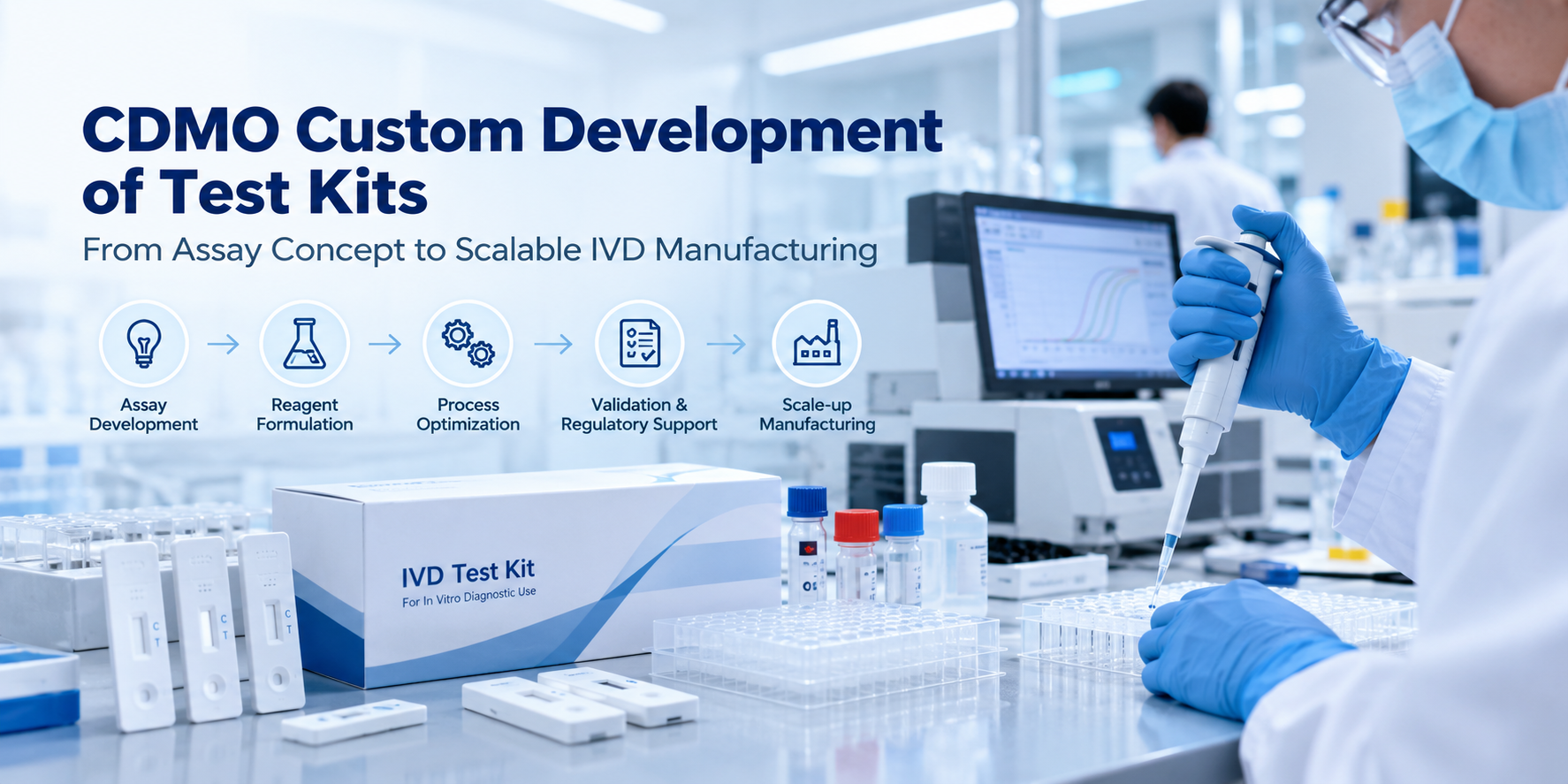
 Assay DevelopmentSeptember 23, 2026CDMO Custom Development of Test Kits: From Assay Concept to Scalable IVD Manufacturing
- IVD ManufacturingJuly 24, 2026Manufacturing for IVD Products: From Assay Transfer to Reliable Commercial Supply
- IVD ManufacturingJuly 13, 2026IVD Contract Manufacturing Cost: NRE, Tooling, Validation, MOQ and Unit Economics
- KnowledgeJuly 6, 2026IVD CDMO vs CRO vs CMO: Which Partner Do You Need at Each Development Stage?