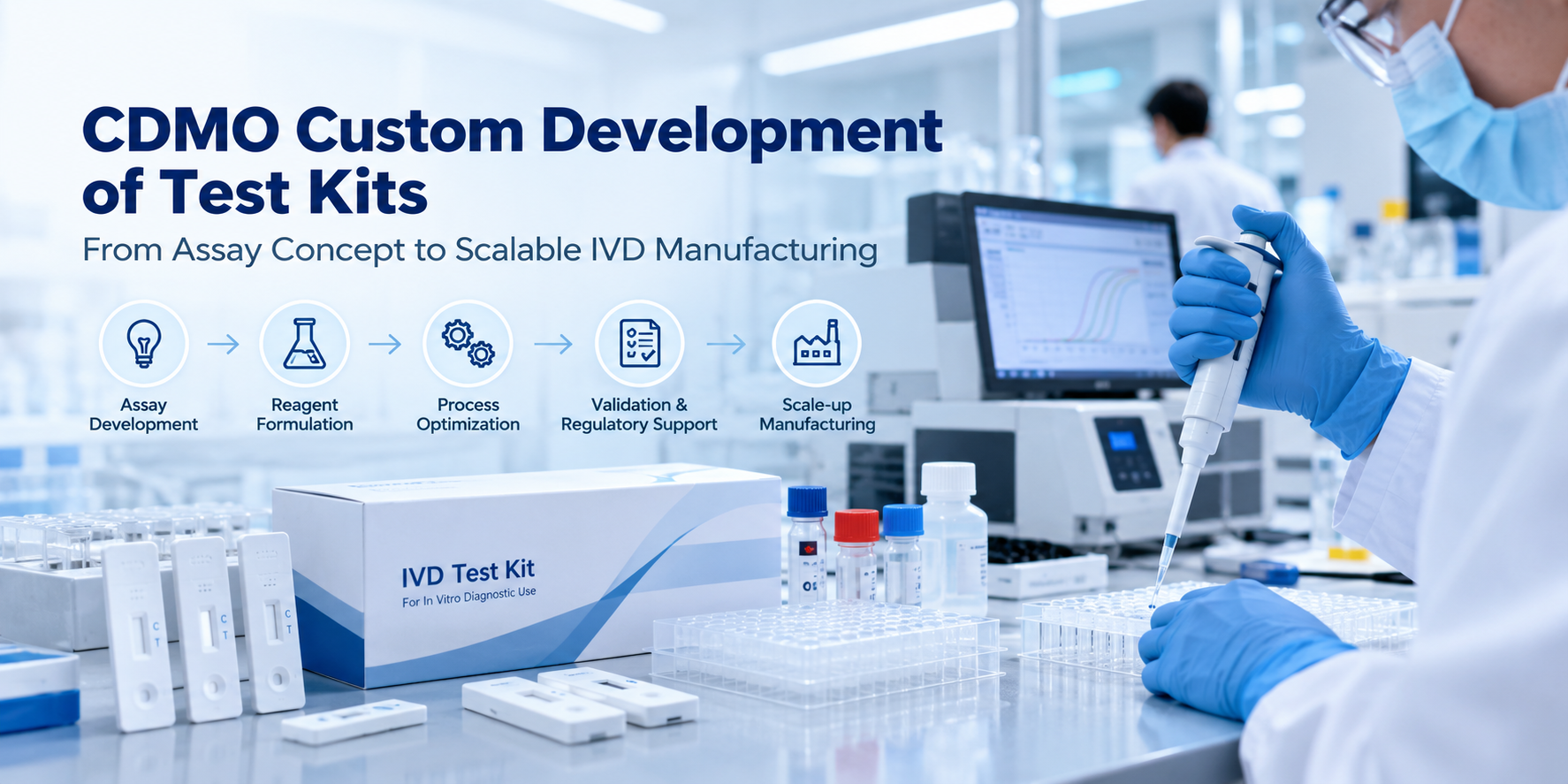
CDMO custom development of test kits provides diagnostic companies with a structured route from an initial assay concept to a reproducible, manufacturable and commercially viable in vitro diagnostic product. Instead of outsourcing only one isolated development task, an IVD-focused CDMO program can integrate assay design, raw-material selection, reagent formulation, analytical optimization, pilot production, stability studies, manufacturing transfer and regulatory-support documentation into a coordinated development pathway.
For diagnostic startups, established IVD manufacturers, laboratories and healthcare companies entering new markets, this model can reduce duplicated development work while addressing one of the most difficult challenges in diagnostics: transforming an assay that works experimentally into a test kit that can be manufactured consistently at scale.
IVD CDMO connects global diagnostic companies with qualified IVD development and manufacturing resources across multiple assay technologies, helping project owners identify suitable technical capabilities and build an appropriate development pathway for their target product and market.
What Is CDMO Custom Development of Test Kits?
In the IVD industry, CDMO custom development of test kits refers to contract development and manufacturing activities performed according to the technical, commercial and regulatory requirements of a specific diagnostic product.
The scope can extend substantially beyond simply manufacturing reagents.
Depending on the project, an IVD test kit CDMO program may include:
- Product requirement definition and feasibility assessment
- Antigen, antibody, enzyme, primer/probe and other raw-material screening
- Assay architecture and reaction-system development
- Reagent formulation and process optimization
- Calibration and control strategy development
- Consumable and packaging selection
- Analytical performance evaluation
- Pilot-batch production
- Stability and transport-condition studies
- Manufacturing process development
- Design and process transfer
- Scale-up and batch-consistency studies
- Quality and regulatory documentation support
- OEM/ODM manufacturing and commercial production
The exact scope should be defined according to the intended use of the assay, target analyte, sample type, detection technology, regulatory pathway and expected production volume.
Major Technology Platforms for Custom IVD Test Kit Development
A key advantage of an IVD CDMO model is access to different diagnostic technologies without requiring the project owner to establish every development platform internally.
1. Colloidal Gold Lateral Flow Assay Development
Colloidal gold immunochromatography remains an important platform for rapid diagnostic tests and point-of-care applications.
A typical custom lateral flow development project may involve optimization of:
- Capture and detection antibody pairs
- Gold nanoparticle conjugation
- Conjugate-pad treatment
- Nitrocellulose membrane selection
- Test and control line concentrations
- Sample-pad treatment
- Running buffers
- Membrane flow characteristics
- Strip dimensions
- Cassette configuration
- Detection time
- Packaging and moisture protection
The objective is not simply to produce a visible test line. Developers must balance analytical sensitivity, specificity, flow consistency, background suppression, reading window and long-term reagent stability.
Potential applications include infectious diseases, fertility testing, drugs of abuse, veterinary diagnostics and other point-of-care testing scenarios.
2. Fluorescence Immunochromatography Development
Fluorescence immunoassays can provide quantitative or semi-quantitative measurement while retaining many of the operational advantages of lateral flow technology.
Custom development may involve fluorescent particle selection, conjugation chemistry, reaction optimization, calibration-curve development and adaptation to a specific fluorescence reader.
Because instrument-based interpretation is involved, development should consider the assay and analyzer as an integrated system rather than optimizing the reagent independently.
Important variables can include:
- Fluorescent label characteristics
- Antibody conjugation efficiency
- Signal-to-background ratio
- Calibration methodology
- Lot-to-lot consistency
- Reader compatibility
- Algorithm and cutoff settings
3. Chemiluminescence Immunoassay — CLIA
Chemiluminescence has become an important technology for high-throughput clinical immunodiagnostics.
Custom CLIA development may cover antigen/antibody selection, magnetic-particle chemistry, labeling systems, reagent formulation, calibration, reaction sequence optimization and analyzer adaptation.
Depending on the assay design, developers may need to evaluate factors such as signal kinetics, interference, dynamic range, Hook effect, carryover and reagent stability.
The assay should ultimately be optimized not only for analytical performance but also for reliable operation on the intended instrument platform.
4. ELISA Kit Custom Development
Custom ELISA kit development remains relevant for infectious disease testing, antibody detection, biomarkers, research applications and specialized laboratory diagnostics.
Possible formats include:
- Direct ELISA
- Indirect ELISA
- Sandwich ELISA
- Competitive ELISA
Development typically includes coating optimization, blocking-system selection, conjugate development, sample dilution, incubation conditions, wash parameters, substrate selection and cutoff or calibration strategy.
For commercial ELISA products, plate-to-plate and lot-to-lot reproducibility are especially important considerations.
5. Specific Protein Assay Development
Specific protein testing can include immunoturbidimetric, nephelometric or related immunochemical methods for quantitative measurement of proteins and biomarkers.
Development work may include latex particle preparation, antibody sensitization, reaction-buffer optimization, calibration and instrument adaptation.
Particular attention should be paid to reaction kinetics, linearity, analytical measuring range and potential interference from complex clinical matrices.
6. Clinical Chemistry and Biochemical Reagent Development
Custom biochemical reagent development can support assays based on enzymatic, colorimetric and related clinical chemistry principles.
Projects may require:
- Reagent formulation
- Enzyme stabilization
- Buffer optimization
- Calibration
- Linearity studies
- Interference assessment
- Analyzer parameter development
- Accelerated and real-time stability studies
The final formulation must remain sufficiently robust for manufacturing, transportation, storage and routine laboratory operation.
7. qPCR Diagnostic Kit Development
For molecular diagnostics, custom qPCR kit development requires coordinated optimization of nucleic-acid targets, primers, probes, enzymes, buffers, controls and amplification conditions.
Typical development considerations include:
- Target-sequence selection
- Primer and probe design
- Inclusivity and exclusivity
- Amplification efficiency
- Internal controls
- Positive and negative controls
- Multiplex compatibility
- Limit of detection
- Cross-reactivity
- Sample matrix
- Extraction-method compatibility
- Instrument compatibility
Molecular diagnostic development should consider the entire workflow from sample preparation through result interpretation.
8. Isothermal and Other Molecular Amplification Platforms
Applications requiring rapid amplification or simplified instrumentation may use isothermal amplification technologies or other molecular detection architectures.
Depending on the intended product, these platforms can be relevant to decentralized diagnostics, field testing and point-of-care molecular detection.
However, choosing a technology solely because it offers faster amplification can create downstream problems. Specificity, contamination control, reagent stability, sample preparation and manufacturing reproducibility must also be considered during platform selection.
A Practical CDMO Test Kit Development Workflow
Successful CDMO custom development of test kits should be milestone-driven rather than treated as one continuous laboratory experiment.
A practical workflow can be divided into the following stages.
Stage 1: Product Requirement Definition
Before laboratory development begins, the project should establish a Target Product Profile or equivalent technical requirement document.
Key questions include:
What analyte will the product detect?
What specimen types will be used?
Is the result qualitative, semi-quantitative or quantitative?
What analytical sensitivity is required?
What turnaround time is expected?
Will the assay operate manually or on a specific instrument?
What shelf life and storage conditions are required?
Which countries or regulatory markets are targeted?
This stage is often underestimated.
A technically successful assay can still become commercially unsuitable when the development team optimizes for the wrong sample type, instrument, cost target or regulatory requirement.
Stage 2: Feasibility and Raw-Material Screening
Critical biological and chemical raw materials are evaluated before full system optimization.
Depending on the assay, this can include:
- Monoclonal or polyclonal antibodies
- Recombinant or native antigens
- Enzymes
- Fluorescent labels
- Magnetic particles
- Latex particles
- Primers and probes
- Membranes
- Blocking reagents
- Buffers and stabilizers
Candidate materials should be evaluated not only for initial analytical performance but also for supply continuity, manufacturability and batch consistency.
A reagent that performs exceptionally in one experiment but cannot be supplied consistently may create substantial risk during commercialization.
Stage 3: Assay Architecture and System Optimization
Once critical materials have been selected, the complete reaction system is optimized.
Typical variables include reagent concentrations, labeling conditions, coating parameters, buffer composition, reaction time, temperature, dilution ratios and consumable compatibility.
Design-of-experiments approaches may be useful when several interacting variables must be optimized simultaneously.
The objective is to identify a robust operating window rather than a single set of conditions that produces the best laboratory result.
Stage 4: Prototype and Small-Batch Verification
Prototype kits are produced under controlled conditions to determine whether the optimized assay can be reproduced as a product.
Evaluation may include:
- Precision
- Repeatability
- Reproducibility
- Analytical sensitivity
- Specificity
- Linearity
- Measuring range
- Interference
- Cross-reactivity
- Cutoff verification
- Reference-material testing
The exact studies depend on assay type and intended use.
Stage 5: Pilot Production and Stability Assessment
Pilot manufacturing is one of the points where an assay begins transitioning from R&D into an industrial product.
Multiple batches should be produced to evaluate whether the manufacturing process consistently reproduces the required performance.
Stability programs may include accelerated, real-time and—in appropriate cases—transport or stress-condition studies.
The purpose is not merely to assign an expiration date. Stability work can reveal formulation weaknesses, packaging problems and process variability that were not visible during initial development.
Stage 6: Customer Evaluation and Design Iteration
Prototype or pilot products can then be evaluated by the project owner or designated laboratories.
Feedback may reveal issues associated with real samples, workflow, instrumentation, packaging or interpretation.
The development team can then conduct controlled optimization before the product design is finalized.
Stage 7: Design Transfer and Manufacturing Scale-Up
A major difference between research assay development and professional IVD CDMO test kit development is the requirement for transferability.
Manufacturing personnel must be able to reproduce the assay without depending on undocumented knowledge held by individual R&D scientists.
Design transfer may therefore require controlled specifications for:
- Raw materials
- Formulations
- Manufacturing procedures
- In-process controls
- Acceptance criteria
- Equipment
- Packaging
- QC methods
- Finished-product release
This is one of the most important steps in converting an assay into a scalable commercial product.
Why Raw-Material Control Matters in IVD CDMO Projects
Many diagnostic performance problems originate upstream.
Antibodies, antigens, enzymes, membranes, particles and other critical materials can influence sensitivity, specificity, stability and batch reproducibility.
For this reason, supplier qualification and incoming-material specifications should be considered during development rather than postponed until commercial manufacturing.
A mature development strategy asks two different questions:
Does this raw material make the assay work?
and
Can this raw material reliably support thousands or millions of tests over the commercial lifecycle of the product?
These are not necessarily the same question.
Alternative-source evaluation can also reduce dependence on a single critical supplier.
From Analytical Performance to Manufacturability
One of the biggest risks in custom diagnostic development is optimizing exclusively for analytical performance.
The assay may achieve excellent sensitivity in an R&D laboratory but require highly sensitive manufacturing conditions, expensive components or manual procedures that cannot be reproduced economically at scale.
Therefore, manufacturability should be considered from the early development stage.
A commercially realistic CDMO program should balance:
Analytical performance + process robustness + manufacturing cost + supply-chain stability + regulatory requirements.
This concept is particularly important when the anticipated annual production volume is high.
A small difference in reagent consumption, membrane dimensions, filling volume or manufacturing yield can become economically significant at scale.
Quality and Regulatory Considerations
The regulatory requirements applicable to a diagnostic product depend on its intended use and target markets.
Consequently, quality and regulatory planning should begin early in the development process.
Depending on the project, documentation may include:
- Product requirements
- Design inputs and outputs
- Risk-management documentation
- Raw-material specifications
- Manufacturing procedures
- Analytical performance records
- Stability protocols and reports
- Batch manufacturing records
- QC and release specifications
- Traceability documentation
- Verification and validation records
For regulated IVD products, developers should align the project with the applicable quality-management and regulatory framework rather than assuming that good analytical results alone are sufficient for commercialization.
Technical Training and Technology Transfer
Some CDMO customers do not intend to outsource manufacturing permanently.
They may instead require a development partner to establish the assay and subsequently transfer the technology to their own facility.
A technology-transfer program can therefore include:
Production Training — preparation, dispensing, coating, conjugation, assembly and production procedures.
Process Training — critical process parameters, troubleshooting and process control.
Quality-System Training — QC procedures, acceptance criteria, documentation and batch-release practices.
Facility and Production-Line Consultation — workflow planning, equipment selection and manufacturing-area requirements.
This approach can be particularly relevant to diagnostic companies establishing local manufacturing capacity or transferring technology into new geographic markets.
CDMO vs. OEM vs. ODM for IVD Test Kits
These terms are frequently used interchangeably, although they describe different relationships.
| Model | Typical Scope | Suitable For |
|---|---|---|
| OEM | Manufacturing an existing product/specification | Companies with established products |
| ODM | Existing or adaptable product design plus manufacturing | Faster private-label market entry |
| CDMO | Customized development plus manufacturing and scale-up | New assays and differentiated products |
| Technology Transfer | Development followed by transfer of manufacturing know-how | Companies building internal manufacturing |
For a genuinely new diagnostic assay, CDMO custom development is generally broader than conventional OEM production because substantial technical development occurs before commercial manufacturing begins.
How Long Does Custom Test Kit Development Take?
There is no universal development timeline.
The schedule depends on assay complexity, maturity of the starting materials, sample availability, performance requirements, instrument integration, stability requirements and regulatory strategy.
A straightforward adaptation of an established assay architecture may progress relatively quickly, whereas development of a novel multiplex molecular diagnostic or instrument-integrated immunoassay can require substantially more work.
Projects should therefore be planned around technical milestones rather than marketing-driven promises of a fixed development period.
Typical milestones include:
Feasibility → Raw-Material Screening → Assay Optimization → Prototype Verification → Pilot Manufacturing → Stability Evaluation → Design Transfer → Validation Support → Commercial Manufacturing
Progression to the next stage should ideally depend on predefined acceptance criteria.
Process
| Development Process | Cycle Time | Experiment Content |
| Primary sieving of raw materials | 1-2 weeks | Preliminary screening of raw materials |
| Process and reaction System optimization | 6-8 weeks | Services provided include the determination of encapsulation concentration and system, optimization and determination of labeling conditions, formulation determination of treatment solutions, determination of reaction system, determination of dilution ratio, determination of reaction time, and screening and adaptation of consumables |
| Small sample validation | 1 week | Verification of the performance of small samples |
| Intermediate test Thermal stability assessment | 1 week | Produce 3 batches of intermediate tests and conduct thermal stability assessment |
| Sample acceptance and optimization | 3-4 weeks | Sending samples to customers, acceptance, reagent optimization according to customer feedback |
How to Select an IVD CDMO Partner
Selecting a CDMO for custom development of diagnostic test kits should involve more than comparing quotations.
Companies should evaluate whether the prospective partner has demonstrated capability in the relevant assay technology and can support the project beyond the first successful prototype.
Important evaluation criteria include:
- Relevant assay-development experience
- Appropriate laboratory and manufacturing capabilities
- Quality-management systems
- Raw-material development or sourcing capability
- Analytical testing capabilities
- Pilot and scale-up manufacturing
- Documentation and traceability
- Regulatory-support experience
- Intellectual-property arrangements
- Technology-transfer capability
- Supply-chain resilience
- Commercial manufacturing capacity
- Communication and project-management processes
A particularly useful question is:
Can the same organization or coordinated supply network support the product from feasibility through commercial-scale manufacturing?
Fragmenting development, raw-material sourcing, validation and manufacturing among multiple unrelated providers can increase transfer risk.
IVD CDMO: Connecting Diagnostic Projects with Development and Manufacturing Resources
IVD CDMO is designed as a specialized platform connecting international diagnostic companies, project owners and buyers with IVD development and manufacturing capabilities.
Rather than limiting a project to a single predefined manufacturing route, the platform can support sourcing and technical matching across areas such as:
- Custom IVD test kit development
- ELISA development
- Lateral flow assay development
- Fluorescence immunoassays
- CLIA development
- Clinical chemistry reagents
- qPCR and molecular diagnostic kits
- Diagnostic antibodies and antigens
- Enzymes and molecular diagnostic raw materials
- OEM/ODM manufacturing
- Technology transfer
- Pilot and commercial-scale manufacturing
For buyers, this provides a structured route for identifying potential technical partners according to assay platform, development stage, production requirements and target market.
For qualified manufacturers and CDMO providers, it creates a specialized channel for connecting technical capabilities with international diagnostic projects.
Frequently Asked Questions About CDMO Custom Development of Test Kits
What does CDMO mean in IVD?
CDMO stands for Contract Development and Manufacturing Organization. In IVD, a CDMO may support diagnostic product development, assay optimization, pilot manufacturing, technology transfer and commercial-scale production.
Can a CDMO develop a diagnostic test kit from an early-stage concept?
Potentially, yes. The feasibility depends on the target analyte, available biological materials, intended use, assay technology and required performance. Early-stage projects normally require feasibility studies before a complete development program can be defined.
Which diagnostic platforms can be developed through an IVD CDMO?
Common platforms include lateral flow assays, fluorescence immunoassays, ELISA, chemiluminescence, specific protein assays, clinical chemistry, qPCR and other molecular amplification technologies.
Can an existing laboratory assay be converted into a commercial test kit?
In many cases, yes, but additional work is usually required. Laboratory methods must be assessed for robustness, manufacturability, stability, QC requirements, batch reproducibility and applicable regulatory requirements before commercial production.
Does CDMO development include manufacturing?
It can. A full-service model may cover feasibility, assay development, pilot production, design transfer, scale-up and commercial manufacturing. The exact responsibilities should be defined in the project agreement.
Can IVD CDMO help companies find diagnostic development and manufacturing partners?
Yes. IVD CDMO is intended to connect global diagnostic projects with appropriate development, manufacturing, raw-material and technology-transfer resources according to the project’s technical and commercial requirements.
Conclusion
Successful CDMO custom development of test kits is not simply a matter of making an assay produce a positive and negative result. The real engineering challenge is converting biological recognition and analytical chemistry into a diagnostic product that remains sensitive, specific, stable, reproducible and manufacturable throughout its commercial lifecycle.
That requires coordinated control of assay architecture, critical raw materials, formulation, process parameters, analytical performance, stability, manufacturing transfer, quality documentation and supply-chain risk.
For companies developing new diagnostic products, the right IVD CDMO strategy can provide a practical bridge between assay concept, product development and scalable manufacturing.
IVD CDMO helps international diagnostic companies identify and connect with suitable IVD development and manufacturing resources for custom test kit development, OEM/ODM production, raw-material sourcing and technology-transfer projects.
Author Profile

- Written by the IVDCDMO technical and regulatory team, with expertise in diagnostic assay development, GMP manufacturing, ISO 13485 systems, and global IVD commercialization for biotech innovators worldwide.
Latest entries
 Assay DevelopmentSeptember 23, 2026CDMO Custom Development of Test Kits: From Assay Concept to Scalable IVD Manufacturing
- IVD ManufacturingJuly 24, 2026Manufacturing for IVD Products: From Assay Transfer to Reliable Commercial Supply
- IVD ManufacturingJuly 13, 2026IVD Contract Manufacturing Cost: NRE, Tooling, Validation, MOQ and Unit Economics
- KnowledgeJuly 6, 2026IVD CDMO vs CRO vs CMO: Which Partner Do You Need at Each Development Stage?