An IVD contract manufacturing quote can appear competitive and still produce poor commercial economics.
The quoted unit price often covers only the visible production work: reagents, components, assembly, packaging and routine labor. It may not show the substantial cost of assay transfer, manufacturing engineering, custom fixtures, process validation, lot-release testing, stability commitments, scrap, retained samples, inventory exposure or changes introduced after design freeze.
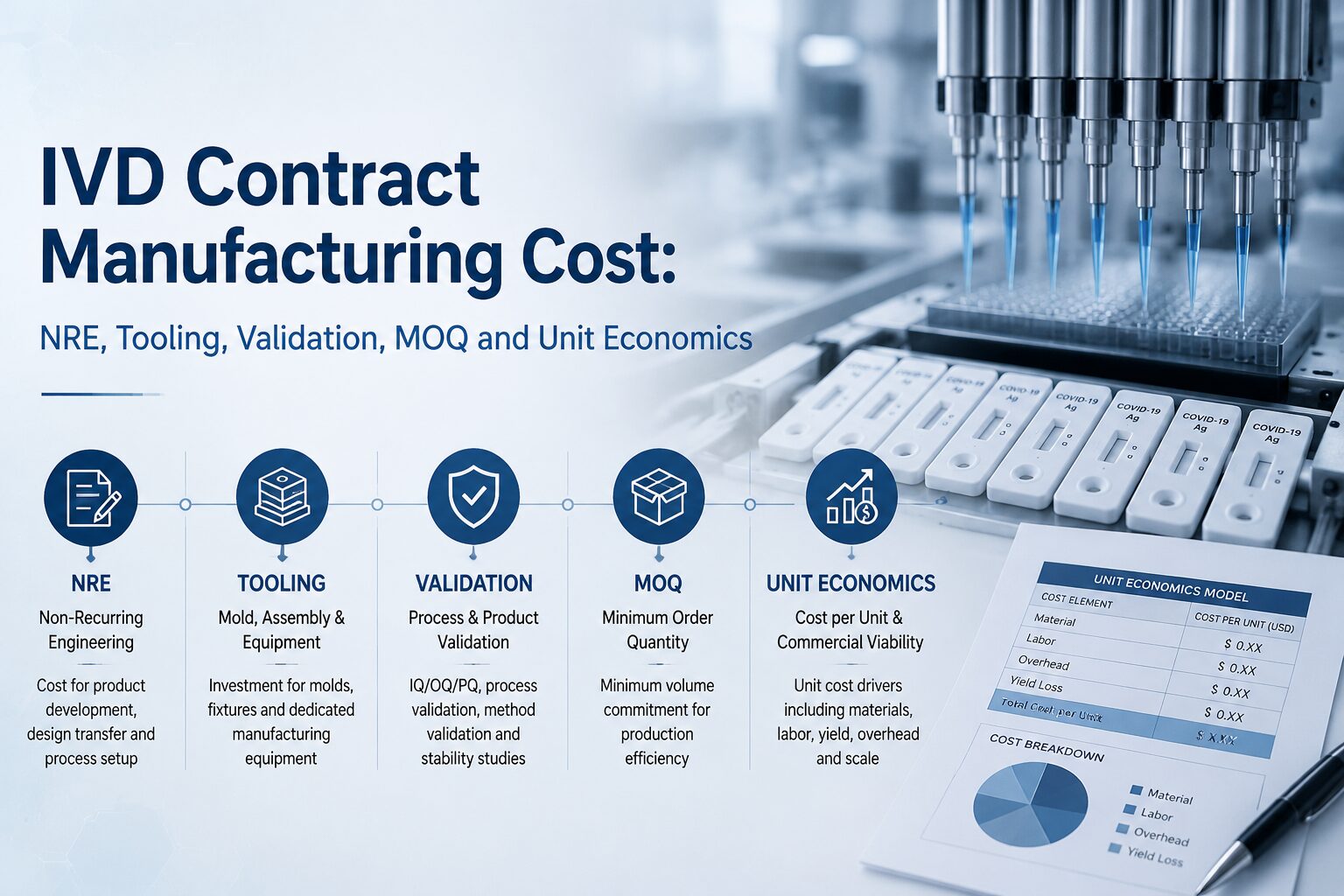
A useful IVD contract manufacturing cost model therefore separates three fundamentally different cost layers:
- One-time launch costs, including NRE, tooling and validation
- Batch-level costs, such as line setup, environmental clearance, QC testing and release
- Unit-level costs, including reagents, consumables, labor, packaging and yield loss
This separation matters. At low commercial volumes, batch costs and amortized launch costs may exceed the direct material cost of the test. At higher volumes, yield, automation, reagent utilization and supplier pricing become the dominant variables.
The objective is not to obtain the lowest nominal price per test. It is to establish the lowest sustainable cost per released, saleable and conforming test over the expected product lifecycle.
Why IVD Manufacturing Costs Are Difficult to Compare
No two contract manufacturing quotations are directly comparable unless they are based on the same scope, assumptions and definition of a finished unit.
One supplier may quote the price of an unpackaged strip. Another may quote a labeled cassette. A third may include controls, calibrators, instructions for use, serialized cartons and batch-release testing. All three may describe their offer as a “cost per test.”
The manufacturing scope may also differ substantially:
- Build-to-print assembly using customer-supplied components
- Reagent filling and packaging
- Assay transfer into an existing manufacturing platform
- Conversion from a laboratory protocol to a controlled production process
- Development of automated or semi-automated equipment
- Finished-device manufacturing and lot release
- Stability management and ongoing performance monitoring
- Procurement, inventory ownership and supply-chain management
- Regulatory documentation or submission support
Before comparing prices, the buyer must define the exact deliverable. A meaningful quotation should identify the manufacturing stage at which responsibility begins and the condition in which the product leaves the contractor.
The Regulatory Baseline Behind the Cost
IVD manufacturing costs cannot be separated from regulatory and quality-system obligations.
In the United States, the FDA’s Quality Management System Regulation became effective on February 2, 2026. The QMSR incorporates ISO 13485:2016 by reference into 21 CFR Part 820. FDA also states that contract manufacturing is considered an extension of the finished-device manufacturer’s process. The finished-device manufacturer retains overall responsibility, while a contract manufacturer is independently responsible for the QMSR requirements applicable to the work it performs. (FDA QMSR; FDA Inspection Program 7382.850)
For products placed on the European market, the IVDR requires performance evaluation to address scientific validity, analytical performance and clinical performance. These activities are not interchangeable with manufacturing process validation, although commercial or validation lots produced by a contract manufacturer may support them. (Regulation (EU) 2017/746)
This distinction is commercially important:
- Manufacturing process validation demonstrates that a production process can consistently meet predetermined requirements.
- Analytical performance studies establish characteristics such as precision, analytical sensitivity, specificity, measuring range and interference.
- Clinical performance studies evaluate whether the device performs as intended in the target clinical context.
- Stability studies support shelf-life, transport, open-vial, in-use or onboard stability claims.
A contract manufacturing proposal may include some, all or none of these activities. The cost responsibility must be stated explicitly.
Typical IVD Contract Manufacturing Cost Structure
The following figures are practical early-stage budgeting envelopes rather than published industry tariffs. Actual costs can be materially lower or several times higher depending on assay complexity, product risk, automation, required markets, transfer readiness and the extent of the contractor’s responsibility.
| Cost element | Indicative planning range | Principal cost drivers |
|---|---|---|
| Technical and quality gap assessment | $5,000–$25,000 | Documentation quality, assay maturity, number of SKUs and manufacturing sites |
| Assay transfer and manufacturing development | $15,000–$100,000+ | Method complexity, optimization requirements, transfer experiments and engineering effort |
| Quality documentation and production record creation | $10,000–$60,000+ | Existing design history, specifications, risk files, work instructions and traceability requirements |
| Fixtures and test equipment | $10,000–$150,000+ | Custom dispensing, alignment, sealing, inspection and test requirements |
| Injection molds or dedicated production equipment | $30,000–$500,000+ | Cavitation, materials, tolerances, automation and equipment qualification |
| Process and test-method validation | $25,000–$250,000+ | Number of processes, product families, lots, operators, shifts and acceptance tests |
| Stability and transport studies | $20,000–$200,000+ | Shelf-life claim, storage conditions, time points, sample quantities and test panel |
| Pilot and engineering builds | $10,000–$100,000+ | Batch size, component cost, destructive testing and number of iterations |
These estimates normally exclude regulatory submission fees, notified-body fees, large clinical performance studies, sponsor labor, freight, customs duties and post-market obligations.
A mature build-to-print project placed on an existing line may require limited one-time expenditure. A new cartridge, reader and reagent platform may require hundreds of thousands or several million dollars before routine commercial production begins.
1. NRE: What the Customer Is Actually Paying For
Non-recurring engineering, or NRE, is the cost of converting a product definition into a repeatable, documented and transferable manufacturing process.
It is often misunderstood as an administrative setup fee. In a well-structured program, NRE pays for specific technical and quality deliverables.
Typical NRE activities
NRE may include:
- Transfer planning and technical gap analysis
- Review of design inputs, outputs and risk controls
- Design-for-manufacturability assessment
- Bill-of-material reconciliation
- Component and supplier qualification
- Conversion of research protocols into controlled work instructions
- Definition of critical material attributes
- Identification of critical process parameters
- Manufacturing flow development
- Equipment and fixture specification
- Pilot build planning and execution
- Test-method transfer
- Sampling-plan development
- Master production record creation
- Operator training
- Traceability configuration
- Label and packaging implementation
- Project management and design-review participation
The amount of NRE is driven less by the apparent simplicity of the test than by the maturity of the transfer package.
A lateral-flow cassette may look simple, but incomplete membrane specifications, undefined dispense tolerances, unstable conjugate preparation or subjective visual inspection criteria can create extensive development work. Conversely, a more complex assay with controlled specifications, verified methods and complete transfer records may be comparatively efficient to industrialize.
What a strong NRE quotation should contain
A line item labeled “NRE: $75,000” is not sufficiently informative. The proposal should define:
- Deliverables
- Review and approval stages
- Acceptance criteria
- Number of included engineering iterations
- Assumptions about customer-supplied documentation
- Responsibility for additional experiments
- Change-order rates
- Ownership of resulting records, methods and fixtures
- Whether the work can support transfer to another site
- Which activities must be repeated for additional SKUs
NRE should be linked to completed outputs rather than elapsed time alone. Milestone-based billing commonly provides better control than a large, non-refundable payment made before the transfer package has been reviewed.
Can NRE be shared across a product family?
Sometimes.
A platform process may support multiple assays using the same cassette, pouch, labeling architecture, equipment and base manufacturing flow. Common elements should not automatically be charged again for every SKU.
However, assay-specific processes may still require separate work. Different reagents, dispense parameters, cutoff logic, storage conditions or risk controls can require additional verification or validation.
The quotation should therefore divide NRE into:
- Platform-level NRE
- Assay-specific NRE
- SKU or packaging-configuration NRE
- Market-specific labeling or documentation NRE
This structure makes future product extensions easier to budget.
2. Tooling: More Than Injection Molds
In IVD manufacturing, tooling can refer to any dedicated physical asset needed to make or test the product consistently.
Product-forming tooling
Examples include:
- Injection molds for cassettes, caps or sample devices
- Thermoforming tools
- Cutting dies
- Pouch or blister sealing tools
- Extrusion dies
- Custom fluidic components
- Optical alignment hardware
Manufacturing fixtures
These may include:
- Dispensing nests
- Membrane or strip alignment fixtures
- Assembly jigs
- Torque-controlled closure fixtures
- Seal-positioning fixtures
- Camera inspection mounts
- Calibration fixtures
- Leak-test adapters
- Electrical or optical test fixtures
A fixture may cost much less than a mold, but it can still be critical to product conformity. It should be controlled, maintained and included in change assessment.
Tooling questions that affect total cost
A complete tooling agreement should address:
- Who owns the tool?
- Where will it be stored?
- Is it dedicated to one customer?
- Who pays for maintenance and repair?
- What production life is warranted?
- How is wear monitored?
- Who owns replacement inserts or duplicate tools?
- Can the tool be transferred to another manufacturer?
- Is the technical documentation sufficient for duplication?
- What happens to the tool when the contract ends?
Paying for a mold does not automatically mean that the customer owns every associated drawing, process parameter, automation interface or piece of manufacturing know-how.
Tooling cost versus unit-cost reduction
Automation and high-cavitation tooling should be justified by released volume, not by optimism.
Break-Even Analysis for Automation Investment
A simple break-even calculation can be used to evaluate whether additional tooling or automation investment is financially justified:
Break-Even Volume =
Incremental Tooling Investment
÷
(Unit Cost Before Automation − Unit Cost After Automation)
Where:
- Incremental Tooling Investment = Additional upfront investment for automation stations, fixtures, molds, or dedicated equipment
- Unit Cost Before Automation = Manufacturing cost per released unit before automation
- Unit Cost After Automation = Manufacturing cost per released unit after automation
For example, if an automated manufacturing station requires a $120,000 investment and reduces manufacturing cost by $0.70 per released unit, the break-even volume can be calculated as:
Break-Even Volume =
$120,000 ÷ $0.70
= 171,429 released units
This means the automation investment would theoretically recover its initial cost after approximately 171,429 released units, excluding other factors such as maintenance costs, depreciation, financing costs, capacity improvement, quality improvement, and reduced labor risk.
This calculation is incomplete unless it also considers:
- Equipment maintenance
- Validation and revalidation
- Yield improvement or deterioration
- Downtime and spare-part requirements
- Product redesign risk
- Cost of capital
- Forecast uncertainty
- Remaining product life
For an early-stage product with uncertain demand, a controlled manual or semi-automated process may produce better economics than premature automation.
3. Validation: The Most Frequently Underestimated Cost
Validation is often discussed as though it were a single event. In practice, an IVD manufacturing program may require several independent but connected validation activities.
Equipment qualification
Dedicated or modified equipment may require documented qualification. A commonly used framework includes:
- Installation qualification: confirmation that equipment and supporting systems have been installed as specified
- Operational qualification: confirmation that the equipment operates across defined ranges
- Performance qualification: confirmation that the process performs as intended under routine production conditions
The terminology and exact protocol structure should be appropriate to the process and applicable quality system. Buying a machine with a supplier certificate does not, by itself, establish that the complete manufacturing process is validated for the specific IVD.
Process validation
Process validation is particularly important where the result cannot be fully verified through subsequent inspection or testing. The manufacturer must establish objective evidence that the process consistently produces output meeting predetermined specifications.
Potentially relevant IVD processes include:
- Reagent formulation and mixing
- Conjugation
- Membrane coating
- Dispensing
- Drying or lyophilization
- Lamination
- Strip cutting
- Cassette assembly
- Heat or ultrasonic sealing
- Filling and closure
- Packaging under controlled humidity
- Sterilization, where applicable
- Software-controlled production operations
Validation cost increases with the number of variables to be challenged: equipment, lots, operators, shifts, environmental conditions, raw-material lots and manufacturing sites.
Test-method validation
A production process is only as measurable as the methods used to assess it.
Test-method validation or verification may be required for:
- Reagent concentration
- Dispense volume
- Line position and intensity
- Seal integrity
- Moisture content
- Optical response
- Functional performance
- Calibration
- Positive and negative agreement
- Dimensional inspection
- Software-generated acceptance decisions
An unvalidated release method can create false confidence. It may accept defective material or reject conforming product, damaging both compliance and unit economics.
Packaging and distribution validation
Packaging is not a cosmetic afterthought for an IVD. It may protect the product from moisture, oxygen, light, contamination, shock or temperature excursions.
Depending on the configuration and claims, work may include:
- Pouch-seal validation
- Package-integrity testing
- Label durability
- Transport simulation
- Temperature-excursion studies
- Desiccant configuration
- Shipping-lane qualification
- Post-distribution functional testing
IVD labeling must carry applicable stability information, and the FDA recognizes stability as part of product validation and expiration dating. (FDA Shelf Life of Medical Devices)
Stability programs
Stability cost is driven by more than the duration of the study. The full cost includes:
- Production of representative lots
- Storage chambers and monitoring
- Multiple time points
- Test samples and controls
- Destructive testing
- Data review and reporting
- Deviations and invalid runs
- Real-time confirmation following accelerated studies
- Reserve samples
- Transport and in-use conditions
- Management of future changes against the established baseline
The cost is incurred gradually, but the sample commitment and operational burden should be planned before the study begins.
How many validation lots are required?
“Three validation lots” is a common industry convention, not a universal answer for every IVD process.
The appropriate number should be justified by risk, process knowledge, variability, product complexity and the amount of supporting evidence. A low-risk packaging change on a mature platform may require a different strategy from the transfer of a novel reagent formulation with limited scale-up history.
The validation plan should define:
- Purpose of each lot
- Lot size
- Material-lot coverage
- Operators and shifts
- Equipment configuration
- Process ranges or worst-case conditions
- Sampling rationale
- Statistical acceptance criteria
- Relationship to stability or performance studies
- Disposition of the resulting product
Validation lots should not automatically be assumed saleable. Their commercial disposition depends on applicable requirements, protocol design, approval status and evidence that they meet all release requirements.
4. MOQ: Why Minimum Order Quantities Exist
A diagnostic manufacturing MOQ is rarely based on the contractor’s convenience alone. It is usually created by several physical and economic constraints.
Raw-material MOQ
Suppliers may impose minimum quantities for:
- Antibodies and antigens
- Primers and probes
- Membranes
- Conjugates
- Buffers and specialty chemicals
- Injection-molded components
- Foil pouches and desiccants
- Printed cartons
- Labels and instructions for use
The contract manufacturer may be able to produce 1,000 kits but still need to purchase packaging for 10,000.
Process batch minimum
Some processes have minimum workable batch sizes due to:
- Mixing-vessel geometry
- Pump dead volume
- Tubing and filter hold-up
- Coating width
- Dispensing-system priming
- Lyophilizer loading
- Environmental setup
- Cleaning requirements
- Line-clearance procedures
These losses can make a very small batch technically possible but economically irrational.
QC and release minimum
Many quality-control costs are incurred per batch rather than per test. Examples include:
- Incoming material release
- Environmental checks
- Functional panels
- Reference materials
- Calibration
- Data review
- Batch-record review
- Retained samples
- Certificate preparation
- Quality-unit release
If release testing costs $7,500 per batch, the allocation is $15 per unit for a 500-unit batch but only $1.50 per unit for a 5,000-unit batch, before accounting for yield.
Commercial MOQ versus economic batch quantity
These terms should not be treated as equivalent:
- Supplier MOQ: the minimum quantity a supplier will sell
- Manufacturing minimum: the smallest quantity the process can reliably produce
- Commercial MOQ: the smallest order the contractor will accept
- Economic batch quantity: the volume that produces an acceptable cost per released unit
- Forecast commitment: the volume the customer agrees to purchase over a defined period
A supplier may offer a low commercial MOQ while charging the customer for excess raw materials separately. The visible order is small, but the financial commitment is not.
How to reduce MOQ without destabilizing the process
Practical approaches include:
- Use stock cartons and labels during early commercialization
- Delay country-specific labeling until the latest controlled stage
- Standardize components across multiple assays
- Use a common platform cassette and pouch
- Separate base-kit production from final configuration
- Accept a longer lead time so demand can be consolidated
- Purchase and own long-lead raw materials
- Use validated semi-automated production before investing in high-speed equipment
- Negotiate annual volume commitments with scheduled releases
- Design packaging around commercially available materials
The objective should be to reduce committed inventory, not merely to negotiate a smaller number printed next to “MOQ.”
5. Building the True IVD Unit Economics Model
The true unit cost should be calculated per released saleable unit, not per unit started.
Released Unit Cost Calculation
A practical model for calculating the true released unit cost is: <div style=”text-align:center; padding:20px; font-size:18px;”>
Released Unit Cost =
(Material Cost + Conversion Cost + Packaging Cost + Batch QC Cost + Scrap Cost + Quality Overhead)
÷ Released Quantity
- Launch Amortization
- Logistics Cost
- Inventory Risk
</div>
Where:
Released Quantity =
Started Quantity × Process Yield × Final Acceptance Yield
Direct material cost
Include all materials consumed, not just those present in the finished device:
- Biological reagents
- Buffers and chemicals
- Membranes or substrates
- Cassettes and housings
- Sample devices
- Tubes and closures
- Controls and calibrators
- Pouches and desiccants
- Labels, cartons and instructions
- Filters, tubing and disposable process consumables
- Material used for line priming
- QC samples and retains
Conversion cost
Conversion may include:
- Direct labor
- Machine time
- Cleanroom or controlled-environment time
- Setup and cleaning
- In-process inspection
- Documentation
- Production supervision
- Utilities
- Routine equipment maintenance
A quoted “assembly cost” may exclude several of these items. The cost basis should be defined.
Yield loss
Yield has a nonlinear effect on cost because rejected units still consume materials, machine time, labor and often QC resources.
Yield should be examined by step:
- Reagent preparation yield
- Dispensing yield
- Strip-cutting yield
- Assembly yield
- Packaging yield
- Final functional acceptance
- Batch-release success
A single headline yield can hide the location and cause of loss. Step-level yield is more useful for both costing and improvement.
Batch-level quality cost
Batch-release cost should be separated from unit-level testing. Otherwise, a quotation based on a large theoretical batch can make low-volume production appear artificially inexpensive.
The model should include:
- Destructive test quantities
- Reference materials
- External laboratory testing
- Quality review
- Retained samples
- Stability pulls
- Invalid test allowance
- Investigation of out-of-specification or atypical results
Inventory and expiry risk
IVD products often combine expensive biological materials with finite shelf life and uncertain demand. Inventory risk can become a major part of unit economics.
Relevant inputs include:
- Raw-material shelf life
- Minimum remaining shelf life at receipt
- Manufacturing lead time
- Required remaining shelf life at customer delivery
- Safety-stock policy
- Forecast accuracy
- Country-specific packaging inventory
- Obsolescence after labeling changes
- Cost of temperature-controlled storage
- Allocation of expired or unused material
A low unit price built around a 12-month purchase commitment may be more expensive than a higher unit price with flexible releases and lower expiry exposure.
Worked Example: How Volume Changes the Cost Per IVD Kit
Consider a hypothetical 20-test immunoassay kit.
Assume:
- Transfer NRE: $60,000
- Tooling and fixtures: $40,000
- Validation: $90,000
- Total launch cost: $190,000
- Variable materials, conversion and packaging: $12.50 per started kit
- Fixed QC and batch-release cost: $7,500 per batch
- Launch cost amortized over three years
The figures below are illustrative and exclude freight, duties, regulatory submissions, clinical studies and commercial overhead.
| Scenario | Low volume | Base case | Scale case |
|---|---|---|---|
| Annual released-kit demand | 3,000 | 12,000 | 60,000 |
| Started batch size | 500 | 2,000 | 5,000 |
| Overall yield | 88% | 92% | 96% |
| Released kits per batch | 440 | 1,840 | 4,800 |
| Variable cost per released kit | $14.20 | $13.59 | $13.02 |
| Batch QC cost per released kit | $17.05 | $4.08 | $1.56 |
| Launch-cost allocation per kit | $21.11 | $5.28 | $1.06 |
| Modeled manufacturing cost per kit | $52.36 | $22.95 | $15.64 |
| Modeled cost per test | $2.62 | $1.15 | $0.78 |
The direct variable cost changes only modestly. The largest improvements come from spreading batch-release and launch costs across more released units.
This is why a low-volume program cannot be evaluated using the high-volume unit price alone.
It also shows where management attention should move as the product scales:
- At low volume, simplify launch scope and control batch-level costs.
- At moderate volume, improve forecast accuracy, batch sizing and yield.
- At high volume, optimize material pricing, automation, cycle time and supply continuity.
Quoted Unit Price Versus Landed Cost
The contract manufacturer’s price is not necessarily the customer’s complete cost of goods.
A landed-cost model may also include:
- Freight
- Dangerous-goods or cold-chain charges
- Insurance
- Customs duty
- Import VAT or tax timing
- Incoming inspection
- Regional relabeling
- Warehousing
- Distributor handling
- Release by a local responsible organization
- Scrap caused by shipping excursions
- Inventory financing
- Warranty and complaint reserves
The pricing basis should also state the applicable Incoterm and transfer of title. A factory-gate quotation should not be compared directly with a delivered and duty-paid price.
How to Normalize Competing IVD Manufacturing Quotes
Before choosing a supplier, convert each quotation into a common cost model.
| Comparison category | Questions to resolve |
|---|---|
| Finished unit | Is the price per strip, cassette, pouch, test, kit or shipping case? |
| Materials | Which materials are included, excluded or supplied by the customer? |
| Procurement | Who owns excess inventory and supplier MOQs? |
| Batch size | What batch size supports the quoted price? |
| Yield | Is pricing based on started units, produced units or released units? |
| QC | Are in-process tests, release tests and retained samples included? |
| Stability | Are stability setup, storage, pulls and reports included? |
| Packaging | Does pricing include labels, IFUs, controls, cartons and serialization? |
| NRE | What deliverables and iterations are included? |
| Tooling | Who owns, maintains and replaces it? |
| Validation | Which equipment, methods and processes are covered? |
| Price adjustment | How are material inflation, currency and low-volume changes handled? |
| Lead time | Does the quoted lead time begin at purchase order, material receipt or forecast lock? |
| Change control | What changes require customer approval or notification? |
| Transfer-out | What records, tools and support will be provided if manufacturing moves? |
A normalized model often reveals that the lowest quoted unit price carries the highest inventory commitment or the least complete validation scope.
Cost-Reduction Strategies That Do Not Compromise Quality
Reducing IVD contract manufacturing cost should begin before commercial production.
Freeze the intended use and product requirements early
Late changes to specimen type, cutoff, packaging, shelf-life claim or target market can invalidate completed work. Regulatory and commercial requirements should be aligned before expensive tooling and validation begin.
Transfer a complete technical package
A transfer package should contain controlled specifications, methods, acceptance criteria, risk information, known process sensitivities and development history. Missing knowledge does not disappear during outsourcing; it reappears as NRE, delays, deviations or yield loss.
Complete DFM before cutting production tooling
Minor changes to cassette geometry, material selection, label placement or assembly tolerance can materially improve manufacturability. These changes are inexpensive before tooling and costly afterward.
Use platform architecture deliberately
Common cassettes, packaging, production methods and software can reduce tooling, validation and inventory costs across an assay family. Platform claims must still be supported; “same equipment” does not automatically mean “same validated process.”
Combine pilot, validation and stability planning
Where scientifically and regulatorily appropriate, representative lots can be planned to support multiple objectives. This requires advance agreement on materials, process state, protocols, sample quantities and lot disposition.
Producing lots first and deciding how to use them later often results in repeated work.
Focus improvement on cost per released unit
A faster line is not necessarily a lower-cost line. The best improvement may be better reagent recovery, fewer invalid results, improved sealing consistency or reduced batch-release burden.
Establish volume bands
Pricing should be modeled at several realistic annual and batch volumes rather than one aspirational forecast. For example:
- Launch volume
- Expected base volume
- Upside volume
- Demand-shortfall case
Each band should state batch size, lead time, material commitment and price.
Commercial and Quality Terms That Affect Long-Term Cost
The manufacturing agreement can be as important as the original quotation.
Key provisions should address:
- Quality responsibilities
- Audit rights
- Record access and retention
- Material and supplier changes
- Deviation and nonconformance handling
- CAPA responsibilities
- Complaint investigation support
- Yield measurement
- Scrap allocation
- Rework authorization
- Batch-release authority
- Forecast and purchase commitments
- Safety stock
- Price escalation
- Business continuity
- Subcontractor approval
- Intellectual-property ownership
- Tooling ownership
- Transfer assistance
- Termination inventory
- Regulatory inspection support
Under the FDA’s current inspection approach, written agreements may be reviewed to understand how the finished-device manufacturer and contract manufacturer have divided their activities. A quality agreement allocates work; it does not eliminate either party’s applicable regulatory responsibility.
Warning Signs in an IVD Manufacturing Proposal
A low quotation deserves additional scrutiny when it contains any of the following:
- One unit price with no stated batch volume
- NRE without defined deliverables
- Validation described only as “included”
- No distinction between process validation and performance studies
- No yield assumption
- Pricing based on started rather than released units
- Tooling charges without ownership terms
- No policy for excess or expired materials
- No allowance for retained and stability samples
- Supplier substitutions permitted without notification
- Unusually short transfer schedules
- No test-method transfer plan
- No change-control process
- No transfer-out provision
- A very low MOQ paired with large material prepayments
These points do not automatically indicate an unsuitable supplier. They indicate that the commercial model is incomplete.
Questions to Ask Before Requesting a Final Quote
A buyer should be able to answer the following questions:
- What exactly constitutes one saleable unit?
- Which markets and regulatory pathways are planned?
- Is the assay design frozen?
- Is the transfer package complete and controlled?
- Which components are customer-specified?
- Which materials are single-source or long-lead?
- What shelf life and storage condition are required?
- What is the expected launch volume?
- What is the expected three-year volume?
- What is the acceptable batch size?
- Which tests are required for release?
- Who owns raw materials and excess packaging?
- What validation evidence already exists?
- Which manufacturing changes require customer approval?
- Who will own tooling, records and transferred methods?
If these questions are unanswered, the initial quote should be treated as a feasibility estimate rather than a committed commercial price.
Frequently Asked Questions
How much does IVD contract manufacturing cost?
A mature build-to-print project may require relatively limited setup expenditure, while a full assay transfer with custom tooling, validation and stability work can require several hundred thousand dollars before routine production. Instrument-and-assay systems can require substantially more. The cost depends on transfer readiness, product architecture, regulatory scope, automation and volume.
What is NRE in IVD manufacturing?
NRE is the one-time engineering and quality work required to establish the manufacturing process. It may include gap assessment, assay transfer, DFM, process development, documentation, fixture design, pilot builds, test-method transfer and project management.
Why do IVD manufacturers require an MOQ?
MOQs arise from raw-material purchasing requirements, process dead volume, equipment setup, line clearance, packaging print quantities and batch-level QC costs. A smaller order may be possible, but it can create a much higher cost per released test.
Is validation included in the unit price?
Usually not in full. Routine production controls may be included, but equipment qualification, process validation, test-method validation, packaging validation, stability studies and regulatory performance studies are often quoted separately. The proposal should define each activity.
How many lots are needed for IVD process validation?
There is no universally correct number for every product and process. The validation strategy should be justified using product risk, process variability, prior knowledge, equipment configuration, operator coverage and applicable regulatory expectations. Three consecutive lots are common, but they should not be applied without a scientific rationale.
How should NRE and tooling be amortized?
For commercial modeling, one-time costs can be divided by the expected released volume over a defined period. However, amortization does not change the cash required at launch. Financial planning should show both cash expenditure and amortized product cost.
What is the most important number in an IVD manufacturing quote?
The most useful number is the total cost per released, saleable unit at a realistic batch size and annual volume. It should include yield loss, batch-release cost, launch-cost allocation, material commitments and inventory exposure.
Conclusion
A reliable IVD contract manufacturing cost assessment requires more than comparing prices per test.
NRE determines whether the assay can be transferred into a controlled production system. Tooling determines how consistently and efficiently the product can be made. Validation provides objective evidence that the process performs as required. MOQ reflects the physical and economic realities of materials, equipment and batch release. Unit economics then brings these elements together at the level that matters commercially: the cost per released, saleable test.
The strongest manufacturing proposal is not necessarily the one with the lowest headline price. It is the one that makes its assumptions visible, assigns responsibilities clearly and remains economically credible under realistic demand, yield and shelf-life conditions.
For IVD developers, the most valuable question is therefore not, “What is your price per test?”
It is:
“What will our complete cost per released test be at each realistic stage of commercialization—and which assumptions could change it?”
Regulatory requirements vary by product, intended use and target market. Product-specific regulatory, quality and legal advice should be obtained before finalizing a manufacturing or validation strategy.
Author Profile

- Written by the IVDCDMO technical and regulatory team, with expertise in diagnostic assay development, GMP manufacturing, ISO 13485 systems, and global IVD commercialization for biotech innovators worldwide.
Latest entries
 Assay DevelopmentSeptember 23, 2026CDMO Custom Development of Test Kits: From Assay Concept to Scalable IVD Manufacturing
- IVD ManufacturingJuly 24, 2026Manufacturing for IVD Products: From Assay Transfer to Reliable Commercial Supply
- IVD ManufacturingJuly 13, 2026IVD Contract Manufacturing Cost: NRE, Tooling, Validation, MOQ and Unit Economics
- KnowledgeJuly 6, 2026IVD CDMO vs CRO vs CMO: Which Partner Do You Need at Each Development Stage?