The global in vitro diagnostics (IVD) sector is undergoing profound shifts driven by breakthrough technologies, tightened global regulatory frameworks, rising demand for personalized care, and relentless market pressure to compress product development timelines. For diagnostic developers—ranging from early-stage startups and biotech innovators to established medical device enterprises and international brands expanding into new territories—building end-to-end in-house capabilities for R&D, production, quality management, clinical operations and regulatory compliance has become prohibitively costly, operationally complex and resource-intensive.
Against this backdrop, the IVD Contract Development and Manufacturing Organization (CDMO) has evolved from a simple outsourcing option into a core strategic partner across the industry. Specialized IVD CDMOs enable clients to translate novel diagnostic ideas into market-ready commercial products, while effectively mitigating technical and operational risks, cutting capital expenditure and accelerating time-to-market.
This white paper systematically elaborates on the fundamentals of the IVD industry, the full lifecycle workflow of IVD CDMO services, the core value of partnering with a professional CDMO, and the competitive strengths that have established China as a leading global hub for IVD CDMO. It also delivers practical guidance for partner selection and insights into the long-term development trends of the sector.
1. Fundamentals of In Vitro Diagnostics (IVD)
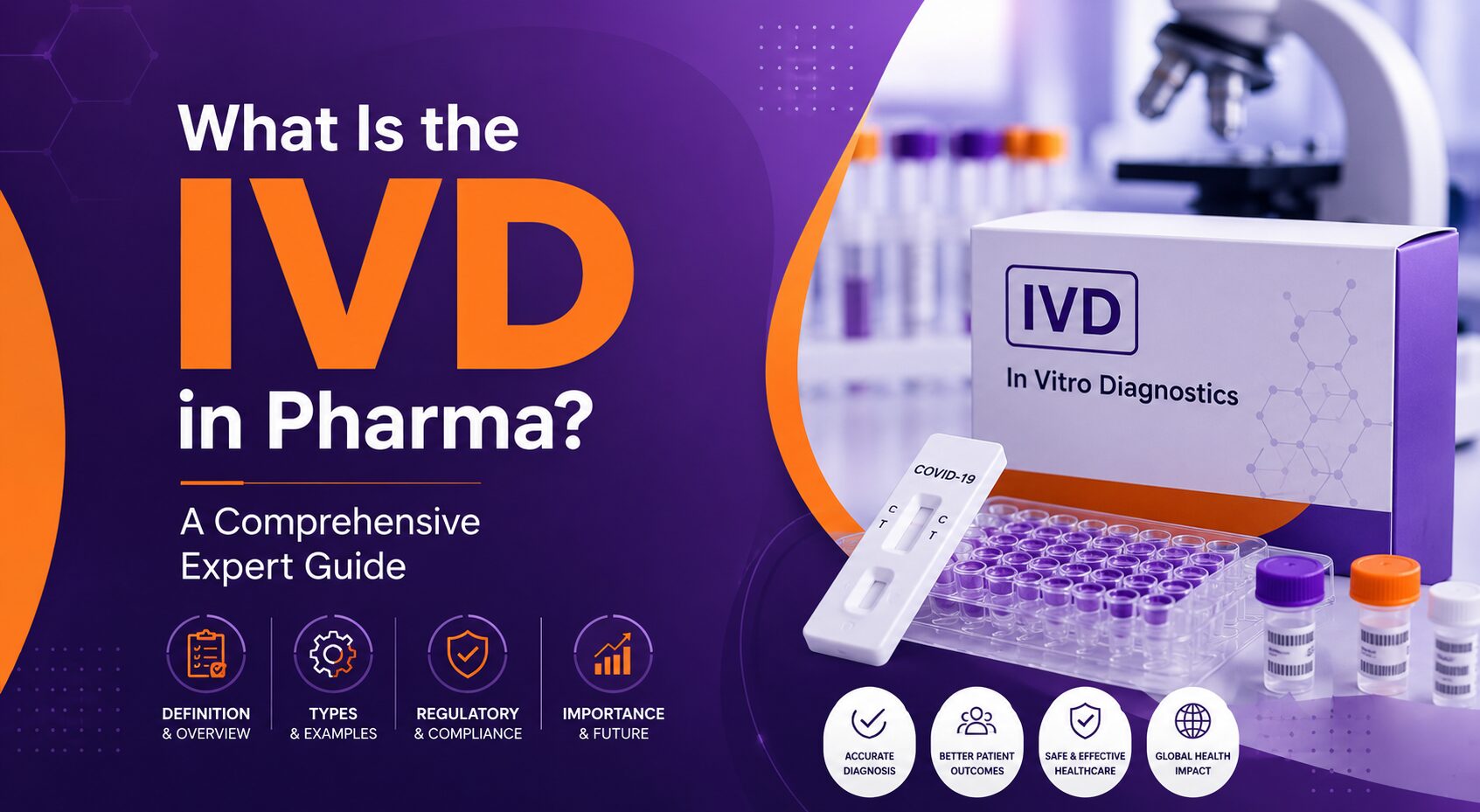
In vitro diagnostics refers to medical testing conducted on human specimens including blood, serum, plasma, urine, saliva and tissue samples. Unlike therapeutic drugs and medical treatments, IVD assays deliver objective diagnostic evidence to support clinical judgment, disease screening, diagnosis, prognosis and treatment monitoring.
Driven by clinical needs and technological iteration, mainstream IVD technical platforms widely applied in clinical and commercial settings are listed below:
- Enzyme-Linked Immunosorbent Assay (ELISA)
- Chemiluminescent Immunoassay (CLIA)
- Fluorescence Immunoassay (FIA)
- Lateral Flow Assays (LFA)
- PCR & Molecular Diagnostic Tests
- Nucleic Acid Amplification Tests (NAAT)
- Next-Generation Sequencing (NGS)
- Clinical Chemistry Assays
- Hematology Diagnostics
- Point-of-Care Testing (POCT)
All IVD products rely on sophisticated reagent formulation, high-quality biological raw materials, robust quality control systems, standardized manufacturing procedures, comprehensive validation protocols and complete regulatory documentation. Every link across the industrial chain directly determines product performance, consistency and market compliance.
2. Definition & Core Scope of IVD CDMO
An IVD CDMO is a professional service provider delivering integrated one-stop solutions covering the entire lifecycle of diagnostic products, from early-stage development through to large-scale commercial manufacturing.
Rather than engaging multiple scattered vendors for separate workstreams, diagnostic companies can collaborate with a single CDMO to manage all key links: product development and assay optimization, reagent formulation, raw material procurement, analytical validation, pilot production, manufacturing scale-up, full quality management, clinical trial support, regulatory dossier compilation and commercial volume production.
This cooperation model allows IVD product owners to fully focus on core strengths such as technological innovation, brand building and market expansion, while leveraging the CDMO’s accumulated technical know-how, mature production facilities and professional talent teams to resolve industrialization and compliance challenges.
CDMO vs. CRO: Key Distinction
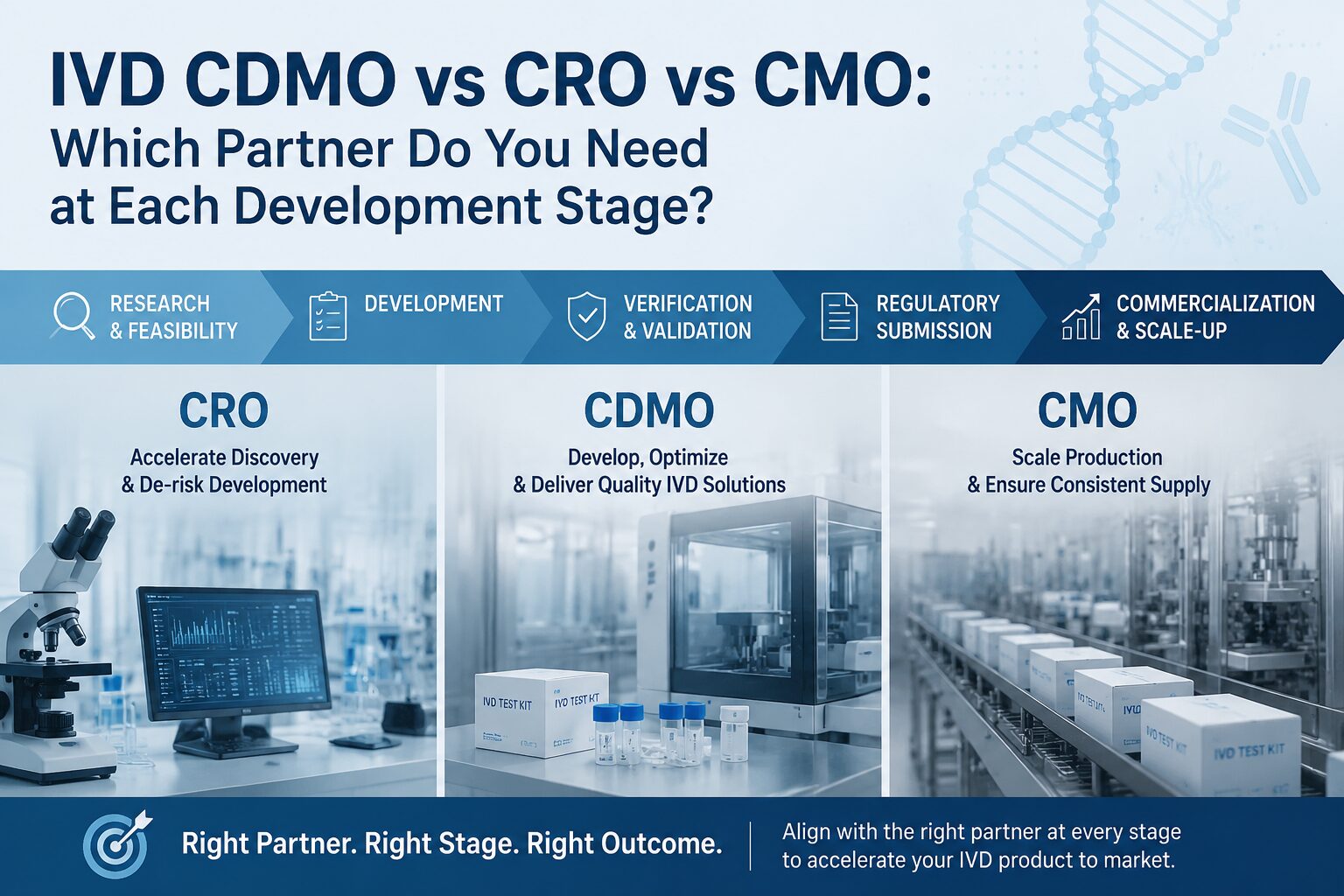
It is critical to differentiate between CDMO and Contract Technology Organization (CRO) in the IVD ecosystem. A CRO primarily focuses on laboratory research, analytical testing and clinical trial execution. An IVD CDMO, by contrast, extends capabilities to process development, manufacturing scale-up and sustained commercial production, serving as the bridge connecting laboratory research and industrialized commercial supply.
2.1 End-to-End IVD CDMO Service Matrix
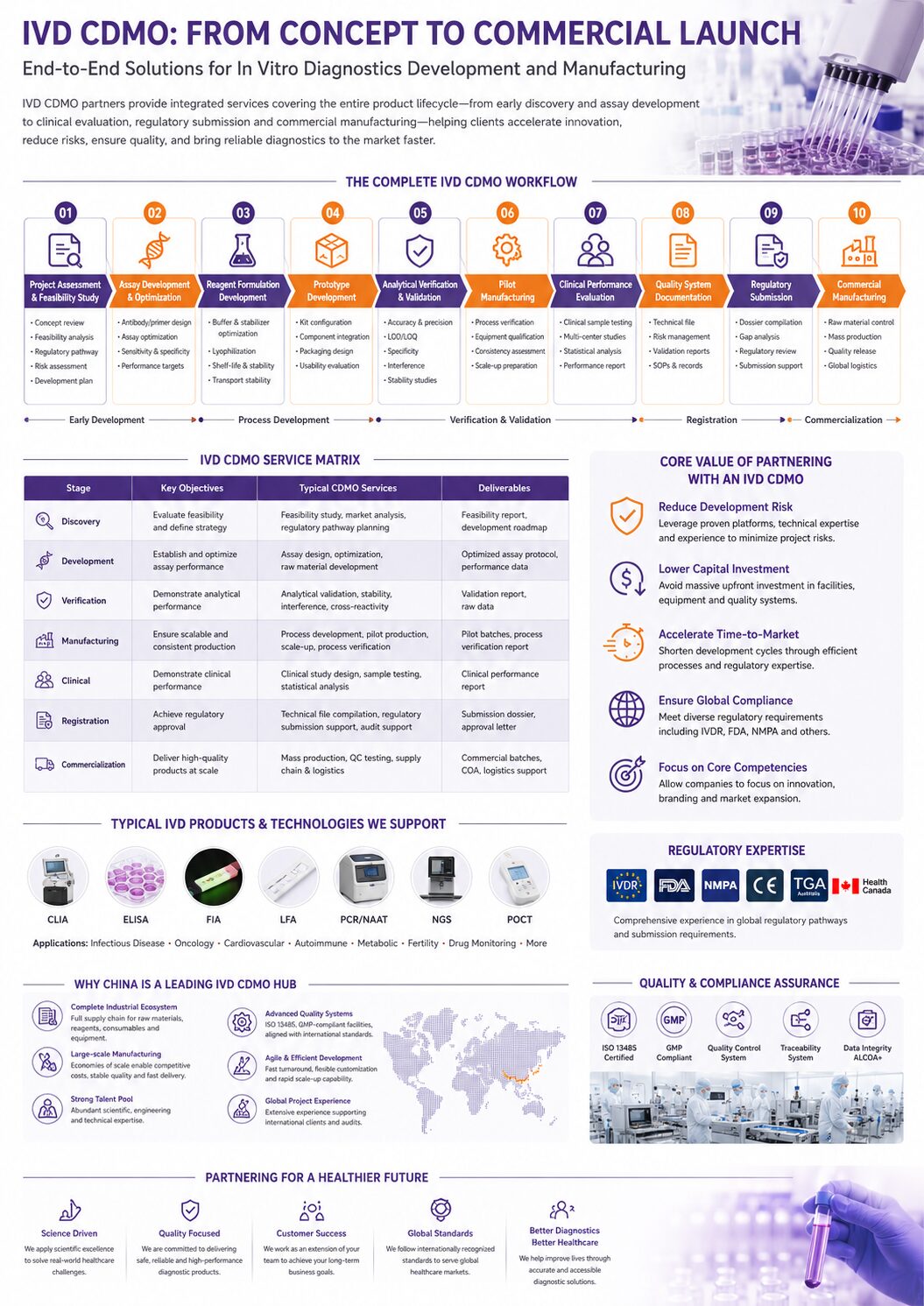
The following matrix clearly maps project stages to corresponding CDMO deliverables, covering the full lifecycle from early discovery to steady commercial supply. This structured service framework aligns with global IVD industrial practices and regulatory requirements.
| Project Stage | Typical CDMO Services |
|---|---|
| Discovery | Feasibility Study, Technical Risk Assessment, Regulatory Pathway Planning |
| Development | Assay Design, Performance Optimization, Raw Material Development |
| Verification | Analytical Validation, Performance Testing, Stability Evaluation |
| Manufacturing | Pilot Production, Process Scale-up, Production Process Verification |
| Clinical | Clinical Sample Testing, Multi-center Trial Support, Statistical Analysis |
| Registration | Regulatory Dossier Compilation, Gap Analysis, Audit Readiness |
| Commercialization | Mass Production, Batch Release, Supply Chain & Logistics Support |
3. Why IVD Commercialization Is So Challenging
Many investors and technical teams underestimate the complexity of turning a lab-proven IVD prototype into a compliant, commercially sustainable product. Unlike general laboratory research, IVD industrialization is a highly coupled system where every single process link determines the final success or failure of the entire project.
Take mainstream CLIA (Chemiluminescent Immunoassay) products as a typical example. A qualified commercial CLIA reagent requires seamless breakthroughs across multiple core technical and production modules: antibody development and high-efficiency pairing, luminescent marker conjugation technology, magnetic particle coating and modification, multi-component buffer system optimization, lyophilization (freeze-drying) process design, long-term stability control under transportation and storage conditions, batch-to-batch production consistency, large-scale clinical performance verification, and full-set regulatory registration documentation.
Any deficiency in antibody activity, unstable conjugation efficiency, inconsistent magnetic particle performance, flawed buffer formulas or unqualified stability will directly lead to substandard assay sensitivity, specificity or repeatability. In severe cases, the entire R&D and industrialization project will be terminated.
Molecular diagnostics, POCT and high-end multiplex assays face similar or even higher technical and production barriers. Such high systemic complexity explains why most IVD startups and technology teams struggle with independent industrialization, and why professional CDMO partners have become an indispensable choice to defuse technical and operational risks.
4. Core Rationale for Partnering with an IVD CDMO
Industry players across the globe increasingly opt for CDMO collaboration, driven by four tangible business and operational advantages.
4.1 Mitigate Technical and Industrialization Risks
IVD product development is a cross-disciplinary endeavor that integrates immunology, molecular biology, biochemistry, clinical medicine, biostatistics, regulatory affairs and production engineering.
A common industry pain point is that many promising laboratory-level technologies fail to achieve commercial success, not due to flawed scientific principles, but because teams lack experience in translating lab-scale experiments into stable, repeatable industrial processes. Experienced IVD CDMOs possess proven development methodologies and rich industrialization experience, effectively identifying and resolving potential technical barriers in advance to lower project failure risks.
4.2 Substantial Reduction of Capital Investment
Constructing a full in-house IVD production system requires massive upfront investment. Enterprises need to establish ISO 13485-aligned quality management systems, build GMP-compliant production facilities and cleanrooms, procure automated production lines and testing equipment, and assemble dedicated validation and regulatory teams.
For most developers, tens of millions of dollars in fixed investment are required before any product generates revenue. The CDMO model converts high fixed capital costs into flexible operational expenses, helping enterprises allocate funds to R&D and market expansion more rationally.
4.3 Accelerate Time-to-Market
In the highly competitive IVD market, launch timeline directly determines market share and revenue potential. Bringing a qualified product to market even six months ahead of competitors can create significant first-mover advantages.
Professional CDMOs come with pre-built quality systems, fully validated production workflows, stable supplier networks, seasoned regulatory specialists and accessible clinical resources. These existing assets greatly streamline project progress and shorten overall development cycles.
4.4 Ensure Compliance with Global Regulatory Requirements
IVD regulatory rules worldwide are continuously updated and becoming more stringent. Major regulatory regimes include EU IVDR, U.S. FDA regulations, Health Canada provisions, Australia TGA requirements and China NMPA guidelines.
The implementation of the European IVDR has significantly increased technical documentation, clinical evidence, and post-market surveillance requirements, further driving demand for experienced IVD CDMO partners. The new rules raise the threshold for technical files, raw material traceability, clinical performance evidence and post-market surveillance. Many small and mid-sized IVD developers lack the manpower and experience to cope with the upgraded compliance standards, which further pushes them to outsource full-lifecycle services to professional CDMOs.
Navigating varying regional compliance standards poses a major challenge for many technology-focused developers. IVD CDMOs with international project experience can compile standard technical files, validation reports, risk assessment documents and production records that meet local submission requirements, supporting smooth regulatory review and approval.
5. End-to-End IVD CDMO Project Lifecycle
A standardized IVD CDMO project follows a rigorous, phased workflow from initial project docking to formal commercial supply. Each stage has clear deliverables and quality control gates.
Phase 1: Project Assessment & Feasibility Study
All projects start with in-depth technical and commercial due diligence. The team conducts a comprehensive review of the client’s product concept, intended use and target positioning, alongside market benchmarking, regulatory pathway analysis and systematic risk evaluation.
The core objective of this phase is to verify whether the proposed diagnostic product is technically viable for industrialization and commercially sustainable.
Key deliverables: Feasibility assessment report, detailed development roadmap, phased timeline and preliminary budget quotation.
Phase 2: Assay Development & Performance Optimization
Upon confirmation of project feasibility, formal scientific development commences. Work varies by product technical platform:
- Immunoassay products: Antibody screening and pairing, antigen characterization, signal system optimization and conjugate process development.
- Molecular diagnostic products: Primer and probe design, amplification system tuning and analytical sensitivity optimization.
All development work targets core performance indicators: sensitivity, specificity, precision, accuracy, linearity and long-term stability.
Phase 3: Reagent Formulation Development
Reagent formulation is widely recognized as one of the most challenging segments in IVD industrialization. Formulas that perform stably in laboratory settings often suffer from performance degradation during mass production or long-term storage.
This stage covers buffer system optimization, preservative and stabilizer screening, lyophilization (freeze-drying) formula development, shelf-life improvement and transportation stability verification. The ultimate goal is to create robust, reproducible formulations adapted for large-scale manufacturing.
Phase 4: Product Prototype Development
The optimized assay and formulas are integrated into complete test kit prototypes. Work includes overall kit configuration, assembly of all components, packaging design and user operation flow verification, as well as preliminary stability testing. Qualified prototypes serve as the baseline for subsequent full validation work.
Phase 5: Analytical Verification & Validation
Prior to clinical evaluation, comprehensive analytical performance verification and validation must be completed in accordance with regulatory requirements.
Standard testing items include accuracy, precision, repeatability, intermediate precision, limit of detection, limit of quantitation, cross-reactivity and anti-interference capability, as well as full stability studies. This phase generates the bulk of technical documentation required for later regulatory submissions.
Phase 6: Pilot Manufacturing
Pilot production acts as a critical transition link between laboratory development and formal commercial manufacturing.
During this stage, teams complete production process verification, equipment qualification and consistency assessment of trial batches, while refining standard operating procedures and production records. Most scalability and process adaptability issues are identified and resolved in pilot production to avoid risks in formal volume manufacturing.
Phase 7: Clinical Performance Evaluation
Clinical evaluation verifies that the product delivers consistent and reliable performance in real clinical scenarios. Typical activities include clinical specimen testing, comparative studies against reference products, multi-center clinical trials and statistical data analysis to compile formal clinical performance reports.
Specific trial scope and standards differ based on product category and the target regulatory jurisdiction.
Phase 8: Compilation of Full Quality System Documentation
A complete technical dossier is assembled by consolidating all preceding data and records, including design history files (DHF), device master records, risk management documents, validation reports, formal production procedures and change control records.
Complete, traceable documentation is a prerequisite for regulatory review and future official audits.
Phase 9: Regulatory Submission Support
The CDMO team provides end-to-end regulatory services, including technical file sorting and gap analysis, professional regulatory consultation, preparation of complete submission packages and pre-audit guidance, to maximize the efficiency of regulatory approval.
Phase 10: Commercial Manufacturing & Continuous Supply
After obtaining market approval, the project enters formal commercial production. Daily operations cover raw material sourcing and incoming inspection, batch production, filling, assembly, packaging, labeling and final quality release. Stable batch-to-batch consistency and on-time delivery become the core management priorities throughout commercial production.
6. China: A Global Core Hub for IVD CDMO
Over the past two decades, China has built one of the most complete, mature industrial ecosystems for IVD worldwide, evolving into a preferred destination for global clients seeking IVD CDMO services. Its comprehensive competitive advantages are reflected in five dimensions.
6.1 Fully Integrated Industrial Supply Chain
China boasts full-spectrum supporting capabilities across the entire IVD upstream and downstream chain, including antibody and recombinant protein production, diagnostic enzymes, magnetic microspheres, plastic consumables, automated production equipment and packaging materials. A highly clustered supply chain effectively shortens procurement cycles and controls overall production costs.
6.2 Large-Scale Manufacturing Capacity
Thousands of life science and medical device enterprises have gathered in China’s IVD industrial clusters, forming obvious economies of scale. Large-volume production capacity supports lower unit costs, more flexible production scheduling and faster response to client order demands.
6.3 Abundant Professional Talent Pool
China outputs a large number of graduates and practitioners majoring in biotechnology, molecular biology, biomedical engineering, clinical laboratory science and related disciplines every year. This solid talent base guarantees sufficient manpower for both innovative R&D and standardized industrial execution.
6.4 Mature and Internationally Aligned Quality Systems
Leading domestic IVD CDMO providers have fully implemented ISO 13485 quality management systems and GMP production specifications. Many production sites have passed on-site audits by overseas regulators, and are fully capable of undertaking projects compliant with FDA and EU quality requirements.
6.5 Agile Development and Scale-Up Capabilities
Compared with traditional manufacturing regions, Chinese IVD CDMOs feature faster prototype iteration, stronger customized service capabilities, shorter engineering cycles and more efficient production scale-up. These strengths make them highly attractive for emerging diagnostic enterprises with agile project demands.
7. Guidelines for Selecting a Qualified IVD CDMO Partner
Supplier selection for IVD CDMO cooperation is a strategic decision, which should never be based on price alone. Enterprises are advised to evaluate potential partners against the following core criteria:
- Core Technical Competence Verify professional experience in corresponding technical platforms, including immunoassays, molecular diagnostics and customized platform development capabilities.
- Quality Management System Confirm valid ISO 13485 certification, standardized GMP production environment and complete product full-lifecycle traceability mechanisms.
- Global Regulatory Experience Review track records of supporting FDA, EU IVDR and other international registration projects, as well as familiarity with regional regulatory differences.
- Manufacturing Capacity & Scalability Assess pilot scale production conditions, large-batch scale-up experience and supply chain management capabilities to match long-term order demands.
- Long-Term Cooperation Compatibility Excellent IVD projects require sustained collaboration. Prioritize partners with consistent service philosophy, stable core teams and willingness to build long-term strategic partnerships, rather than purely transactional cooperation.
8. Future Trends Reshaping IVD CDMO
Looking ahead, the global IVD CDMO landscape is being reshaped by cutting-edge technologies, evolving clinical demands and unified global regulatory rules. The industry is stepping into a more intelligent, precise and interconnected era, with seven core trends leading development:
8.1 AI-assisted assay design
Artificial intelligence is widely applied in antibody pairing, primer/probe design, formula screening and performance prediction. It shortens R&D cycles, reduces repeated trial work and improves the success rate of assay development, becoming a standard capability for high-end CDMOs.
8.2 Digital quality management systems
Electronic quality management systems (eQMS) are replacing traditional paper-based documents, realizing full lifecycle digital traceability, automated deviation handling and audit-ready records. This system fully adapts to strict requirements of ISO 13485, FDA and EU IVDR, and has become a core competitiveness for international-oriented CDMOs.
8.3 Companion diagnostics
Driven by precision medicine, companion diagnostics (CDx) supporting targeted therapy continue to expand. CDMOs need to provide customized development, small-batch flexible production and dedicated regulatory services for CDx products, opening up a high-value service segment.
8.4 Multi-omics diagnostics
Integrated detection of genomics, transcriptomics, proteomics and metabolomics has gradually moved from scientific research to clinical application. Multi-omics assays feature complex processes and high technical thresholds, which rely heavily on professional CDMOs for industrialization and batch production.
8.5 Decentralized testing
POCT, home-use diagnostics and field rapid testing gain growing popularity worldwide. Corresponding miniaturization, portable design and special stability requirements bring new challenges and service demands to CDMO production and formulation development.
8.6 Automation & robotics
Full-process automated production lines and robotic operation are popularized in IVD workshops. They effectively lift production efficiency, guarantee batch consistency and reduce manual errors, and will become the standard configuration for large-scale commercial CDMO bases.
8.7 Global regulatory convergence
Regional regulatory rules are gradually converging in terms of quality standards, validation requirements and documentation specifications. Experienced CDMOs with cross-regional compliance capabilities will occupy a dominant position in the global market.
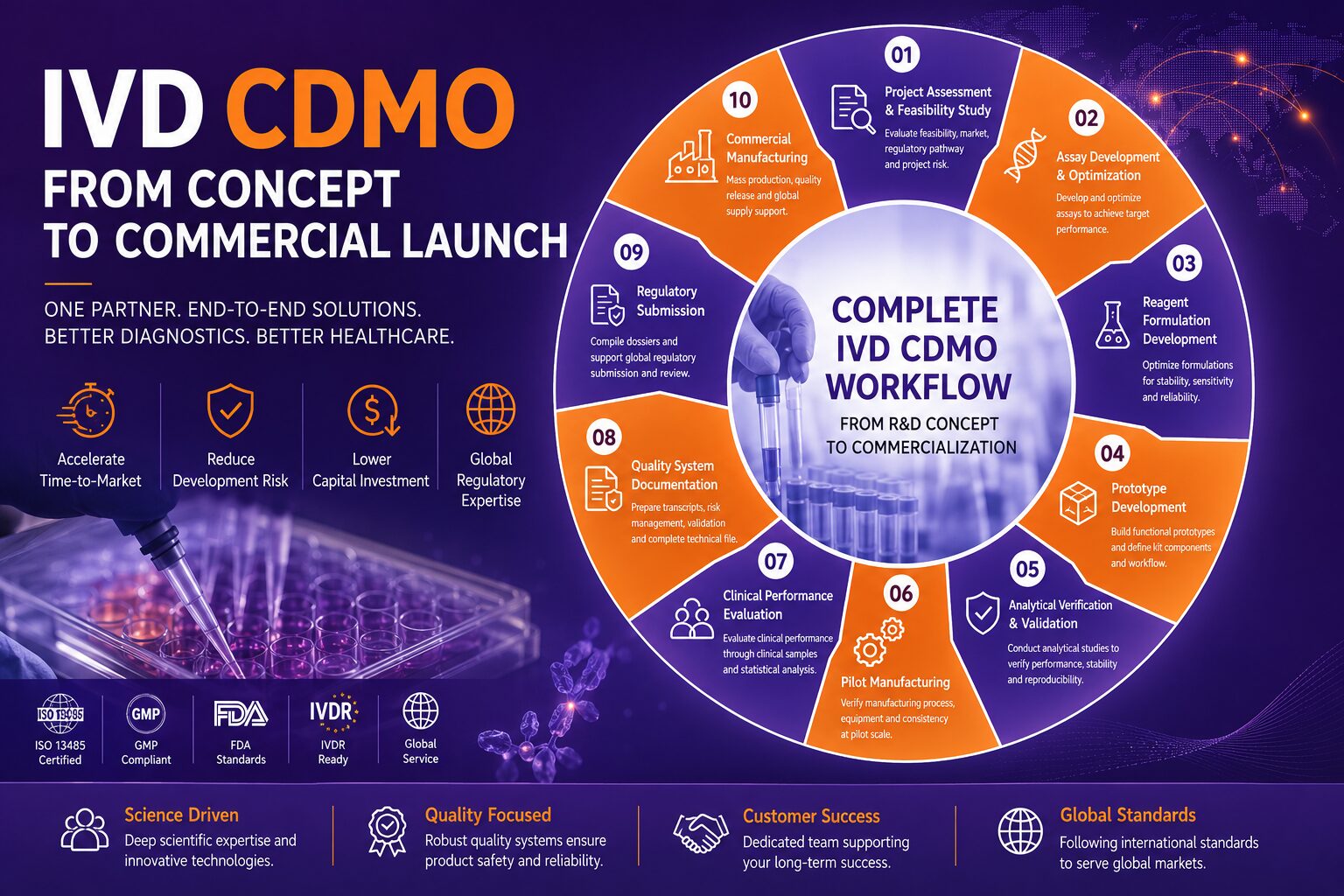
IVD CDMO services have moved beyond simple manufacturing outsourcing, and become an indispensable strategic link in the global diagnostic industry chain. By integrating assay development, reagent formulation, production, quality control, clinical support and regulatory services into a unified workflow, CDMOs help diagnostic enterprises cut risks, compress development cycles and optimize operational efficiency.
For biotech startups, established diagnostic brands and global medical institutions, partnering with an experienced IVD CDMO is a reliable path to accelerate the commercialization of innovative products.
Supported by a complete industrial chain, robust manufacturing capacity, standardized quality systems and professional service teams, China’s IVD CDMO ecosystem will continue to act as a key engine driving global diagnostic innovation, manufacturing upgrading and stable supply chain operation in the years to come.
Frequently Asked Questions (FAQ)
Q1: What is the full name of IVD CDMO?
A1: IVD CDMO stands for In Vitro Diagnostics Contract Development and Manufacturing Organization. It delivers integrated services covering the development, manufacturing, quality control and regulatory compliance of in vitro diagnostic products.
Q2: What is the main difference between CDMO and CRO in the IVD industry?
A2: A CRO focuses primarily on research, analytical testing and clinical trial services. A CDMO takes charge of product process development and commercial manufacturing, covering the full chain from R&D to mass production.
Q3: Why do IVD companies choose to outsource work to CDMOs?
A3: The main purposes are to reduce R&D and production costs, gain access to specialized technical expertise, speed up product launch, and lower risks related to industrialization and regulatory compliance.
Q4: What services are included in a standard IVD CDMO project?
A4: The full scope includes assay development and optimization, reagent formulation, performance validation, pilot production, clinical trial support, regulatory document compilation and commercial volume manufacturing.
Q5: Why has China become a major global IVD CDMO hub?
A5: China features a highly integrated supporting supply chain, large-scale manufacturing infrastructure, sufficient professional talent, cost advantages, as well as increasingly mature quality and international regulatory service capabilities.
Author Profile

- Written by the IVDCDMO technical and regulatory team, with expertise in diagnostic assay development, GMP manufacturing, ISO 13485 systems, and global IVD commercialization for biotech innovators worldwide.
Latest entries
 Assay DevelopmentSeptember 23, 2026CDMO Custom Development of Test Kits: From Assay Concept to Scalable IVD Manufacturing
- IVD ManufacturingJuly 24, 2026Manufacturing for IVD Products: From Assay Transfer to Reliable Commercial Supply
- IVD ManufacturingJuly 13, 2026IVD Contract Manufacturing Cost: NRE, Tooling, Validation, MOQ and Unit Economics
- KnowledgeJuly 6, 2026IVD CDMO vs CRO vs CMO: Which Partner Do You Need at Each Development Stage?