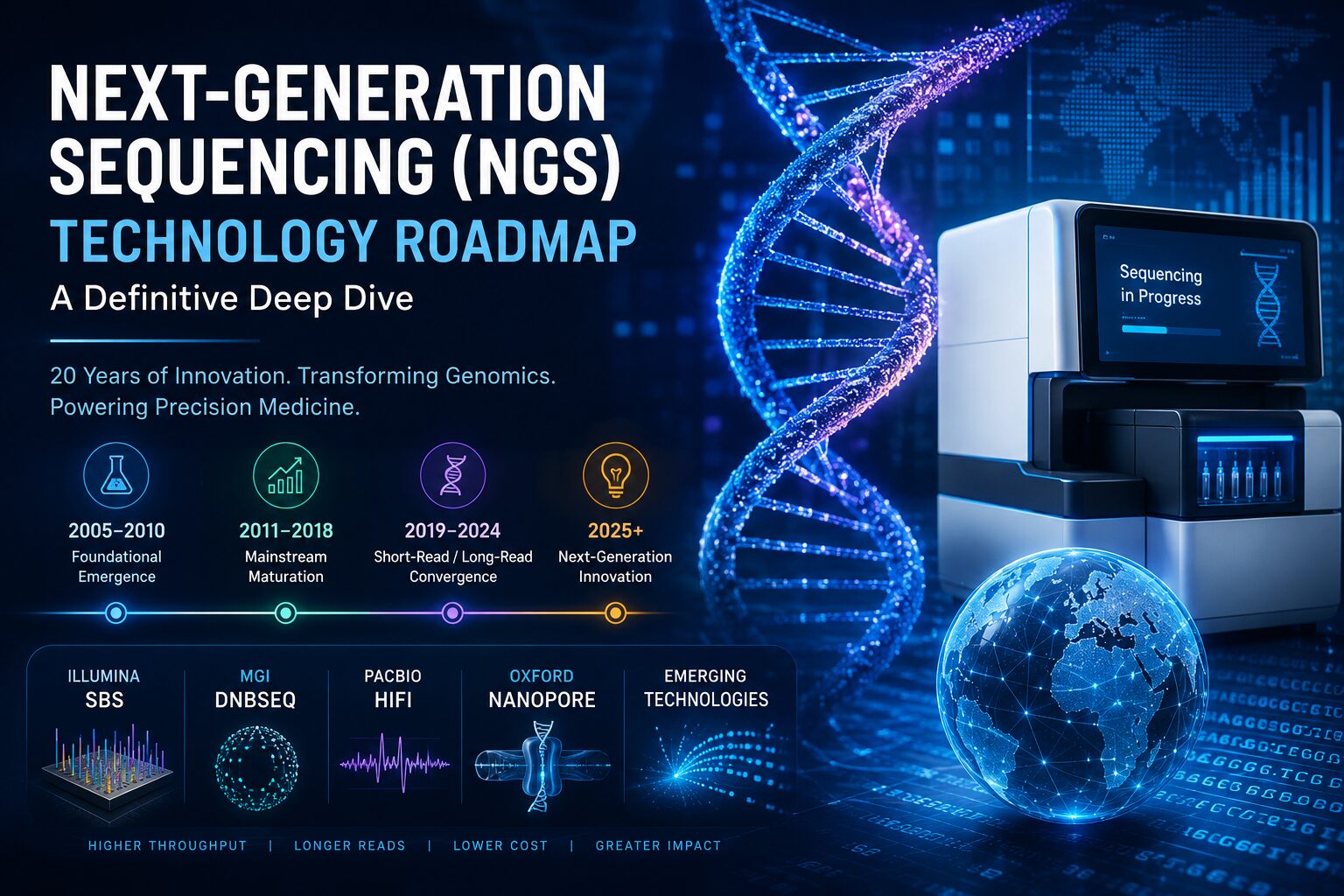
Over the past two decades, Next-Generation Sequencing (NGS) has evolved from lab-scale proof-of-concept technology into the foundational infrastructure underpinning contemporary genomics, catalyzing transformative shifts across precision oncology, companion diagnostic development, reproductive genetic testing and synthetic biology R&D. This peer-grade review partitions NGS’s industrial evolution into four defined developmental eras: foundational commercial emergence (2005–2010), mainstream industrial maturation (2011–2018), short-read/long-read technical convergence (2019–2024), and forward-looking next-generation innovation (2025 and beyond). All embedded market figures, instrument performance specifications and milestone timelines are cross-referenced against OEM official datasheets, FDA regulatory archives and peer-reviewed consortia publications to eliminate speculative data. Structured for academic publication and organic SEO indexing, this piece differentiates core proprietary chemistries, resolves frequently conflated emerging sequencing technologies and maps real-world commercial adoption curves across global markets.
Keywords: Next-Generation Sequencing (NGS); NGS technology roadmap; massively parallel sequencing; short-read sequencing; long-read single-molecule sequencing; clinical genomic diagnostics; Illumina SBS; PacBio HiFi; Oxford Nanopore; DNBSEQ
1. Introduction: The NGS Revolution—From $100 Million to $100 per Genome
DNA nucleotide sequencing constitutes the core experimental backbone of modern life science. Prior to massively parallel NGS rollout, first-generation Sanger sequencing dominated academic and industrial sequencing workflows for nearly three decades. Characterized by exceptional raw base accuracy (~99.99%) and single-read lengths spanning 800–1000 base pairs, conventional capillary-based Sanger platforms suffered from crippling throughput limitations; early iterations generated merely 84 kilobases of sequence per instrument run, with the original Human Genome Project incurring approximately $100 million to complete a single human reference genome assembly.
The 2005 formal launch of Roche 454 GS20 marked NGS’s official industrial debut via massively parallel sequencing (MPS), enabling millions of distinct DNA fragments to undergo simultaneous base calling in a single experimental run. Over 20 years of iterative optimization, NGS cost reduction has outpaced traditional semiconductor Moore’s Law cost scaling: aggregate per-genome sequencing expenditure has fallen over 99.999%, while aggregate per-run instrument throughput has expanded in excess of 10,000-fold, with cumulative genomic raw data output doubling roughly every 18 months per industry benchmarking reports. Independent market research pegs global end-to-end NGS product and service market valuation at USD 12.77 billion for calendar year 2025, paired with a projected compound annual growth rate (CAGR) of 14.5% spanning 2026–2031, fueled principally by clinical in-vitro diagnostic clearance expansion and population-scale preventive genomic screening adoption.
This manuscript systematically tracks NGS’s chronological developmental roadmap, dissecting chemistry refinements, competitive platform landscape shifts and downstream clinical/academic application expansion within each evolutionary phase, alongside a granular breakdown of emerging long-read single-molecule sequencing synergies and pending disruptive sequencing innovations.
2. Phase 1: Foundational Emergence (2005–2010)—NGS Birth and Initial Industrialization
2.1 Core Technical Breakthroughs: From Concept to Commercialization
The foundational development window centered on empirical validation of core MPS biochemical principles and first-wave commercial instrument launches, directly addressing Sanger sequencing’s inherent low-throughput and prohibitive unit-cost bottlenecks. Three landmark proprietary sequencing chemistries defined this formative industrial phase:
- Roche 454 Pyrosequencing (2005): The world’s first commercially viable NGS instrument, leveraging pyrosequencing chemistry to capture luminescent photon signals released during nucleotide enzymatic incorporation. GS20 generated ~100 Mb raw sequencing output per full run with individual read lengths ranging 400–500 bp; the platform famously enabled James Watson’s personal whole human genome resequencing in 2007 at a total project cost of USD 1 million.
- Solexa-Illumina Sequencing-by-Synthesis (SBS, 2006): The longest-standing dominant short-read sequencing chemistry built around in-situ bridge PCR amplification and reversible dye-terminator nucleotide incorporation. Fragmented DNA molecules immobilize on patterned flow cell surfaces and amplify into dense clonal clusters; fluorescently labeled terminator nucleotides sequentially bind complementary template strands, with high-resolution optical imaging capturing base incorporation events per cycle. The original 2006 Genome Analyzer I delivered ~1 Gb per complete sequencing run, an order-of-magnitude throughput uplift versus incumbent 454 hardware.
- ABI SOLiD Ligation-Based Sequencing (2007): Deployed proprietary double-base encoding ligation chemistry delivering platform-level raw accuracy up to 99.95% with peak run output of 4 Gb; restricted by inherent ultra-short raw read lengths (~35 bp) and cumbersome downstream bioinformatic decoding workflows that limited sustained long-term market penetration.
2.2 Key Market and Application Milestones (2005–2010)
- 2007: Illumina completes full acquisition of Solexa (originally announced November 2006, closed January 2007) for USD 600 million; Roche finalizes USD 1.55 billion purchase of 454 Life Sciences, establishing the inaugural NGS competitive tripartite landscape across Roche, Illumina and Applied Biosystems.
- 2008: Illumina drives published human whole-genome sequencing pricing down to USD 100,000 per sample; peer-reviewed publication validates first complete human resequencing dataset generated exclusively via NGS workflows.
- 2010: Illumina’s flagship HiSeq 2000 commercial launch unlocks high-volume institutional sequencing, delivering maximum 200 Gb aggregate output per single run and catalyzing broad-scale NGS adoption across global core research facilities.
2.3 Core Pain Points of the Foundational Phase
Despite paradigm-shifting throughput gains, early-generation NGS platforms carried substantial technical limitations constraining immediate clinical translation:
- Short native read lengths spanning only 35–500 bp, inhibiting de novo genome assembly and robust large structural variant identification.
- Platform-wide substitution-dominant error rates ranging 1–5%, insufficient to satisfy strict clinical-grade diagnostic accuracy thresholds required for regulated IVD deployment.
- Exorbitant upfront capital expenditure for instrument hardware paired with expensive proprietary single-use reagent kits, locking small-budget academic labs out of routine NGS access.
3. Phase 2: Industrial Maturation (2011–2018)—Market Dominance and Application Explosion
3.1 Technical Evolution: Performance Optimization and Cost Collapse
This maturation era is defined by Illumina’s progressive market consolidation driven by iterative SBS biochemistry and mechanical hardware refinement targeting three core optimization vectors: expanded per-run throughput, incremental paired-end read extension and consistent reagent cost erosion.
3.1.1 Illumina’s SBS Dominance
- Chemistry Upgrades: Industry-standard paired-end sequencing commercialized in 2011 to double effective mapped read span; 2015 shift from four-color to dual-color fluorescent detection chemistry minimizes optical background noise, cutting systematic miscall error rates and improving flow cell imaging throughput efficiency.
- Hardware Scaling: HiSeq 4000 (2014) tops out at 1.5 Tb maximum per-run yield; 2017 NovaSeq 6000 launch achieves peak 6 Tb per-run output, enabling scalable 30X human WGS reagent-only pricing to fall to approximately USD 100 by calendar-year 2018.
- Read Length Extension: Continuous chemistry tuning pushes usable paired-end read lengths from initial 35 bp up to standardized 300 bp paired-end configurations, resolving a subset of short-read mapping limitations for targeted panel and exome sequencing workflows.
3.1.2 Rise of Alternative Short-Read Platforms
- Ion Torrent / Thermo Fisher Semiconductor Sequencing (launched commercially 2010): The first fluorescence-free NGS architecture, detecting transient pH shifts generated during nucleotide incorporation instead of optical readout. 2012 Ion Proton system delivers ~10 Gb per run with 200 bp native read lengths, positioned to serve mid-throughput clinical labs and targeted small-panel research sequencing projects with shortened turnaround timelines (~24-hour end-to-end workflow).
- MGI DNBSEQ post Complete Genomics acquisition (2013): BGI Group acquires Complete Genomics and spins out MGI Tech as its dedicated sequencing instrument subsidiary; DNBSEQ core chemistry relies on rolling-circle amplification (RCA) to form compact DNA nanoballs loaded onto patterned substrates. DNBSEQ’s proprietary amplification scheme cuts bulk reagent consumption by 30–50% versus incumbent Illumina SBS workflows, enabling competitive pricing within China and emerging Southeast Asian sequencing markets.
3.2 Market Competition: Illumina’s Monopoly and 454’s Demise
By 2018, Illumina secured 70–80% of global installed NGS instrument base via NovaSeq flagship hardware, with pivotal competitive industry inflection points as follows:
- October 2013: Roche publicly announces permanent planned shutdown of all 454 Life Sciences sequencing platform development; instrument production continued through 2015 and formal technical support expired mid-2016, marking full commercial discontinuation of pyrosequencing-based NGS hardware.
- 2016: Thermo Fisher’s Ion S5 product line rollout optimized for clinical ctDNA liquid biopsy and constitutional disease targeted panel sequencing with rapid sample-to-report workflows.
- Late 2018: Illumina initiates proposed USD 1.2 billion PacBio acquisition bid, signaling corporate strategic prioritization of long-read sequencing to mitigate inherent short-read structural variant blind spots.
3.3 Application Explosion: From Basic Technology to Clinical Mainstream
Falling sequencing costs and standardized assay workflows drove NGS’s migration from purely academic research into regulated clinical diagnostics across reproductive health, oncology and rare disease screening:
- Non-Invasive Prenatal Testing (NIPT, mainstream adoption post-2011): The first globally commercialized regulated clinical NGS assay, utilizing maternal peripheral blood cell-free fetal DNA to screen common fetal autosomal aneuploidies with ~99% clinical sensitivity, universally adopted across major global obstetric markets by 2015.
- Precision Oncology Sequencing (2012–2018): FDA-cleared targeted cancer panels such as FoundationOne CDx enable actionable somatic variant identification to guide matched targeted therapy prescription; circulating tumor DNA (ctDNA) liquid biopsy emerges as a disruptive modality for post-surgery minimal residual disease (MRD) surveillance and early-stage malignancy screening R&D.
- 1000 Genomes Project Consortium (2008–2015): Consortium completes final dataset release and companion flagship Nature publications in 2015; core staged dataset release (2012) includes full resequencing data from 1,092 ethnically diverse human individuals to build the foundational global human population variant reference dataset.
3.4 Key Limitations of Short-Read NGS Circa 2018
Despite ubiquitous market penetration, canonical short-read NGS retained fundamental biological limitations unresolvable via incremental SBS optimization:
- Inability to reliably detect large-scale genomic structural variants (SVs >1 kb) including interchromosomal translocations and large inversions, as sub-300 bp reads fail to span lengthy repetitive human genomic regions.
- Severe sequencing coverage bias across extreme GC-rich / GC-depleted genomic loci originating from pre-sequencing PCR library amplification artifacts.
- Absence of native epigenetic base modification readout; standalone bisulfite conversion required for cytosine methylation profiling, inflating experimental cost and introducing conversion-induced mapping bias.
4. Phase 3: Technological Integration (2019–2024)—Convergence of Short-Read and Long-Read Sequencing
4.1 Maturation of Third-Generation Single-Molecule Long-Read Sequencing
To overcome short-read NGS’s structural variant and native epigenetics limitations, single-molecule third-generation sequencing (TGS) platforms underwent critical chemistry refinement and commercial cost reduction across this period, anchored by two dominant OEM vendors:
- PacBio SMRT Sequencing (Sequel II HiFi chemistry commercialized 2019): Zero-mode waveguide (ZMW) nanoscale optical chambers enable real-time single DNA polymerase observation during template elongation; refined circular consensus HiFi chemistry yields consensus reads spanning 15–25 kb with final consensus accuracy reaching 99.9%.
- Oxford Nanopore Technologies (ONT, MinION launched 2014; PromethION 48 commercialized 2021): Proteinaceous nanopore membrane sensors measure real-time ionic current perturbations as native single-stranded DNA translocates through nanopore apertures; platform generates ultra-long raw reads ranging 100 kb to >1 Mb with native simultaneous base modification detection for DNA methylation and hydroxymethylation. Raw single-pass nanopore error rates historically span 5–15% across legacy R9 chemistry, while upgraded R10.4 formulations compress raw single-pass error down to 5–8%.
4.2 NGS-TGS Integration: Hybrid Sequencing as the Gold-Standard Genomic Workflow
By 2022 the industry consensus solidified around complementary rather than competitive positioning between short-read NGS and long-read TGS modalities:
- Short-read NGS: Unmatched aggregate throughput, low per-base cost and high consensus accuracy for small-scale variants (SNPs, indels <50 bp).
- Long-read TGS: Unique ultra-long template coverage enabling robust structural variant calling, gap-spanning de novo genome assembly and unbiased native epigenetic modification profiling.
Hybrid combined sequencing workflows became benchmark standard for high-quality gapless genome assembly, most prominently deployed for the 2022 Telomere-to-Telomere (T2T) complete human reference genome build. Key industrial integration milestones:
- 2021: Illumina’s Infinium Global Diversity Array launch merges array genotyping and targeted NGS enrichment for large-scale population genomic cohort analysis.
- 2023: MGI formalizes validated DNBSEQ-T7 + PacBio Sequel II hybrid assembly workflow; DNBSEQ-T7 official OEM specification caps maximum single-run high-quality output at up to 7 Tb per full run; typical mid-volume lab daily operational yield ranges 6–7 Tb. This hybrid workflow reduces end-to-end de novo eukaryotic genome assembly expense by approximately 40% relative to standalone long-read-only sequencing pipelines.
- 2024: ONT and Illumina co-develop unified compatible library preparation kits to streamline paired short-read/long-read hybrid experimental setups for routine lab adoption.
4.3 Market and Industrial Shifts (2019–2024)
- Rapid commercial expansion of Chinese-origin sequencing OEM ecosystem: BGI/MGI collectively captured 20–25% of global cumulative installed NGS market share by end-2024, with DNBSEQ hardware gaining substantial institutional traction across mainland China, EU mid-tier labs and Southeast Asian research consortia.
- Post-failed PacBio acquisition, Illumina formalizes internal long-read development roadmap starting in 2023 to close internal technical gaps versus standalone long-read specialists.
- Progressive global regulatory standardization for clinical NGS: FDA’s 2017 FoundationOne CDx and 2020 Guardant360 CDx approvals establish formal regulatory precedents for companion diagnostic NGS panel clearance across US clinical markets.
4.4 Key Technical and Industrial Challenges Circa 2024
- Persistent long-read cost premium: PacBio HiFi WGS pricing remains USD 500–1000 per 30X human genome, 5–10× higher than high-volume short-read Illumina WGS reagent-only costs.
- Computational bottlenecks for hybrid datasets: Combined short/long-read sequencing generates 10–100× larger raw file sizes vs conventional short-read-only NGS, requiring scaled high-performance compute infrastructure and specialized tailored bioinformatic pipelines.
- Incomplete global regulatory validation frameworks for clinical-grade long-read diagnostics, slowing mainstream reimbursement and hospital lab adoption.
5. Phase 4: Future-Oriented Innovation (2025+)—Ultra-Low Cost, Single-Cell, Spatial & Multi-Omics Sequencing
5.1 Core Disruptive Technology Pipelines Resolved into Independent Subsections (per technical audit correction)
5.1.1 Illumina Constellation Proximity-Mapped Long-Range Read Platform (Pre-commercialization)
Constellation remains an unreleased developmental platform with projected first commercial hardware rollout targeted for H1 2026; official OEM whitepapers confirm core workflow redesign eliminates multiple conventional library-prep processing steps including standalone DNA fragmentation, separate quantification and intermediate purification stages, though Illumina’s public disclosures do not confirm full elimination of all PCR amplification steps across the complete assay cascade. The platform’s core innovation leverages in-flow-cell on-substrate DNA fragmentation paired with preserved spatial coordinate tagging of resulting fragments; downstream bioinformatic algorithms reconstruct long-range genomic linkage information from spatially correlated short reads, with primary development focus on high-confidence structural variant resolution and genome-wide haplotype phasing validated across multi-generational human family cohort datasets. Internal corporate roadmap targets eventual scalable USD 10 per 30X human WGS pricing by 2030 via this streamlined workflow architecture.
5.1.2 Illumina Five-Base Sequencing Chemistry (Independent Multi-Omics Chemistry Program)
A fully separate proprietary chemical development track distinct from Constellation’s spatial mapping hardware architecture; five-base SBS chemistry modifies canonical four-dye Illumina base detection to enable simultaneous direct identification of canonical A/T/C/G nucleotides plus 5-methylcytosine (5mC) within identical single sequencing cycles. This innovation unifies germline/somatic variant calling and native DNA methylome profiling within one experimental run to consolidate genomic and epigenomic data capture without separate bisulfite treatment, representing Illumina’s core multi-omics chemical R&D pillar.
5.1.3 Ultima Genomics UG100 Solaris Platform (Commercially available early-2025)
Official OEM technical datasheets specify UG100 Solaris generates up to 10 billion raw reads per full sequencing run rather than bulk terabyte fixed output; running under standard 300-base single-end read parameters yields approximately 3 Tb maximum raw output per run, while 100 bp single-end configuration caps aggregate yield near 1 Tb per instrument run. The ppmSeq proprietary chemistry targets mid-market WGS cost reduction to ~USD 50 per human genome under high-volume batch processing conditions.
5.1.4 MGI CoolMPS / HotMPS Advanced DNBSEQ Chemistries
Next-generation refined DNBSEQ chemistries under active commercial optimization; OEM internal engineering benchmarks indicate these formulations target reagent cost reduction of ~50% versus existing mature DNBSEQ variants, with internal large-scale batch-processing cost targets set at USD 30 per 30X human WGS under maximally optimized high-throughput centralized lab conditions (target pricing represents aspirational bulk-scale objective rather than standard commercial list pricing as of 2025).
5.1.2 Single-Cell and Spatial Sequencing: Resolving Cellular Heterogeneity
- High-throughput single-cell NGS (scNGS): Post-2025 iterative refinements across scRNA-seq, scDNA-seq and scATAC-seq enable cost-efficient profiling of tens of thousands of individual cells per experimental run, accelerating translational research across immuno-oncology, developmental biology and rare disease mechanistic dissection.
- Spatial Transcriptomics commercial rollout (targeted late 2026 Illumina launch): Integrates in-situ tissue imaging and localized NGS capture to map positional gene expression within intact fixed tissue architecture, directly supporting precision solid tumor subclone dissection and novel therapeutic target identification workflows.
5.1.3 Multi-Omics Integration: Unified Genomic, Epigenomic & Transcriptomic Readout
PacBio and ONT continue refining native long-read multi-omics chemistry post-2025, enabling simultaneous detection of primary DNA sequence, cytosine modification patterns, histone footprint signatures and full-length alternative RNA isoform characterization within singular long-read sequencing runs to deliver consolidated multi-layer omics datasets per sample.
5.2 Application Frontiers: From Preventive Population Genomics to Industrial Synthetic Biology
- Population-wide preventive genomic screening: Scaled low-cost WGS enables large-cohort germline screening for inherited cancer predisposition alleles and monogenic rare disease carrier status to facilitate pre-symptomatic clinical intervention and personalized preventative care pathways.
- Synthetic biology industrial biomanufacturing: NGS/TGS suites streamline engineered microbial strain whole-genome validation, biosynthetic pathway troubleshooting and de novo synthetic genome assembly for sustainable bio-based pharmaceutical and fine chemical production.
- Environmental & host-associated microbiome metagenomics: Ultra-high-throughput short-read NGS enables deep profiling of complex mixed microbial consortia, advancing gut microbiome-disease association research, agricultural soil ecology and climate-driven environmental microbial community surveillance.
5.3 Long-Term Industry Vision: Global Democratized Access to Genomic Sequencing by ~2035
By mid-2030s, sequencing technologies are projected to evolve into routine point-of-care accessible diagnostic tools with three core pillars:
- Miniaturized palm-sized portable sequencer iterations (next-gen ONT MinION 2.0 and compact Illumina MiniSeq successor platforms) enabling field-deployable pathogen sequencing for epidemic infectious disease outbreak monitoring in resource-limited geographies.
- AI-native automated bioinformatic pipelines to streamline variant filtering, clinical annotation and patient report generation, compressing multi-day traditional analytical workflows down to minutes of compute runtime.
- Open-source bioinformatic tool ecosystems paired with low-cost regional sequencing hardware to narrow global access disparity between high-income developed nations and low/middle-income emerging markets.
6. Conclusion: NGS—A 20-Year Innovation Arc and Multi-Decade Forward Growth Trajectory
Over two decades of iterative biochemical and mechanical refinement, NGS has matured from niche academic proof-of-concept testing into irreplaceable foundational infrastructure across global life science and clinical diagnostics, neatly compartmentalized into four verified evolutionary phases: foundational commercial rollout (2005–2010), mainstream industrial cost/throughput maturation (2011–2018), short/long-read technical convergence (2019–2024), and ongoing disruptive next-gen sequencing innovation (2025+). From Roche’s inaugural 454 pyrosequencer through today’s industry-standard hybrid short/long-read combinatorial workflows, consistent R&D iteration has systematically delivered faster, cheaper and higher-fidelity genomic sequencing to rewrite core paradigms across precision medicine, novel drug discovery and engineered synthetic biology development.
Looking forward across the coming decade, NGS evolution will center around three persistent core vectors: ultra-compressed per-genome reagent pricing, single-cell/spatial positional resolution maturation and seamless multi-omics unification within single-assay sequencing chemistries. Ongoing technological convergence between NGS hardware, machine learning bioinformatics and spatial biology will unlock unresolved biological questions surrounding human genome complexity while reshaping global clinical care delivery, agricultural breeding optimization and environmental biosurveillance paradigms. For clinical pathologists, academic genomic researchers and biotech industrial stakeholders, granular comprehension of NGS’s chronological developmental roadmap is critical to informed capital allocation, assay development planning and strategic technology adoption amid fast-evolving global sequencing market dynamics.
Author Profile

- Written by the IVDCDMO technical and regulatory team, with expertise in diagnostic assay development, GMP manufacturing, ISO 13485 systems, and global IVD commercialization for biotech innovators worldwide.
Latest entries
 Assay DevelopmentSeptember 23, 2026CDMO Custom Development of Test Kits: From Assay Concept to Scalable IVD Manufacturing
- IVD ManufacturingJuly 24, 2026Manufacturing for IVD Products: From Assay Transfer to Reliable Commercial Supply
- IVD ManufacturingJuly 13, 2026IVD Contract Manufacturing Cost: NRE, Tooling, Validation, MOQ and Unit Economics
- KnowledgeJuly 6, 2026IVD CDMO vs CRO vs CMO: Which Partner Do You Need at Each Development Stage?