
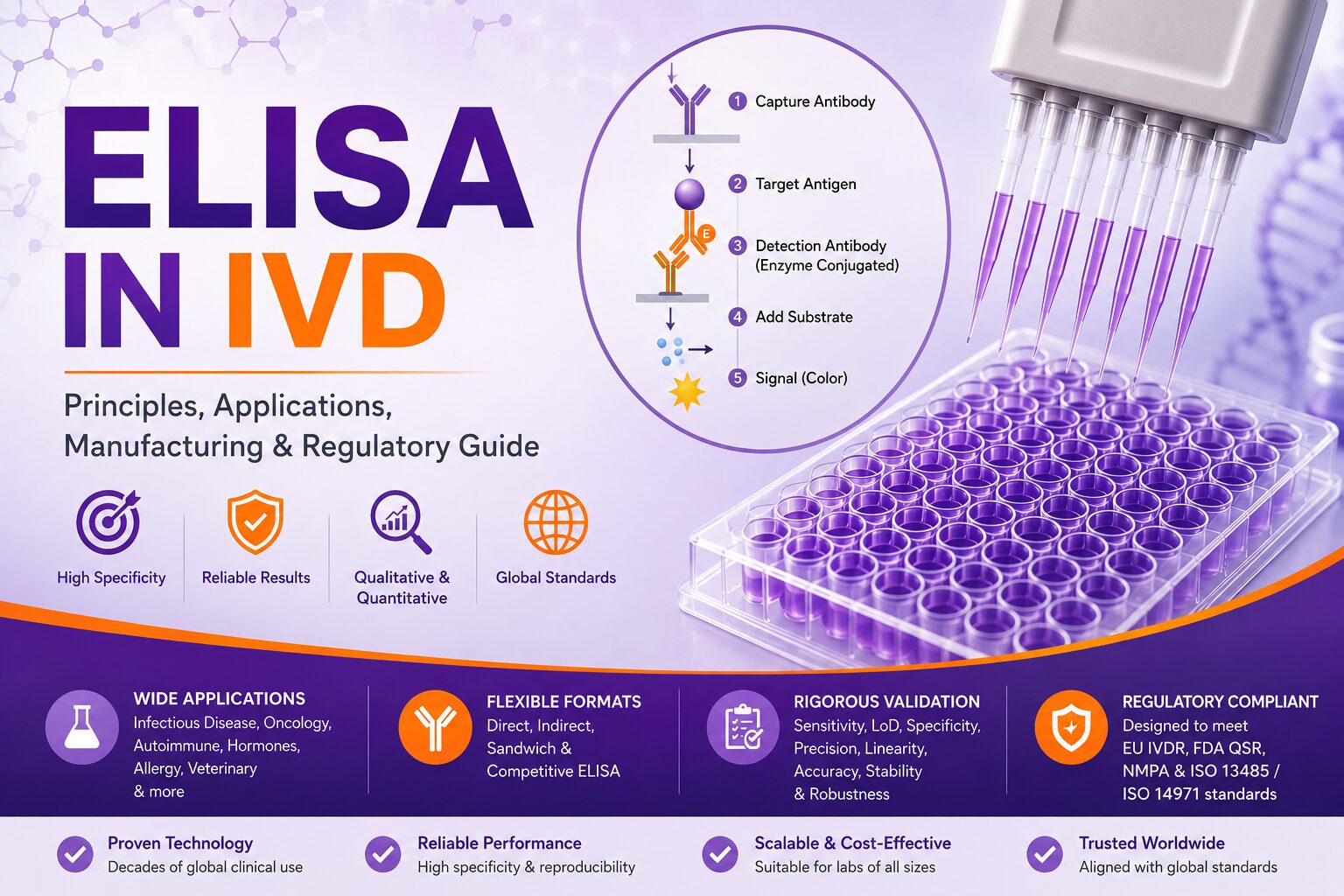
Why ELISA Remains Essential in IVD Diagnostics
Among all immunodiagnostic technologies used in modern healthcare, ELISA (Enzyme-Linked Immunosorbent Assay) remains one of the most widely adopted and trusted analytical methods. Despite the emergence of advanced technologies such as chemiluminescence immunoassays (CLIA), molecular diagnostics, next-generation sequencing (NGS), and digital immunoassays, ELISA continues to serve as a foundational platform in the global In Vitro Diagnostics (IVD) industry.
From infectious disease screening and autoimmune disease detection to hormone testing, allergy diagnostics, and biomarker research, ELISA offers a unique combination of reliable performance, high throughput scalability, low overall cost, and decades of global regulatory acceptance.
Today, thousands of IVD manufacturers, clinical laboratories, research institutions, and specialized CDMO organizations rely on ELISA technology for both routine clinical diagnostics and novel assay development pipelines.
This article delivers expert-level, commercially actionable insights into ELISA for IVD stakeholders. It systematically covers core biochemical principles, step-by-step workflow, four mainstream assay formats, kit component design, manufacturing bottlenecks, complete analytical & clinical validation frameworks, ELISA-CLIA head-to-head comparison, worldwide regulatory compliance rules, forward-looking industry innovations, and the full value proposition of partnering with an IVD CDMO.
What Is ELISA?
ELISA stands for Enzyme-Linked Immunosorbent Assay, a microplate-based solid-phase immunoassay designed to qualitatively detect and quantitatively measure target biological analytes via highly specific antigen-antibody immune recognition.
The core technological logic translates invisible biomolecular binding events into quantifiable colorimetric, fluorescent, or luminescent optical signals readable via laboratory instrumentation.
Commercial and research ELISA platforms detect a broad spectrum of target substances:
- Free or bound antigens
- Diagnostic antibodies (IgG, IgM, total IgE)
- Circulating proteins & peptides
- Endogenous hormones
- Inflammatory cytokines & chemokines
- Disease-specific protein biomarkers
- Pathogen-derived immune response markers
- Small-molecule drugs, steroids, and toxicants
Assays are standardized on industry-standard 96-well polystyrene microplates, supporting mid-to-high batch testing capacity suitable for hospital labs, central reference laboratories, and mass screening programs.
How ELISA Works
The fundamental principle of ELISA relies on the lock-and-key binding specificity between an antigen and its matching antibody.
- Target analytes are captured and immobilized on a hydrophobic polystyrene microplate solid phase.
- An enzyme-conjugated detection antibody selectively binds to the captured target molecule.
- Chromogenic/fluorogenic substrate is introduced; the conjugated enzyme catalyzes a proportional color change or light emission reaction.
- Signal intensity directly correlates linearly with the concentration of the unknown analyte within the tested sample.
Basic ELISA Standard Workflow
Step 1: Plate Coating
Capture antibodies or purified target antigens are passively adsorbed or covalently immobilized onto microplate well surfaces. Coating buffer pH, incubation temperature, and incubation time are critical optimized parameters impacting final assay sensitivity.
Step 2: Blocking
Unoccupied hydrophobic binding sites on well walls are saturated with blocking reagents to eliminate non-specific antibody adsorption and reduce background optical noise.
Common blocking agents for commercial IVD kits:
- Purified BSA (bovine serum albumin)
- Acidified casein
- Fish/gelatin hydrolysate
- Proprietary composite blocking buffers (BSA + Tween-20, industry standard for clinical products)
Step 3: Sample Addition & Incubation
Calibration standards, quality controls, and patient-derived test samples are loaded into coated wells and incubated to enable target capture.
Clinically validated sample matrices for IVD ELISA:
- Serum
- EDTA/ heparin plasma
- Filtered whole blood
- Urine
- Oral saliva
- Cell culture supernatant
- Tissue homogenate
Step 4: Washing Cycle
Wash buffer containing low-concentration Tween-20 is repeatedly aspirated and dispensed to strip all unbound matrix proteins, free antibodies, and residual sample contaminants. Insufficient washing is a top cause of false positive results.
Step 5: Detection Antibody Binding
A primary or secondary labeled antibody binds selectively to the captured target analyte’s unique epitope region.
Step 6: Enzyme Conjugation
Two enzyme labels dominate commercial IVD ELISA manufacturing for their high catalytic activity and low off-target reactivity:
- Horseradish Peroxidase (HRP)
- Alkaline Phosphatase (AP)
Step 7: Substrate Catalytic Reaction
Enzyme-substrate pairing is standardized across the industry:
| Conjugated Enzyme | Matching Chromogenic Substrate | Visual Readout |
|---|---|---|
| HRP | TMB (3,3’,5,5’-Tetramethylbenzidine) | Blue color before stop solution, yellow post-stop |
| AP | pNPP (p-Nitrophenyl phosphate) | Bright yellow color |
Color saturation intensity correlates positively with analyte concentration within the assay’s linear quantitative range.
Step 8: Stop Solution Termination
Acidic or alkaline stop reagent halts enzyme catalytic activity to stabilize optical density signals for consistent plate reading.
Step 9: Quantitative Signal Measurement
Microplate readers measure absorbance optical density (OD) at specified wavelengths (450 nm primary for TMB). Raw OD values are converted to absolute analyte concentrations using pre-established calibration curves and assay-specific mathematical algorithms.
Major Types of ELISA Assays & IVD Commercial Applicability
Each ELISA format is engineered to solve distinct diagnostic measurement challenges, with clear boundaries for clinical commercialization vs pure research use.
1. Direct ELISA
Core Principle
A single enzyme-labeled primary antibody binds directly to immobilized target antigen with no secondary antibody amplification step.
Advantages
- Simplest minimal reagent workflow
- Fast assay development timeline
- Fewer raw material components required
Key Limitations & Commercial Restrictions
- No signal amplification cascade → drastically lower overall assay sensitivity
- Cannot detect polyclonal human patient antibodies
Critical industry note: No FDA/IVDR-certified clinical IVD kits use direct ELISA; this format is limited exclusively to laboratory antigen screening and academic research.
Typical Lab Applications
- Recombinant antigen purity screening
- Rapid antibody clone binding characterization
2. Indirect ELISA
Core Principle
Unlabeled primary antibody from test sample binds coated antigen; a species-specific enzyme-conjugated secondary antibody targets the constant region of the primary antibody to generate amplified signal.
Advantages
- Strong signal amplification delivers superior sensitivity
- Universal secondary antibodies cut reagent development costs
- Flexible platform adaptable to multiple antibody isotypes (IgM/IgG)
Primary IVD Clinical Applications (Serology Gold Standard)
Serological antibody detection for infectious and autoimmune disease screening:
- HIV anti-body confirmatory testing
- COVID-19 retrospective seroprevalence surveys
- Hepatitis A/B serology screening
- Lyme disease, syphilis, dengue antibody testing
- Systemic autoimmune disorder autoantibody screening
3. Sandwich ELISA
Core Principle
Dual-antibody capture system: one immobilized capture antibody binds one epitope of the target analyte, while a labeled detection antibody binds a separate non-overlapping epitope of the same molecule, forming a “sandwich” immune complex.
Advantages
- Highest analytical specificity of all ELISA formats
- Excellent low-end sensitivity for trace biomarkers
- Minimal matrix-derived background interference
- Wide linear quantitative detection range
Primary IVD Clinical Applications
Universally recognized as the gold-standard ELISA format for quantitative clinical testing:
- Circulating cytokine & inflammatory factor quantification
- Tumor marker protein measurement
- Infectious antigen direct detection (virus, bacteria)
- Human hormone quantitative assays
4. Competitive (Inhibition) ELISA
Core Principle
Free unlabeled analyte present in patient samples competes with known quantities of labeled reference analyte for limited antibody binding sites. Signal intensity decreases proportionally to higher target concentration.
Critical design rationale
This format solves the core limitation of sandwich ELISA: small-molecule analytes possess only a single antigenic epitope and cannot simultaneously bind two distinct capture/detection antibodies.
Advantages
- Unique suitability for low-molecular-weight small molecules (<10 kDa)
- Robust performance against small-molecule matrix interference
Primary IVD Clinical Applications
- Therapeutic drug monitoring (TDM)
- Steroid & peptide hormone analysis (estrogen, testosterone, cortisol)
- Mycotoxin, heavy metal, and toxicology screening
- Thyroid small-molecule hormone testing
Why ELISA Is Universally Adopted Across Global IVD Markets
Four decades of market dominance stem from unmatched balanced technical, economic, and regulatory benefits for all tiers of healthcare providers and manufacturers.
1. Exceptional Analytical Specificity
Antigen-antibody epitope-level binding eliminates cross-reactivity against unrelated biomolecules when paired with high-quality monoclonal antibody raw materials.
2. Consistent Intra-Assay & Inter-Assay Reproducibility
Fully standardized coating, blocking, incubation, and wash protocols paired with mature GMP manufacturing controls deliver tight CV% precision data required for regulatory approval.
3. Unmatched Total Cost Efficiency
- Minimal upfront capital equipment investment compared to CLIA, chemiluminescence, or molecular testing platforms
- Low-cost bulk raw materials and disposable microplates
- No requirement for fully integrated automated workstations for low-volume lab settings
4. Fully Scalable Production & Testing Capacity
ELISA platforms adapt seamlessly to all operational scales:
- Small clinic satellite laboratories (manual single-plate processing)
- Regional mid-volume hospital core labs (semi-automated washers/readers)
- National population-wide mass screening programs (high-throughput batch processing)
- GMP mass commercial kit manufacturing (millions of microplates per batch)
5. Long-Standing Global Regulatory Familiarity
Regulatory authorities across every major market possess decades of established review frameworks for ELISA IVD products. Review teams have well-defined expectations for:
- Analytical performance acceptance criteria
- Complete validation study design methodologies
- Mandatory in-process and end-product quality control requirements
6. Broad Matrix Compatibility
Optimized buffer formulations mitigate common interferences from serum, plasma, urine, and other human-derived biological samples without specialized pre-treatment workflows.
Common ELISA Clinical & Veterinary IVD Applications
Infectious Disease Diagnostic Screening
ELISA remains the primary mass screening tool for pathogen antigen and antibody detection globally:
- HIV 1/2 combined antibody/antigen screening
- Hepatitis B surface antigen & anti-HCV antibody testing
- Dengue, Zika, chikungunya serology panels
- Lyme disease, syphilis, toxoplasmosis
- COVID-19 seroprevalence antibody testing
- Enteric bacterial and parasitic pathogen screening
Autoimmune Disorder Testing
Quantitative and qualitative detection of circulating autoantibody panels:
- ANA (antinuclear antibody) screening
- Anti-dsDNA, anti-CCP, anti-Sm autoantibodies
- Rheumatoid factor (RF) quantification
- Organ-specific autoimmune antibodies (thyroid, liver)
Endocrine Hormone Quantitative Analysis
Sandwich & competitive ELISA platforms for routine endocrine panels:
- TSH, LH, FSH pituitary hormones
- Testosterone, progesterone, estradiol
- Cortisol, insulin, thyroid hormones
Clinical Allergy Diagnostics
Immunoglobulin E quantification for hypersensitivity testing:
- Total circulating IgE measurement
- Specific allergen IgE antibody panels (food, pollen, dust mite)
Oncology Tumor Biomarker Monitoring
Quantitative serial testing for cancer screening and treatment response tracking:
- AFP (alpha-fetoprotein, liver cancer)
- PSA (prostate-specific antigen)
- CEA (carcinoembryonic antigen)
- CA125 (ovarian), CA19-9 (gastrointestinal)
Veterinary IVD Diagnostics
ELISA dominates affordable livestock and companion animal health screening:
- Livestock infectious disease mass screening (foot-and-mouth, brucellosis)
- Canine/feline viral and parasitic diagnostic kits
- Poultry flock health monitoring panels
Key Standard Components of Commercial GMP-Grade ELISA Kits
Regulatory-compliant finished ELISA kits contain fully validated, pre-formulated component sets with batch-specific COA documentation:
- Pre-coated 96-well polystyrene microplates (single-use breakaway strips preferred for clinical labs)
- Lyophilized or liquid calibrator standards (traceable reference materials per ISO 17511)
- Assay-specific positive control matrix samples
- Negative control matrix blanks to monitor background non-specific binding
- Purified detection antibody solution
- HRP/AP enzyme-conjugated secondary antibody working conjugate
- Concentrated wash buffer (formulated with Tween-20 for clinical interference reduction)
- Ready-to-use chromogenic substrate solution
- Acidic stop reagent for signal stabilization
- Package insert with validated linear range, LoD, LoQ, and cross-reactivity data
Core ELISA Kit Manufacturing & Development Challenges (IVD CDMO High-Value Intervention Zones
Internal lab-scale assay protocols almost never translate directly to stable, reproducible commercial production. Specialized IVD CDMOs resolve the following critical bottlenecks through dedicated process development teams.
1. Antibody Raw Material Selection & Batch Consistency
The single largest driver of ELISA performance variability. Key evaluation criteria for antibody clones:
- Antigen binding affinity (KD value characterization)
- Epitope specificity and off-target cross-reactivity risk
- Long-term liquid/lyophilized thermal stability
- Batch-to-batch production consistency from hybridoma or recombinant cell lines
2. Microplate Coating Process Optimization
Suboptimal coating parameters directly degrade finished kit sensitivity, intra-assay precision, and shelf-life stability. Variables requiring formal DOE (Design of Experiments) testing: coating pH, incubation temperature, coating antigen/antibody concentration, post-coat drying cycles.
3. Matrix Effect & Endogenous Interference Mitigation
Patient sample matrices contain common interfering substances that generate false positive or false negative clinical results; top sources of matrix interference include:
- Lipemic, hemolytic, icteric patient specimens
- Heterophilic antibodies (HAMA), human anti-animal antibodies
- Endogenous circulating binding proteins
CDMO teams formulate customized diluent buffers to suppress matrix cross-reactivity during assay development.
4. Comprehensive Stability Testing Mandates for Regulatory Filing
All commercial ELISA kits require full stability characterization packages as part of registration dossiers:
- Real-time long-term shelf-life stability (storage labeled temperature)
- Accelerated thermal stability stress testing
- Shipping transport simulation stability (temperature cycling)
- Post-opening/ reconstitution in-use stability for end-user labs
5. Lab Scale-Up & GMP Technology Transfer
Bench-scale low-volume R&D formulations face massive reproducibility risks when scaled to 100k+ kit batch production. CDMOs deliver validated technology transfer workflows, GMP process SOP drafting, intermediate batch testing, and full scale-up validation to eliminate production drift.
Complete ELISA Assay Validation Framework (Analytical + Clinical, Global Regulatory Mandatory)
All IVD ELISA products require dual-layer validation packages for FDA, IVDR, NMPA submission: analytical performance validation and prospective clinical performance validation.
Part 1: Mandatory Analytical Validation Studies
- Analytical Sensitivity
- LoB (Limit of Blank): Blank matrix signal upper threshold
- LoD (Limit of Detection): Lowest distinguishable target concentration
- LoQ (Limit of Quantitation): Lowest concentration meeting precision & accuracy acceptance criteria
- Analytical Specificity
- Cross-reactivity testing against homologous interfering analytes
- Matrix interference spiking studies (hemolysis, lipemia, HAMA)
- Precision
- Intra-assay repeatability (same plate, multiple replicates)
- Inter-assay reproducibility (different batches, operators, equipment)
- Linearity
- Serial dilution recovery testing across full reportable concentration range
- Accuracy
- Spike-and-recovery matrix testing
- Method comparison against FDA/ISO reference gold standard assays
- Robustness
- Stress testing variable incubation time, temperature, wash cycle deviations
- Carryover Contamination Assessment
- High-concentration adjacent well cross-contamination risk testing
- Sample Stability
- Patient specimen storage stability pre-testing (room temp, refrigerated, frozen)
Part 2: Mandatory Clinical Validation (Required for All Clinical IVD ELISA)
- Prospective patient cohort testing matching intended clinical population
- Clinical sensitivity & clinical specificity calculation
- Positive predictive value (PPV) / negative predictive value (NPV) statistical analysis
- Cutoff threshold determination and clinical correlation studies
ELISA vs CLIA: Head-to-Head IVD Platform Selection Comparison
Development and procurement teams frequently compare ELISA and CLIA during early-stage assay platform selection; the table below includes complete decision-making dimensions for lab managers, R&D leads, and procurement stakeholders.
| Evaluation Parameter | ELISA | CLIA (Chemiluminescence Immunoassay) |
|---|---|---|
| Ultimate Analytical Sensitivity | High | Very High (superior low-biomarker trace detection) |
| Upfront Capital Equipment Investment | Low (basic microplate reader/washer only) | Higher (integrated automated chemiluminescence analyzers) |
| Single-Batch Testing Throughput | Moderate (96-well manual/semi-auto) | Ultra-High (continuous random-access full automation) |
| End-User Automation Capability | Limited semi-automation only | Fully walkaway integrated workflow |
| Assay R&D & Manufacturing Development Cost | Lower raw material & formulation expenses | Higher conjugate, substrate, instrument integration costs |
| Global Regulatory Submission Track Record | Extensive 40+ year history | Extensive modern immunoassay framework |
| Suitability for Small Rural/Clinic Labs | Excellent, minimal infrastructure required | Moderate, requires dedicated large analyzer footprint |
| Total Test Turnaround Time | Longer multi-step incubation workflow | Shorter single-step automated incubation |
| Long-Term Operational Running Cost Per Test | Low, low-cost disposables | Higher reagent & instrument maintenance fees |
| Clinical Matrix Tolerance | Broad, buffer-mitigated interference | Narrower optimized matrix range |
Core Selection Guidance
ELISA remains the dominant choice for mass population screening, low-resource laboratory environments, multi-target mid-volume panels, and cost-sensitive regional healthcare programs. CLIA is prioritized for centralized high-volume core labs requiring ultra-low detection limits and full end-to-end automation.
Global Regulatory Compliance Rules for Commercial ELISA IVD Kits
Every market enforces distinct classification, testing, and documentation requirements for ELISA diagnostic kits. All registrations require a full technical dossier built from the validation and manufacturing data above.
United States (FDA)
- Governing frameworks: FDA 21 CFR Part 820 Quality System Regulation (QSR)
- Risk-based filing pathways:
- Low-to-moderate risk screening ELISA: 510(k) pre-market notification
- High-risk infectious disease, oncology biomarker ELISA: PMA Premarket Approval
- Mandatory standards: ISO 13485 QMS, ISO 14971 medical device risk management
European Union (EU IVDR 2017/746)
- Risk classification system dictates compliance route for all ELISA kits:
- Class A: Low-risk self-testing general wellness assays (self-declaration, no Notified Body audit)
- Class B: Moderate-risk routine hormone/allergy ELISA (self-declaration + technical file review)
- Class C/D: High-risk infectious, oncology, autoimmune ELISA (mandatory Notified Body audit, full clinical dossier)
- Post-market requirement: PMCF (Post-Market Clinical Follow-up) continuous safety monitoring, adverse event mandatory reporting
China (NMPA National Medical Products Administration)
- IVD risk stratification: Class I / II / III medical devices
- Infectious disease, tumor marker ELISA = Class III high-risk devices requiring full clinical trial registration
- Mandatory local agent representation for overseas ELISA kit manufacturers
- Full domestic sample clinical validation required for imported products
Global Harmonized ISO Standards (Required for All Major Market Filings)
- ISO 13485: Medical device quality management systems (GMP manufacturing)
- ISO 14971: End-to-end medical device risk management file
- ISO 17511: In vitro diagnostic calibrator & control material metrological traceability (critical for quantitative ELISA)
- ISO 10993 / ISO 20993: Biological safety evaluation of raw materials
- CLSI clinical laboratory guideline documents for assay performance acceptance criteria
The Future of ELISA Technology in Global Modern Diagnostics
While novel immunoassay platforms continue launching, iterative innovations extend ELISA’s commercial lifecycle across both developed and emerging healthcare markets; IVD CDMOs lead development of these next-generation ELISA variants.
1. Fully Integrated Automated ELISA Workstations
Closed-system walkaway liquid handlers eliminate manual plate washing, reagent dispensing, and reading steps, cutting human error and improving inter-lab reproducibility for high-volume hospital labs.
2. Multiplex ELISA Panel Platforms
Two industrialized formats now widely developed by CDMO partners:
- Solid-phase multi-epitope microplate multiplex panels (multiple capture antibodies coated on distinct plate regions for simultaneous biomarker detection)
- Suspension bead-based liquid multiplex ELISA (Luminex-style microspheres for 10+ target analytes per single well)
Multiplex ELISA drastically reduces sample volume requirements for multi-marker clinical panels.
3. Digital Single-Molecule ELISA
Next-generation digital ELISA leverages microfluidic partitioning and single-molecule counting, delivering sensitivity orders of magnitude higher than traditional OD-based absorbance ELISA for ultra-low concentration circulating biomarkers.
4. AI-Assisted ELISA Data Interpretation & QC
Machine learning algorithms automate raw OD curve fitting, flag abnormal matrix interference patterns, standardize cross-plate result normalization, and streamline batch release quality control workflows for manufacturers and clinical labs.
5. End-to-End IVD CDMO Integrated ELISA Development Platforms
Full-service CDMOs now deliver turnkey ELISA commercialization pipelines: antibody clone screening → formulation optimization → scale-up manufacturing → full analytical/clinical validation → regulatory dossier drafting → batch release production and stability testing, drastically cutting time-to-market for IVD startup and mid-sized manufacturers without internal GMP infrastructure.
IVD CDMO End-to-End ELISA Development Service (Standalone Conversion H2 for SEO/GEO B2B Capture)
For IVD companies lacking in-house GMP labs, regulatory teams, or scale-up manufacturing capacity, specialized IVD CDMOs deliver a full vertical service stack dedicated to ELISA kit development and commercial launch:
- Antibody raw material selection, pairing screening, and stability characterization
- Microplate coating, blocking, conjugate & substrate buffer formulation DOE optimization
- Matrix interference mitigation and custom sample diluent development
- Complete analytical validation study execution per FDA/IVDR/NMPA standards
- Prospective clinical trial study design, patient cohort testing, and clinical performance data generation
- Accelerated + real-time stability testing and shelf-life validation packages
- Lab bench protocol technology transfer to GMP large-batch manufacturing
- Full regulatory technical dossier drafting, including risk management files, validation reports, PMCF plans
- GMP mass production, lyophilization, kit filling, packaging, and batch COA issuance
- Post-launch batch release quality control and ongoing formulation lifecycle support
ELISA remains the foundational workhorse technology of the global IVD industry, with over four decades of validated clinical and regulatory history. Its unmatched balance of analytical reliability, low cost, flexible scalability, and worldwide regulatory acceptance secures its permanent place alongside CLIA, molecular, and digital diagnostic platforms.
Whether deployed for population-wide infectious disease screening, routine endocrine hormone panels, autoimmune autoantibody testing, oncology tumor marker monitoring, or affordable veterinary diagnostic programs, ELISA delivers consistent, actionable clinical value across all healthcare infrastructure tiers.
For IVD R&D directors, manufacturing managers, procurement leaders, and regulatory teams, comprehensive mastery of ELISA’s technical design, manufacturing risks, validation rules, and global compliance frameworks is non-negotiable. For resource-limited diagnostic developers, partnering with a specialized IVD CDMO eliminates internal capacity gaps and accelerates successful ELISA kit commercialization across global markets.
Frequently Asked Questions (FAQ, Expanded for Featured Snippet & B2B Search Queries)
What does ELISA stand for in IVD diagnostics?
ELISA stands for Enzyme-Linked Immunosorbent Assay, a solid-phase immunoassay platform that detects and quantifies antigens, antibodies, proteins, hormones, and disease biomarkers via colorimetric enzyme-substrate optical signals.
Why do labs still use ELISA when CLIA and molecular tests exist?
ELISA provides an unbeatable balance of acceptable clinical sensitivity, broad matrix compatibility, ultra-low capital and per-test costs, simple manual operation for low-resource facilities, and well-established global regulatory pathways unavailable to newer emerging platforms.
What are the core differences between ELISA and CLIA immunoassays?
CLIA delivers higher analytical sensitivity and full integrated automation but requires expensive dedicated lab equipment and higher reagent running costs. ELISA uses affordable standard microplate readers, simpler multi-site deployment, and lower development/manufacturing overheads for mass screening programs.
Can ELISA kits deliver fully quantitative clinical test results?
Yes. Sandwich and competitive ELISA formats generate linear calibration curves using traceable calibrator standards, enabling precise quantitative measurement of target analyte concentrations for clinical reporting.
What critical validation tests are required to register an ELISA IVD kit under IVDR / FDA rules?
Regulatory authorities mandate full analytical validation (LoB/LoD/LoQ, precision, linearity, matrix interference, stability) plus prospective clinical validation including clinical sensitivity, specificity, and patient cohort correlation data. Full ISO 13485 QMS and ISO 14971 risk files are also required.
What value does an IVD CDMO provide for ELISA kit development and manufacturing?
IVD CDMOs offer turnkey outsourced solutions covering antibody screening, assay formulation optimization, full analytical & clinical validation, GMP scale-up production, complete regulatory dossier writing, stability testing, and batch manufacturing—eliminating the need for diagnostic firms to build costly internal lab and manufacturing infrastructure.
Which ELISA format is most suitable for small-molecule hormone or therapeutic drug testing?
Competitive (inhibition) ELISA is the only viable format for low-molecular-weight analytes such as steroids, thyroid hormones, and therapeutic drugs, as small molecules contain only one antigenic epitope and cannot form dual-antibody sandwich complexes.
What causes false positive results in clinical ELISA testing?
Top root causes include insufficient microplate well washing, unoptimized blocking buffers, heterophilic (HAMA) matrix antibodies, cross-reactive antibody clones, degraded substrate reagents, and contaminated patient lipemic/hemolytic samples.
Is direct ELISA used for commercial clinical IVD diagnostic kits?
No. Direct ELISA lacks signal amplification and cannot detect human polyclonal patient antibodies; all FDA/IVDR/NMPA certified clinical diagnostic ELISA products rely on indirect, sandwich, or competitive formats only.
Author Profile

- Written by the IVDCDMO technical and regulatory team, with expertise in diagnostic assay development, GMP manufacturing, ISO 13485 systems, and global IVD commercialization for biotech innovators worldwide.
Latest entries
 Assay DevelopmentSeptember 23, 2026CDMO Custom Development of Test Kits: From Assay Concept to Scalable IVD Manufacturing
- IVD ManufacturingJuly 24, 2026Manufacturing for IVD Products: From Assay Transfer to Reliable Commercial Supply
- IVD ManufacturingJuly 13, 2026IVD Contract Manufacturing Cost: NRE, Tooling, Validation, MOQ and Unit Economics
- KnowledgeJuly 6, 2026IVD CDMO vs CRO vs CMO: Which Partner Do You Need at Each Development Stage?