Why Accurate Diagnostics Have Become the Most Critical Infrastructure in Modern Healthcare
For most of modern medical history, healthcare has been built on averages.
Patients with similar symptoms were grouped together, diagnosed according to broad disease categories, and treated using standardized therapeutic protocols. While this approach has improved human health for decades, it also revealed a fundamental limitation: people are biologically different.
Two patients diagnosed with the same disease may respond very differently to identical treatments. One may achieve complete remission, while another experiences little benefit or severe adverse effects.
The emergence of precision medicine seeks to solve this challenge.
Precision medicine aims to tailor prevention, diagnosis, and treatment strategies to the unique genetic, molecular, environmental, and lifestyle characteristics of each individual. However, precision medicine cannot exist without one essential prerequisite: the ability to accurately measure biological differences.
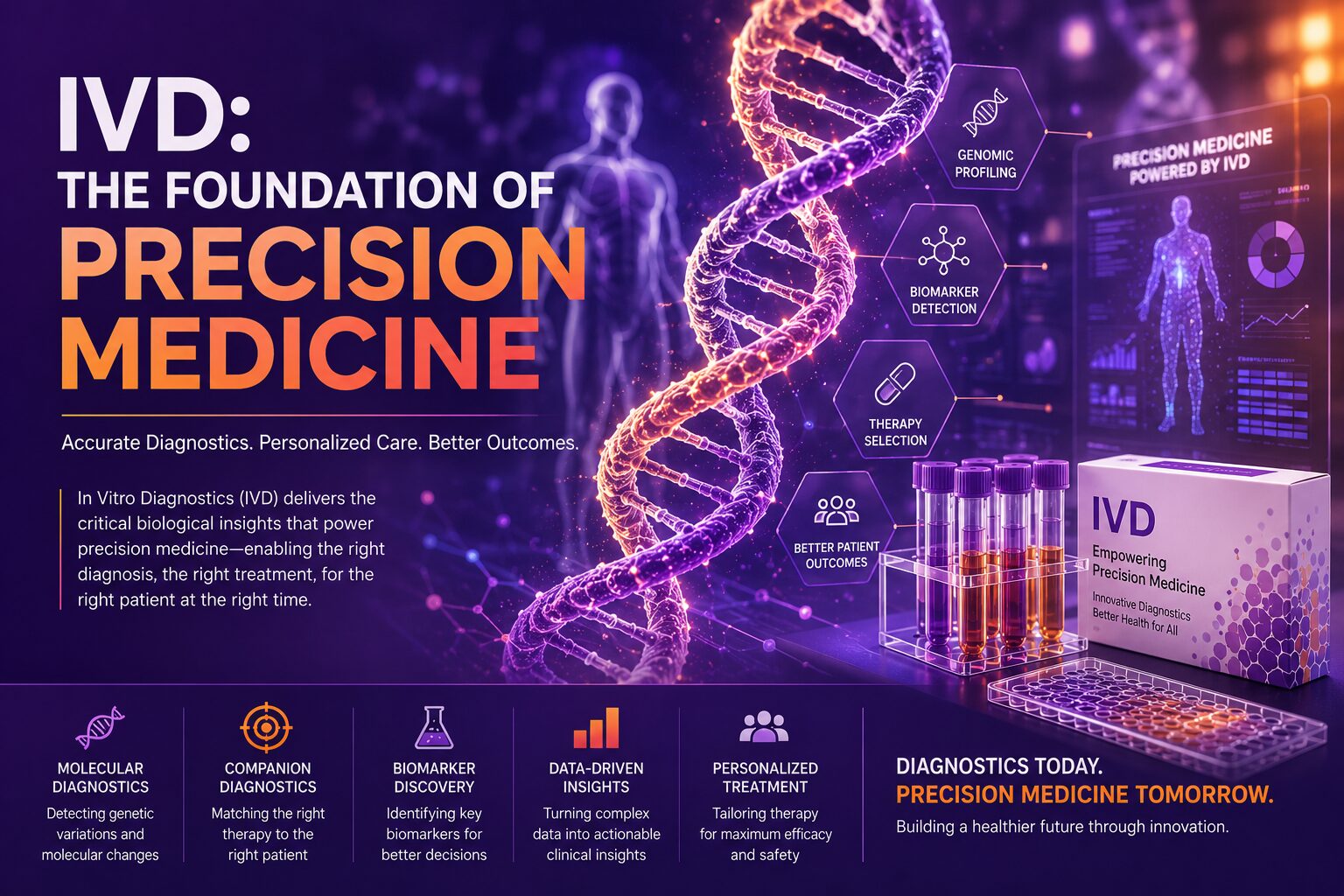
That capability comes from In Vitro Diagnostics (IVD).
Today, IVD is no longer merely a tool for disease detection. It has become the foundational infrastructure that enables precision medicine to move from scientific theory into clinical reality.
From One-Size-Fits-All Medicine to Precision Healthcare
Traditional medicine is largely reactive.
Patients develop symptoms, seek medical attention, receive a diagnosis, and begin treatment.
Precision medicine introduces a fundamentally different model.
Instead of asking:
“What disease does this patient have?”
Precision medicine asks:
“What specific biological mechanisms are driving this patient’s disease?”
Answering this question requires access to highly detailed biological information, including:
- Genetic mutations
- Gene expression patterns
- Protein biomarkers
- Metabolic signatures
- Immune system characteristics
- Microbiome composition
These data cannot be obtained through clinical observation alone.
They require advanced diagnostic technologies capable of analyzing biological samples at molecular resolution.
This is precisely where IVD becomes indispensable.
Why Diagnostics Are the Cornerstone of Precision Medicine
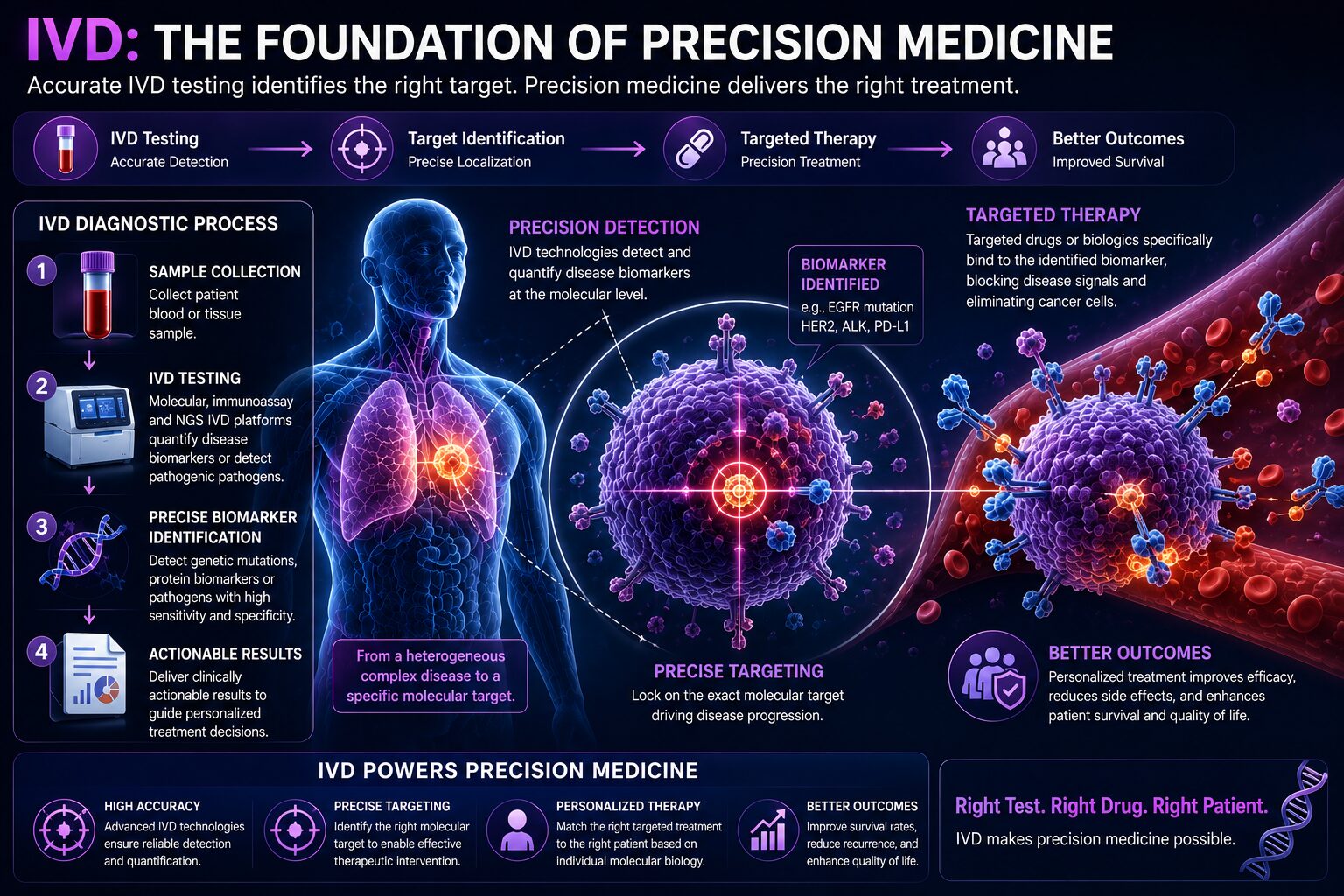
Precision medicine depends on three sequential steps:
- Identify biological differences
- Interpret clinical significance
- Guide individualized intervention
IVD enables all three.
Without diagnostics, precision medicine would be reduced to educated guesswork.
Every personalized treatment decision begins with diagnostic information.
Whether selecting a targeted oncology therapy, predicting drug response, monitoring disease progression, or assessing recurrence risk, clinicians rely on diagnostic data to make evidence-based decisions.
In practical terms:
No precision medicine exists without precision diagnostics.
Molecular Diagnostics: The Engine Behind Personalized Care
Among all diagnostic technologies, molecular diagnostics has become the primary driver of precision medicine.
Molecular diagnostic tests analyze DNA, RNA, and other genetic materials to identify disease-associated biological changes.
These technologies include:
- Polymerase Chain Reaction (PCR)
- Real-Time PCR (qPCR)
- Digital PCR (dPCR)
- Next-Generation Sequencing (NGS)
- Liquid Biopsy
- Cell-Free DNA Analysis
- Multi-Gene Panels
Unlike conventional testing, molecular diagnostics reveals the underlying biological mechanisms responsible for disease development.
This information allows physicians to move beyond symptom-based treatment toward mechanism-based intervention.
As a result, molecular diagnostics has become one of the fastest-growing sectors in healthcare worldwide.
Oncology: The Most Visible Success Story of Precision Medicine
Cancer provides one of the clearest examples of how IVD enables precision medicine.
Historically, cancers were classified according to their anatomical location:
- Lung Cancer
- Breast Cancer
- Colon Cancer
- Melanoma
Today, oncologists increasingly classify cancers according to their molecular characteristics.
For example:
A patient with non-small cell lung cancer may undergo testing for:
- EGFR mutations
- ALK rearrangements
- ROS1 fusions
- BRAF mutations
- KRAS mutations
- MET alterations
Each biomarker can influence treatment selection.
A targeted therapy may be highly effective for one genetic subtype while providing no benefit to another.
Without molecular diagnostic testing, physicians would be unable to determine which patients are likely to respond.
Modern precision oncology therefore depends on a close partnership between therapeutics and diagnostics.
Companion Diagnostics: Connecting Diagnostics and Therapeutics
One of the most important developments in precision medicine is the rise of companion diagnostics (CDx).
A companion diagnostic is a diagnostic test that provides information essential for the safe and effective use of a specific therapeutic product.
Regulatory agencies increasingly require companion diagnostics alongside targeted therapies.
The reason is simple.
A drug may only work in patients carrying a specific biomarker.
Administering the treatment to biomarker-negative patients can increase costs while exposing patients to unnecessary risks.
Companion diagnostics help identify:
- Likely responders
- Non-responders
- Patients at risk of adverse events
- Optimal treatment candidates
As precision medicine expands, companion diagnostics are becoming integral components of modern drug development.
Genomics and the Expansion of Precision Medicine
The rapid decline in sequencing costs has transformed genomics into a routine clinical tool.
According to the National Human Genome Technology Institute (NHGRI), the cost of sequencing a human genome has fallen from approximately $100 million in 2001 to less than $1,000 today.
This remarkable technological progress has enabled broader adoption of:
- Whole Genome Sequencing (WGS)
- Whole Exome Sequencing (WES)
- Targeted Gene Panels
- Pharmacogenomic Testing
Genomic diagnostics now support clinical decision-making across numerous specialties, including:
- Oncology
- Rare Diseases
- Cardiology
- Neurology
- Reproductive Medicine
As sequencing technologies continue to improve, genomics is expected to become a routine component of healthcare delivery.
Precision Medicine Beyond Cancer
Although oncology often receives the most attention, precision medicine is rapidly expanding into many other medical fields.
Rare Genetic Disorders
Genomic testing has dramatically improved diagnostic rates for previously unexplained diseases.
Many patients who once spent years seeking answers can now receive molecular diagnoses within weeks.
Cardiovascular Disease
Genetic testing can identify inherited cardiac conditions and guide preventive interventions.
Infectious Diseases
Molecular diagnostics can identify pathogens, antimicrobial resistance markers, and outbreak patterns with unprecedented speed.
Autoimmune Disorders
Biomarker testing helps stratify patients and optimize treatment strategies.
Neurological Diseases
Emerging biomarkers are improving the early detection of neurodegenerative disorders such as Alzheimer’s disease.
The future of precision medicine extends far beyond oncology.
Artificial Intelligence and the Next Era of Precision Diagnostics
Precision medicine generates enormous volumes of biological data.
Interpreting these datasets increasingly requires artificial intelligence and advanced computational tools.
Modern diagnostic platforms produce information across multiple biological dimensions:
- Genomics
- Transcriptomics
- Proteomics
- Metabolomics
- Clinical Data
Artificial intelligence enables researchers and clinicians to identify patterns that would be impossible to detect manually.
Future diagnostic systems are expected to integrate:
- Multi-omics analysis
- Real-time clinical decision support
- Predictive disease modeling
- Personalized risk assessment
The convergence of diagnostics and AI is likely to define the next generation of precision medicine.
Economic and Healthcare Impact
Precision medicine is not only transforming clinical outcomes but also improving healthcare efficiency.
Accurate diagnostics can:
- Reduce unnecessary treatments
- Improve therapeutic effectiveness
- Lower adverse event rates
- Accelerate clinical decision-making
- Optimize healthcare resource allocation
For pharmaceutical companies, precision diagnostics increase the probability of clinical trial success.
For healthcare systems, they support more efficient and sustainable care delivery.
For patients, they improve the likelihood of receiving the right treatment at the right time.
The Future: Precision Medicine Begins with Diagnostics
Precision medicine is often described as the future of healthcare.
In reality, it is already reshaping clinical practice today.
However, personalized therapies, targeted drugs, and AI-powered healthcare systems all depend upon a single foundational capability: accurate biological measurement.
That capability is provided by In Vitro Diagnostics.
As genomics, artificial intelligence, digital health, and molecular medicine continue to advance, diagnostics will become even more deeply integrated into every stage of healthcare decision-making.
The future of medicine will not be defined solely by new drugs or advanced therapies.
It will be defined by our ability to understand the unique biology of every individual patient.
And that journey begins with diagnostics.
Precision medicine represents one of the most significant transformations in the history of healthcare.
Its promise is simple but profound: delivering the right intervention to the right patient at the right time.
Achieving that goal requires accurate, actionable, and clinically meaningful biological information.
IVD provides the data foundation that makes this possible.
From molecular diagnostics and companion diagnostics to genomics, biomarker discovery, and AI-powered healthcare, every major advancement in precision medicine depends on diagnostic innovation.
As healthcare moves toward increasingly individualized care, IVD will continue to serve as the indispensable foundation upon which the future of precision medicine is built.
Author Profile

- Written by the IVDCDMO technical and regulatory team, with expertise in diagnostic assay development, GMP manufacturing, ISO 13485 systems, and global IVD commercialization for biotech innovators worldwide.
Latest entries
 Assay DevelopmentSeptember 23, 2026CDMO Custom Development of Test Kits: From Assay Concept to Scalable IVD Manufacturing
- IVD ManufacturingJuly 24, 2026Manufacturing for IVD Products: From Assay Transfer to Reliable Commercial Supply
- IVD ManufacturingJuly 13, 2026IVD Contract Manufacturing Cost: NRE, Tooling, Validation, MOQ and Unit Economics
- KnowledgeJuly 6, 2026IVD CDMO vs CRO vs CMO: Which Partner Do You Need at Each Development Stage?