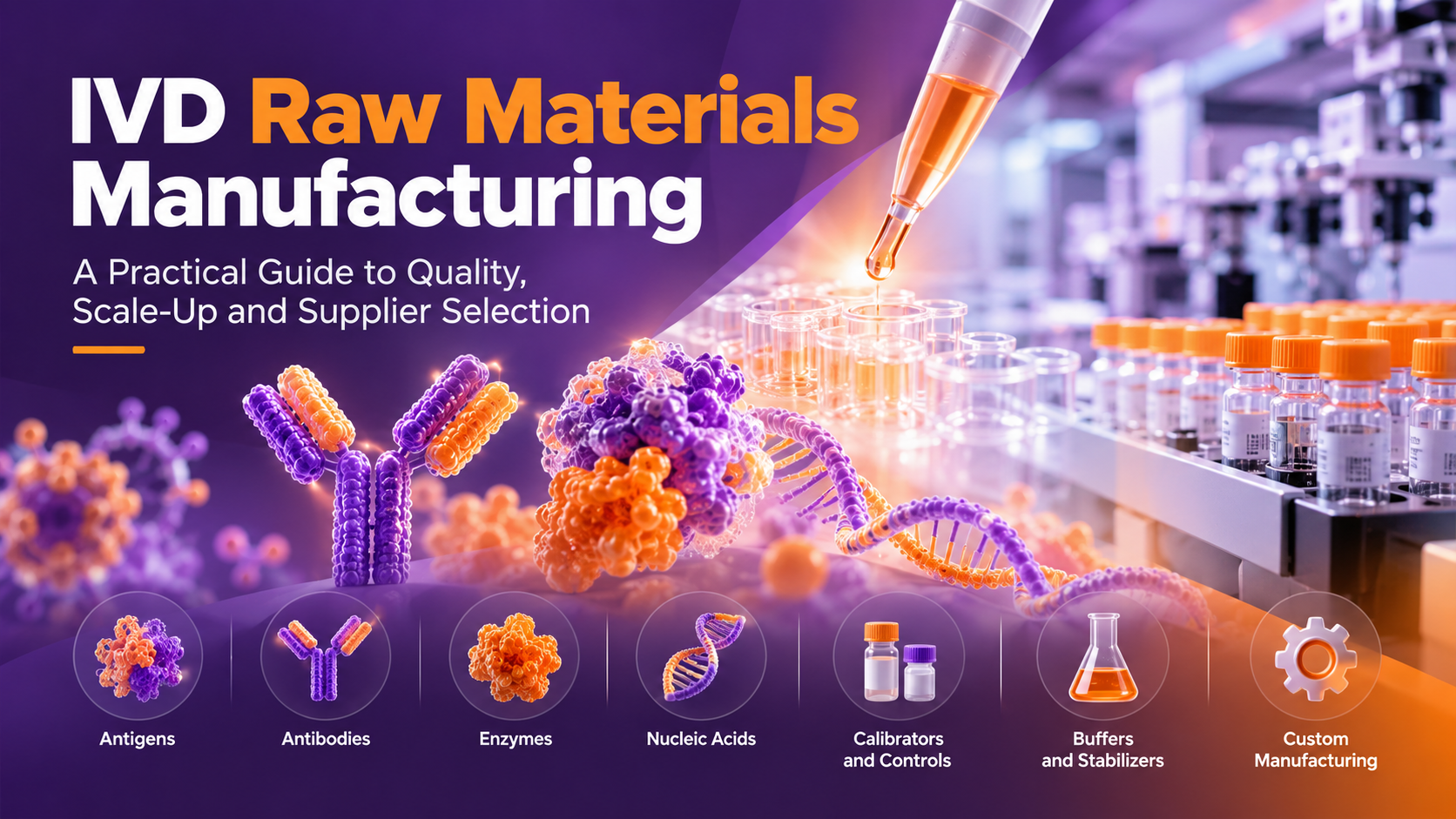
IVD Raw Materials Manufacturing Is Where Diagnostic Performance Begins
The performance of an in vitro diagnostic assay is often discussed in terms of sensitivity, specificity, precision, detection limits and clinical agreement. Yet many of these outcomes are determined much earlier—at the IVD raw materials manufacturing stage.
Antigens, antibodies, enzymes, nucleic acids, reference materials, proteins, blockers and other critical reagents form the biochemical foundation of modern diagnostic products.
A high-performing assay cannot reliably compensate for a poorly characterized critical raw material.
For an IVD developer, therefore, selecting a raw material is not simply a purchasing decision. It is a combination of analytical performance, manufacturing consistency, supply-chain management, change control, documentation and lifecycle risk management.
This distinction becomes especially important when an assay moves from feasibility research to verification, validation, regulatory submission and commercial production.
A reagent that performs well in ten laboratory experiments is not automatically a suitable material for manufacturing one million diagnostic tests.
The real challenge is reproducibility at scale.
What Are IVD Raw Materials?
IVD raw materials are biological, biochemical or chemical components used to develop and manufacture reagents, calibrators, controls and other functional components of in vitro diagnostic products.
Depending on the diagnostic technology, these materials may include:
| Category | Typical Materials | Common Applications |
|---|---|---|
| Antigens | Recombinant proteins, native antigens, peptides | Infectious disease and antibody detection |
| Antibodies | Monoclonal, polyclonal, recombinant antibodies | Immunoassays, lateral flow, CLIA, ELISA |
| Enzymes | Polymerases, reverse transcriptases, nucleases, phosphatases | PCR, RT-PCR, sequencing, immunoassays |
| Nucleic Acids | DNA, RNA, oligonucleotides, synthetic targets | Molecular diagnostics and controls |
| Proteins | Binding proteins, conjugation proteins, carrier proteins | Immunodiagnostics |
| Calibrator Materials | Characterized analytes and matrices | Quantitative assays |
| Control Materials | Positive, negative and multi-level controls | Quality control and assay verification |
| Blocking Reagents | Proteins, polymers and specialized blockers | Reduction of nonspecific interactions |
| Substrates | Chromogenic, fluorescent or chemiluminescent substrates | Signal generation |
| Buffers & Stabilizers | Salts, proteins, preservatives, surfactants | Reagent formulation and stability |
Not every material carries the same level of risk.
A critical antibody determining assay specificity, for example, normally requires substantially greater characterization and supplier control than a routine formulation ingredient whose variability has little impact on diagnostic performance.
This is why sophisticated IVD manufacturers increasingly apply risk-based raw material management rather than treating every incoming material identically.
How IVD Raw Materials Are Manufactured
There is no single manufacturing process applicable to all diagnostic raw materials.
The appropriate process depends on whether the product is a recombinant antigen, monoclonal antibody, enzyme, nucleic acid, control material or another reagent.
However, a robust IVD raw materials manufacturing process usually follows the same fundamental lifecycle:
Material design → source selection → process development → upstream production → downstream purification → characterization → formulation → quality control → stability assessment → lot release → controlled storage
Each stage can influence final assay performance.
1. Target Definition and Material Design
Manufacturing begins before the production line.
The supplier and IVD developer must first define what the material is expected to accomplish inside the assay.
For an antigen, important considerations may include:
- target protein or epitope;
- full-length versus fragment design;
- expression system;
- folding requirements;
- post-translational modifications;
- solubility;
- tag configuration;
- expected cross-reactivity;
- downstream assay format.
For antibodies, developers must consider affinity, specificity, epitope recognition, cross-reactivity, antibody class, conjugation compatibility and performance within the intended assay architecture.
For molecular diagnostic enzymes, relevant parameters may include catalytic activity, inhibitor tolerance, thermostability, fidelity, processivity and compatibility with the intended reaction chemistry.
The technically “purest” raw material is therefore not necessarily the best diagnostic raw material.
Functional suitability matters more than purity alone.
Recombinant Antigen Manufacturing
Recombinant antigens are widely used in infectious disease testing, serology, immunoassays and other diagnostic applications.
A typical manufacturing workflow includes:
Gene and Construct Design
The target sequence is selected and optimized for the chosen expression platform.
Developers may need to evaluate conserved regions, immunodominant epitopes, undesirable cross-reactive sequences and structural characteristics.
Expression
Common expression systems include:
- E. coli;
- yeast;
- insect cells;
- mammalian cells.
Each platform involves trade-offs in cost, scalability, protein folding and post-translational modification.
For relatively simple recombinant proteins, bacterial expression can offer attractive manufacturing economics and scalability.
Proteins requiring more complex folding or glycosylation may require eukaryotic expression systems.
Purification
Depending on the molecule and intended application, purification may involve combinations of:
- affinity chromatography;
- ion-exchange chromatography;
- size-exclusion chromatography;
- filtration;
- precipitation;
- ultrafiltration and diafiltration.
The goal should not simply be a high numerical purity specification.
The purification strategy should remove impurities capable of interfering with the intended diagnostic reaction while maintaining the functional integrity of the target protein.
Characterization
Testing may include identity, purity, concentration, molecular weight, functional activity and other product-specific attributes.
Where relevant, additional testing may address aggregation, host-cell contaminants, residual nucleic acids or microbial contamination.
Antibody Manufacturing for IVD Applications
Antibodies remain among the most important raw materials in immunodiagnostics.
They may function as capture antibodies, detection antibodies, conjugated reagents or components of controls and calibrators.
Common antibody types include:
Monoclonal Antibodies
Monoclonal antibodies provide defined specificity and are widely used where controlled epitope recognition and long-term reproducibility are important.
Polyclonal Antibodies
Polyclonal antibodies recognize multiple epitopes and can provide strong signal intensity in some applications.
However, biological variability and long-term supply continuity require careful management.
Recombinant Antibodies
Recombinant technologies can offer advantages in sequence definition, engineering capability and manufacturing reproducibility.
Regardless of antibody format, IVD developers should evaluate actual assay performance rather than relying exclusively on general specifications such as concentration or purity.
Two antibodies against the same analyte can behave very differently in the same diagnostic system.
Enzyme Manufacturing for Molecular Diagnostics
The growth of PCR, RT-PCR, isothermal amplification and other molecular diagnostic technologies has made diagnostic-grade enzymes increasingly important.
Common materials include:
- DNA polymerases;
- reverse transcriptases;
- hot-start polymerases;
- ligases;
- nucleases;
- proteases;
- phosphatases;
- other assay-specific enzymes.
For molecular diagnostics, small variations in enzyme performance may influence amplification efficiency, background signal, detection limits or robustness.
Important attributes can therefore include:
activity, purity, stability, inhibitor tolerance, reaction compatibility and lot-to-lot consistency.
An enzyme intended for high-volume commercial diagnostics should also be evaluated under realistic manufacturing and storage conditions rather than only under optimized research laboratory conditions.
Why Lot-to-Lot Consistency Is One of the Biggest Challenges
For commercial IVD manufacturing, one excellent batch is not enough.
The supplier must be capable of manufacturing the material repeatedly within specifications.
This is especially challenging for biological materials.
Variability can arise from:
- biological source material;
- cell culture conditions;
- fermentation parameters;
- purification processes;
- reagent preparation;
- equipment;
- operators;
- analytical methods;
- storage;
- transportation.
Even relatively subtle changes may affect a sensitive diagnostic assay.
For example, an antibody lot can meet general purity and concentration specifications while producing a different signal-to-background ratio in the finished test.
That is why raw material qualification should include application-relevant functional testing whenever justified by risk.
Quality Control in IVD Raw Materials Manufacturing
A professional IVD raw materials manufacturer should establish specifications appropriate to the material’s intended use and manufacturing process.
Depending on the product, testing may include:
Identity
Confirms that the manufactured material is the intended molecule or analyte.
Purity
Evaluates unwanted components using methods appropriate to the material.
Concentration
Determines the amount of active or total material.
Functional Activity
Measures whether the material performs its intended biological or biochemical function.
Specificity
Particularly important for antibodies, antigens and nucleic-acid-based reagents.
Cross-Reactivity
Assesses interactions with potentially interfering targets where relevant.
Stability
Evaluates whether the material maintains required characteristics during defined storage conditions.
Microbiological Attributes
Where relevant to the material and manufacturing process, microbial contamination, bioburden or related parameters may need to be controlled.
The appropriate test panel should always be determined by the material, process, intended application and associated risk.
Certificate of Analysis: Important, but Not Enough
A Certificate of Analysis is an important supplier document, but procurement teams should not confuse a CoA with comprehensive supplier qualification.
A CoA usually confirms that a particular lot met defined release specifications.
It does not necessarily answer broader questions such as:
- How robust is the manufacturing process?
- How are reference standards controlled?
- How is lot-to-lot consistency demonstrated?
- What happens when the process changes?
- How are deviations investigated?
- How are critical suppliers managed?
- How long are production records retained?
- Can the same material be supplied five years from now?
- Will customers receive advance notification of significant changes?
These questions become increasingly important as an IVD program approaches commercialization.
ISO 13485 and IVD Raw Material Manufacturing
ISO 13485 provides an internationally recognized quality management framework for organizations involved in the medical device supply chain.
Its relevance extends beyond finished-device manufacturers and can include organizations supplying raw materials, components, subassemblies and contract manufacturing services.
For IVD developers, however, supplier certification should never become a substitute for supplier qualification.
ISO 13485 certification can provide useful evidence regarding the supplier’s quality management framework, but buyers should still evaluate whether the supplier’s actual controls are appropriate for the specific material and its role in the diagnostic product.
Supplier qualification should therefore be risk-based and material-specific.
The 2026 U.S. Quality Environment: Why Supplier Controls Matter More
The U.S. regulatory environment for medical-device manufacturing changed materially in 2026.
The FDA Quality Management System Regulation, or QMSR, became effective on February 2, 2026 and incorporates ISO 13485:2016 by reference into the U.S. device quality-system framework.
For global IVD companies, this further reinforces the practical importance of structured quality management, supplier controls, documented purchasing requirements, traceability and risk-based manufacturing processes.
Raw material manufacturers serving regulated diagnostic companies should understand that customers increasingly require more than a technical datasheet and CoA.
They need a defensible supply chain.
Risk Management Should Extend to Critical Raw Materials
ISO 14971 remains an important framework for medical-device risk management, including IVD medical devices.
From a raw material perspective, the practical question is straightforward:
What could happen to the performance or safety of the finished IVD if this material changes or fails?
For critical materials, manufacturers should consider risks associated with:
- incorrect identity;
- loss of activity;
- contamination;
- cross-reactivity;
- degradation;
- manufacturing drift;
- supplier process changes;
- discontinuation;
- transportation excursions;
- inadequate traceability.
The level of control should reflect the potential effect on the finished diagnostic product.
Reference Materials and Metrological Traceability
Quantitative IVDs create additional challenges.
Where measurement results depend on calibration hierarchies and reference systems, appropriate reference materials become fundamental to measurement comparability.
ISO 15194:2026 addresses requirements for certified reference materials of higher metrological order and their supporting documentation within calibration hierarchies used in laboratory medicine.
For IVD developers, this highlights an important distinction:
a general-purpose biological raw material and a reference material intended to support metrological traceability are not interchangeable concepts.
Quantitative assay developers should establish their calibration and traceability strategy early rather than attempting to solve it after assay development is nearly complete.
Stability Is a Manufacturing Attribute, Not an Afterthought
Raw materials can change during storage.
Proteins may aggregate or degrade. Enzymatic activity may decline. Nucleic acids may degrade. Antibody binding characteristics can change under unfavorable conditions.
Therefore, stability programs should be designed according to the characteristics of the material and its intended storage and transport conditions.
Relevant studies may include:
- real-time stability;
- accelerated stability;
- freeze-thaw evaluation;
- transportation simulation;
- temperature excursion studies;
- in-use stability.
Stability claims should be supported by appropriate data rather than assumptions.
Scaling from R&D to Commercial IVD Manufacturing
One of the most expensive mistakes in diagnostic development is selecting a material based entirely on small-scale research performance.
An R&D supplier may provide an excellent 1 mg sample.
Commercial production may require grams, tens of grams or substantially more over the product lifecycle.
The questions then change.
Can the supplier scale production without changing critical material attributes?
Can the process maintain reproducibility?
Can production capacity support forecast demand?
Are critical starting materials secured?
Is there an appropriate change-notification mechanism?
Can the supplier maintain documentation throughout the commercial lifecycle?
This is the difference between research reagent sourcing and commercial IVD raw materials manufacturing.
Custom IVD Raw Materials Manufacturing
Off-the-shelf materials are not always sufficient.
Custom manufacturing may be required when an assay needs:
- proprietary recombinant antigen design;
- custom antibody development;
- specific epitope recognition;
- modified enzymes;
- customized conjugation;
- defined nucleic acid controls;
- specialized calibrators;
- optimized blockers;
- specific buffer formulations;
- OEM packaging or bulk supply.
A capable custom IVD raw materials manufacturer should be able to support the transition from technical requirement to scalable manufacturing.
A typical program may include:
Requirement definition → feasibility → prototype material → analytical characterization → application testing → process optimization → pilot batch → scale-up → validation → routine manufacturing
The earlier manufacturing constraints are considered, the lower the risk of expensive redevelopment later.
What IVD Buyers Should Ask a Raw Material Manufacturer
Procurement price should rarely be the first question.
A more useful supplier qualification discussion should cover four areas.
Technical Capability
Ask:
- What production platform is used?
- What analytical methods are used for release?
- Can application-specific functional testing be performed?
- What manufacturing scale is available?
- Can custom development be supported?
Quality System
Evaluate:
- quality management system;
- lot traceability;
- deviation handling;
- CAPA processes;
- document control;
- change control;
- equipment and process controls;
- supplier management.
Supply Reliability
Determine:
- standard lead time;
- manufacturing capacity;
- safety-stock options;
- raw material sourcing risks;
- business continuity arrangements;
- batch reservation possibilities;
- lifecycle availability.
Documentation
Depending on the material and regulatory strategy, buyers may request:
- specification;
- Certificate of Analysis;
- Safety Data Sheet where applicable;
- traceability documentation;
- stability information;
- manufacturing information appropriate to the commercial relationship;
- quality agreements;
- change-notification commitments.
The documentation package should be determined by the material’s criticality and intended application.
The Hidden Cost of Choosing the Cheapest IVD Raw Material
Raw material pricing is easy to compare.
Failure costs are not.
Suppose Supplier A offers an antibody at a substantially lower unit price than Supplier B.
If Supplier A subsequently introduces an inconsistent production lot, the downstream cost could include:
- repeated verification;
- reagent re-optimization;
- failed manufacturing batches;
- additional stability studies;
- validation delays;
- regulatory documentation updates;
- delayed market launch;
- field complaints;
- product investigation.
For a commercial diagnostic product, these costs can greatly exceed the original raw-material savings.
Procurement should therefore evaluate total lifecycle risk, not merely price per milligram.
When Should You Consider a Second Source?
Single-source dependency is common in IVD development because biological materials can be difficult to replace.
Unfortunately, waiting until a supply interruption occurs is usually the worst time to qualify an alternative.
For high-risk materials, manufacturers should consider whether a second-source strategy is technically and economically justified.
This does not mean every raw material requires two suppliers.
Some proprietary biological materials may have no true interchangeable alternative.
The appropriate strategy may instead involve:
- increased safety stock;
- reserved manufacturing capacity;
- larger qualified lot purchases;
- technology transfer arrangements;
- long-term supply agreements;
- alternative material development.
The decision should be based on risk.
Change Control: One of the Most Important Supplier Requirements
A material can remain under the same catalog number while its manufacturing environment changes.
Possible changes include:
- manufacturing location;
- production equipment;
- expression system;
- purification process;
- critical starting material;
- analytical method;
- formulation;
- packaging;
- storage condition.
For a critical IVD raw material, these changes may affect downstream assay performance.
Commercial agreements should therefore clearly define which changes require notification and, where appropriate, customer assessment before implementation.
Strong change control protects both the raw material supplier and the IVD manufacturer.
A Practical Supplier Qualification Framework
When evaluating an IVD raw materials manufacturer, consider using a structured framework rather than relying solely on samples.
| Evaluation Area | Key Question |
|---|---|
| Identity | Is the material clearly characterized? |
| Functional Performance | Does it work in the intended assay? |
| Consistency | Is performance reproducible between lots? |
| Manufacturing | Is the process controlled and scalable? |
| Quality System | Are appropriate quality controls established? |
| Traceability | Can materials and manufacturing records be traced? |
| Stability | Is the claimed storage period supported? |
| Change Control | Will significant changes be communicated? |
| Capacity | Can future commercial demand be supported? |
| Documentation | Can required technical and quality documents be provided? |
| Supply Continuity | Is long-term availability credible? |
| Technical Support | Can the supplier investigate performance problems? |
This framework shifts supplier selection away from a simple purchasing exercise toward lifecycle risk management.
Common Mistakes in IVD Raw Material Sourcing
Choosing Materials Based Only on Datasheets
A specification sheet cannot reproduce the conditions of your assay.
Always evaluate critical materials in the actual or representative assay system.
Over-Focusing on Purity
High purity does not automatically mean high diagnostic performance.
Functional activity and application suitability are often more important.
Ignoring Lot Variation
Evaluate multiple production lots where justified, particularly before commercial lock-in.
Qualifying the Product but Not the Supplier
A good sample does not prove that the manufacturer can repeatedly supply the same quality at commercial scale.
Ignoring Change Notification
Undisclosed process changes can create significant downstream risk.
Waiting Too Long to Consider Scale-Up
Manufacturability should be evaluated before the assay architecture becomes difficult to change.
From Raw Material to Finished IVD: Think in Systems
The most effective IVD development teams do not treat raw materials, assay development, manufacturing and regulatory compliance as separate activities.
They consider the entire chain:
Raw material → reagent formulation → assay architecture → analytical performance → manufacturing process → quality control → stability → clinical performance → regulatory documentation → commercial supply
A change near the beginning of this chain can affect everything downstream.
That is why successful IVD raw materials manufacturing requires collaboration between molecular biology, immunology, analytical development, manufacturing engineering, quality assurance, regulatory affairs and supply-chain teams.
How IVDCDMO Supports IVD Raw Material Development and Manufacturing
For companies developing diagnostic products, identifying a technically suitable raw material is only one part of the challenge.
The larger objective is building a reliable pathway from concept to commercial manufacturing.
IVDCDMO connects global IVD developers with manufacturing and development resources across areas such as:
- recombinant antigens;
- monoclonal and recombinant antibodies;
- molecular diagnostic enzymes;
- nucleic acid materials;
- controls and calibrators;
- immunoassay raw materials;
- molecular diagnostic raw materials;
- custom reagent development;
- OEM and CDMO manufacturing;
- assay development and scale-up.
For custom programs, supplier selection should begin with the intended assay, target performance, expected manufacturing scale, regulatory market and required documentation—not simply a product catalog.
This approach makes it easier to identify manufacturing partners capable of supporting both technical development and long-term commercialization.
Frequently Asked Questions About IVD Raw Materials Manufacturing
What are the most important raw materials used in IVD manufacturing?
Common materials include antibodies, antigens, recombinant proteins, enzymes, nucleic acids, oligonucleotides, controls, calibrators, substrates, blockers, buffers and stabilizers. The exact materials depend on the diagnostic technology.
What is the difference between research-grade and IVD-grade raw materials?
There is no universal definition that automatically makes a material “IVD grade.” For commercial diagnostic use, the important considerations are whether the material has appropriate specifications, manufacturing controls, consistency, traceability, documentation, stability and supplier controls for its intended application.
Does an IVD raw material manufacturer need ISO 13485 certification?
The exact regulatory and quality requirements depend on the manufacturer’s role, jurisdiction and material. ISO 13485 certification can provide valuable evidence of an established medical-device quality management system, but certification alone does not eliminate the IVD manufacturer’s responsibility to qualify suppliers and materials appropriately.
Why is lot-to-lot consistency important for IVD raw materials?
Changes in antibodies, antigens, enzymes or other critical reagents can affect signal intensity, specificity, sensitivity, calibration or other assay characteristics. Consistency therefore becomes especially important after an assay has been validated and transferred into routine production.
How should I qualify a new IVD raw material supplier?
Qualification should consider technical performance, multiple-lot consistency where appropriate, manufacturing controls, quality systems, documentation, stability, change control, capacity, traceability and long-term supply capability.
Can IVD raw materials be custom manufactured?
Yes. Antigens, antibodies, recombinant proteins, enzymes, nucleic acids, controls, calibrators and other materials can be developed or manufactured to customer-specific requirements, depending on technical feasibility and regulatory considerations.
When should raw material suppliers be selected during IVD development?
Critical suppliers should ideally be evaluated early enough that manufacturability, scalability, quality and supply risks can be addressed before design verification, validation and commercialization make material replacement substantially more expensive.
Conclusion
Reliable diagnostics begin long before a patient sample reaches an analyzer or test cartridge.
They begin with controlled, characterized and reproducible raw materials.
For this reason, IVD raw materials manufacturing should be evaluated as a critical part of diagnostic product development rather than a commodity purchasing activity.
The best manufacturing partner is not necessarily the supplier offering the highest stated purity, the lowest unit price or the fastest initial sample.
For commercial IVD development, the more important questions are whether the supplier can deliver consistent functional performance, controlled manufacturing, appropriate documentation, reliable change management, scalable capacity and long-term supply continuity.
As global IVD quality systems become increasingly aligned around risk-based quality management, these capabilities will become even more important.
For diagnostic companies developing new immunoassays, molecular diagnostics, rapid tests or quantitative laboratory assays, early investment in raw material qualification can prevent expensive problems later in development—and create a much stronger foundation for successful commercialization.
Author Profile

- Written by the IVDCDMO technical and regulatory team, with expertise in diagnostic assay development, GMP manufacturing, ISO 13485 systems, and global IVD commercialization for biotech innovators worldwide.
Latest entries
 IVD ManufacturingNovember 2, 2026OEM IVD Manufacturing & Private Label Diagnostics: A Practical Guide from Product Concept to Market Launch
- IVD ManufacturingOctober 29, 2026IVD Manufacturing Company: A Complete Guide to Choosing the Right Diagnostic Manufacturing Partner
- IVD ManufacturingOctober 26, 2026IVD Raw Materials Manufacturing: A Practical Guide to Quality, Scale-Up and Supplier Selection
- IVD ManufacturingOctober 19, 2026In Vitro Diagnostic Contract Manufacturing Buyer Guide