Understanding China’s Medical Device MAH Framework and Its Impact on Innovation, Manufacturing, and Market Access
The global in vitro diagnostics (IVD) industry is undergoing a structural transformation. Increasingly complex technologies, rising regulatory requirements, and accelerating innovation cycles are reshaping how diagnostic products are developed, manufactured, and commercialized.
Historically, China required medical device applicants to own both product registration certificates and in-house production facilities. This vertically integrated model often created significant entry barriers for startups, research institutions, and asset-light technology innovators.
To address these challenges, China introduced the Medical Device Marketing Authorization Holder (MAH) framework, officially designated as the Registrant System. For the IVD industry, this regulatory reform decoupling product ownership from manufacturing represents one of the most significant policy shifts of the past decade.
Terminology Note: Throughout this guide, “Registrant System” refers specifically to the Medical Device MAH framework as applied to IVDs in China. While conceptually similar to pharmaceutical MAH systems globally, it operates under distinct medical device regulations governed by the National Medical Products Administration (NMPA).
What Is the IVD Registrant System?
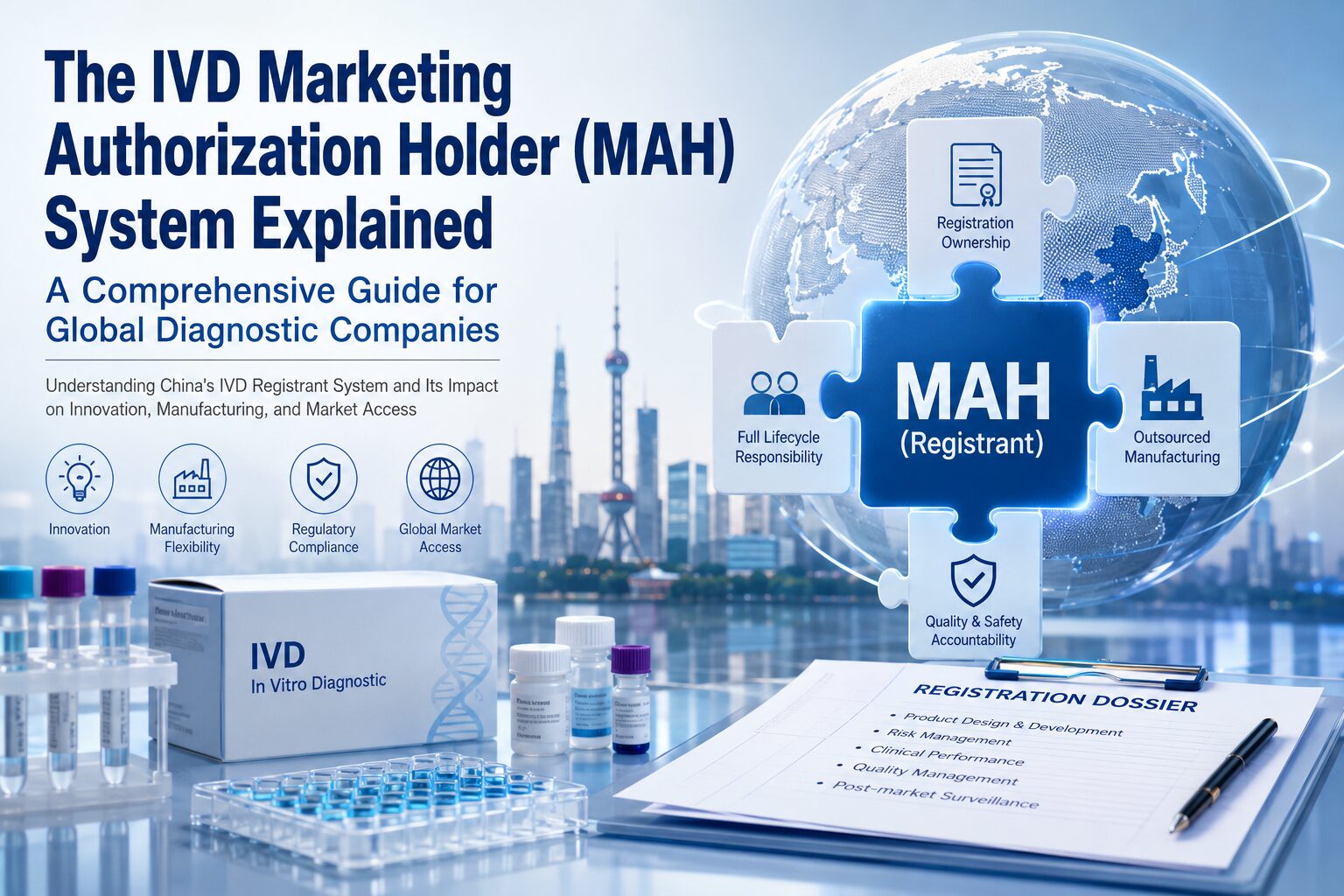
The IVD Registrant System allows an eligible enterprise or research institution (the Registrant) to hold the medical device registration certificate (or filing voucher) while commissioning the physical manufacturing activities to a qualified contract manufacturer (such as an IVD CDMO).
Under this framework:
- Ownership & Responsibility: The Registrant exclusively owns the product registration certificate and bears full, non-delegable legal and quality responsibilities throughout the product lifecycle.
- Outsourced Production: Manufacturing can be outsourced to an authorized contract manufacturer that possesses the corresponding production qualifications, provided the product does not fall under China’s Negative List for Entrusted Medical Device Manufacturing.
- Regulatory Accountability: Regulatory accountability remains solely with the Registrant. Regulatory authorities hold the Registrant directly liable for product safety, efficacy, and compliance non-conformities.
Note: IVD reagents used for blood screening and radioisotope-labeled IVD reagents are legally regulated as pharmaceutical products in China. They do not fall under the medical device framework and are excluded from the scope of this guide.
Regulatory Evolution of China’s Registrant System
China’s transition toward a registrant-based regulatory model occurred gradually through phased piloting before achieving nationwide enforcement.
Pilot Stage (2017–2019)
The Medical Device Registrant System pilot was first launched in the Shanghai Pilot Free Trade Zone in March 2017. It was subsequently expanded to other regional clusters, including Guangdong, Tianjin, Beijing, Jiangsu, and Zhejiang, to evaluate regulatory feasibility, promote industrial specialization, and optimize medical device resource allocation.
Formal Nationwide Implementation
The framework was fully codified into national law through two milestone regulatory updates:
- June 1, 2021: The revised Regulations for the Supervision and Administration of Medical Devices (State Council Order No. 739) came into force, officially establishing the Registrant System as the statutory standard nationwide.
- October 1, 2021: Supporting rules, including the Measures for the Administration of Medical Device Registration and Filing and the Measures for the Supervision and Administration of Medical Device Production, took effect to provide explicit implementation procedures.
The system applies systematically to Class I, Class II, and Class III medical devices, including IVD reagents regulated as medical devices.
Core Principles: Non-Delegable Responsibilities
Although manufacturing operations may be outsourced to a CDMO, the Registrant’s legal and quality liabilities cannot be outsourced or transferred. The Registrant must maintain active, substantive oversight across the entire product lifecycle:
[Registrant: Full Lifecycle & Legal Accountability]
  │
  ├── Product Design & Development (Verification, Validation, Risk Management)
  ├── Regulatory Compliance (Submissions, Renewals, Technical Changes)
  ├── QMS Oversight (CDMO Audits, Supplier Control, Final Market Release)
  └── Post-Market Vigilance (Adverse Event Monitoring, Recalls, CAPA)
1. Product Design and Development
The Registrant must ensure comprehensive design verification, validation, and continuous risk management to guarantee that the product achieves its intended clinical performance safely and effectively.
2. Regulatory Compliance
The Registrant is responsible for compiling technical documentation, managing change controls, handling registration renewals, and maintaining direct communication with regulatory authorities.
3. Quality Management System (QMS) Oversight
The Registrant must establish a robust QMS that seamlessly connects with the contract manufacturer’s system. Critically, the Final Market Authorization Release of each batch is a statutory duty of the Registrant and cannot be delegated to the manufacturer.
4. Post-Market Vigilance
The Registrant must monitor adverse events, execute corrective and preventive actions (CAPA), handle customer complaints, and initiate product recalls when necessary.
Who Can Become an IVD Registrant in China?
The system accommodates diverse domestic market participants, provided they establish a compliant, operational entity within China:
- Biotechnology Startups: Innovative diagnostic developers can commercialize proprietary assays without heavy capital expenditure on manufacturing infrastructure.
- Technology and Technology Institutes: Academic and scientific bodies can bridge the gap between laboratory innovation and commercialization by holding the certificate and outsourcing production.
- Domestic Brand Operators: Companies focused on commercialization and marketing can leverage the CDMO model to remain asset-light.
- Foreign-Invested Enterprises (FIEs): International diagnostic firms can establish local subsidiaries in China to act as the “Domestic Registrant,” holding local registration certificates while utilizing domestic contract manufacturing networks.
Contract Manufacturing Mechanisms and Supervision
A compliant contract manufacturing arrangement requires a strict division of operational duties, legally codified through formal agreements.
| Entity | Core Responsibilities under the Registrant System |
| Registrant | • Holds full product ownership and regulatory liability. • Executes final market authorization release. • Conducts ongoing QMS audits of the manufacturer. • Manages post-market surveillance and adverse event reporting. |
| Contract Manufacturer (CDMO) | • Conducts GMP-compliant production in accordance with technical specifications. • Manages production process control, testing, and batch manufacturing records. • Executes internal production release. • Co-operates with the Registrant during regulatory inspections. |
Legal Instruments
The partnership must be governed by comprehensive, legally binding documents, including a Quality Agreement, a Technical Transfer Agreement, and a Manufacturing Contract that clearly define the regulatory responsibility matrix.
Enhanced Regulatory Supervision (NMPA Announcement No. 38)
To eliminate “shell companies” that hold certificates without true compliance capabilities, regulatory supervision has intensified. Under the NMPA’s strict enforcement framework:
- Substantive Capabilities: Registrants must possess independent quality management departments and retain qualified, full-time technical and quality management personnel capable of performing substantive lifecycle oversight.
- On-Site Verification: Regulatory inspections focus heavily on the Registrant’s ability to supervise the contract manufacturer’s critical processes and special validation states in real-time.
- Risk Mitigation: Registrants are strongly encouraged to secure commercial medical device liability insurance to reinforce risk-compensation capabilities.
Strategic Opportunities for Global IVD Companies
For global diagnostic enterprises, China’s Registrant System—paired with targeted localization policies—offers efficient pathways to serve the Chinese clinical market.
1. Legal Distinction for Localization
It is critical for international firms to understand that a foreign legal entity cannot directly act as a “Domestic Registrant” to outsource production to a Chinese CDMO. Instead, global companies establish a local subsidiary (a Foreign-Invested Enterprise) within China. This domestic subsidiary acts as the statutory Registrant, allowing the parent company to retain corporate control over the IP and registration while fully utilizing local CDMO capacity.
2. Accelerated Local Production (NMPA Announcement No. 30 Pathway)
Under NMPA policy frameworks optimizing the domestic production of imported medical devices, the transition from an import model to a localized model has been significantly streamlined:
- Data Reuse: Where a domestic applicant and a foreign registrant belong to the same actual controlling group, the domestic applicant may utilize the original data from the imported IVD product’s registration dossier (including non-clinical and clinical evaluation data) to support its domestic registration application.
- Strict Consistency Standard: To successfully utilize this pathway, the localized product must maintain absolute consistency with the original imported product regarding design, critical raw materials, manufacturing processes, and quality control metrics.
3. Supply Chain Agility
By working with established local IVD CDMOs, international brands can mitigate the massive capital risks of facility construction, accelerate validation cycles, and respond rapidly to localized market procurement requirements.
Compliance Challenges and Risk Mitigation
While the Registrant System accelerates market access, it demands sophisticated operational compliance:
- Technical Transfer Rigor: The transfer of complex IVD methodologies (e.g., molecular diagnostics or chemiluminescence assays) requires exhaustive process validation, analytical method verification, and batch reproducibility studies. Inadequate design transfer remains a leading cause of regulatory audit failures.
- Upstream Supply Chain Control: Registrants must maintain absolute transparency and control over core components, including enzymes, antibodies, antigens, and calibrators. Any material or supplier change initiated at the CDMO level must go through the Registrant’s formal change-control process and, where required, receive regulatory approval prior to implementation.
- Joint and Several Liability: In cases of severe non-compliance or public health risks, both the Registrant and the outsourced manufacturer are subject to coordinated regulatory investigations, with severe enforcement actions targeted directly at the Registrant’s legal representative and quality executives.
Summary
The Medical Device Registrant System has successfully decoupled innovation from manufacturing in China’s diagnostic sector. It offers global companies a legally secure, asset-light mechanism to manufacture locally via domestic subsidiaries and CDMO partners. However, compliance cannot be outsourced. Global enterprises must ensure their local持证 (certificate-holding) entities possess the substantive quality management infrastructure required to meet China’s strict, ongoing regulatory oversight.
FAQ
1. Can a foreign corporate entity directly act as a Registrant and outsource production to a Chinese CDMO?
No. Under current regulatory implementation, a foreign enterprise seeking to utilize a Chinese contract manufacturer must establish a compliant legal entity within China (such as a subsidiary) to serve as the Domestic Registrant. The foreign parent company cannot directly hold a domestic manufacturing-linked certificate as a non-resident entity.
2. Can a Registrant outsource all of its activities to a CDMO?
Only physical manufacturing and related operational testing operations may be outsourced. Core responsibilities—including design and development control, final market authorization release, supplier qualification approvals, and post-market clinical vigilance—must be executed independently by the Registrant and cannot be outsourced.
3. Are all IVD products eligible for contract manufacturing under this system?
Most IVD reagents and instruments regulated as medical devices are eligible. However, products that fall under China’s Negative List for Entrusted Medical Device Manufacturing or involve highly pathogenic pathogens face strict statutory prohibitions or operational restrictions. Additionally, blood screening and radioisotope-labeled reagents are classified as pharmaceuticals and are completely excluded from this device framework.
4. Does the use of multiple contract manufacturers simultaneously work well for IVD reagents?
While the overarching regulations legally permit a Registrant to commission multiple qualified manufacturers for the same product, it is exceptionally rare and operationally difficult in the IVD reagent sector. Because IVD assays are highly sensitive to micro-environments, raw material lots, and specific scaling equipment, maintaining identical batch uniformity across different CDMO facilities involves prohibitive bridging studies, change-control filings, and QMS alignment costs.
Author Profile

- Written by the IVDCDMO technical and regulatory team, with expertise in diagnostic assay development, GMP manufacturing, ISO 13485 systems, and global IVD commercialization for biotech innovators worldwide.
Latest entries
 Assay DevelopmentSeptember 23, 2026CDMO Custom Development of Test Kits: From Assay Concept to Scalable IVD Manufacturing
- IVD ManufacturingJuly 24, 2026Manufacturing for IVD Products: From Assay Transfer to Reliable Commercial Supply
- IVD ManufacturingJuly 13, 2026IVD Contract Manufacturing Cost: NRE, Tooling, Validation, MOQ and Unit Economics
- KnowledgeJuly 6, 2026IVD CDMO vs CRO vs CMO: Which Partner Do You Need at Each Development Stage?