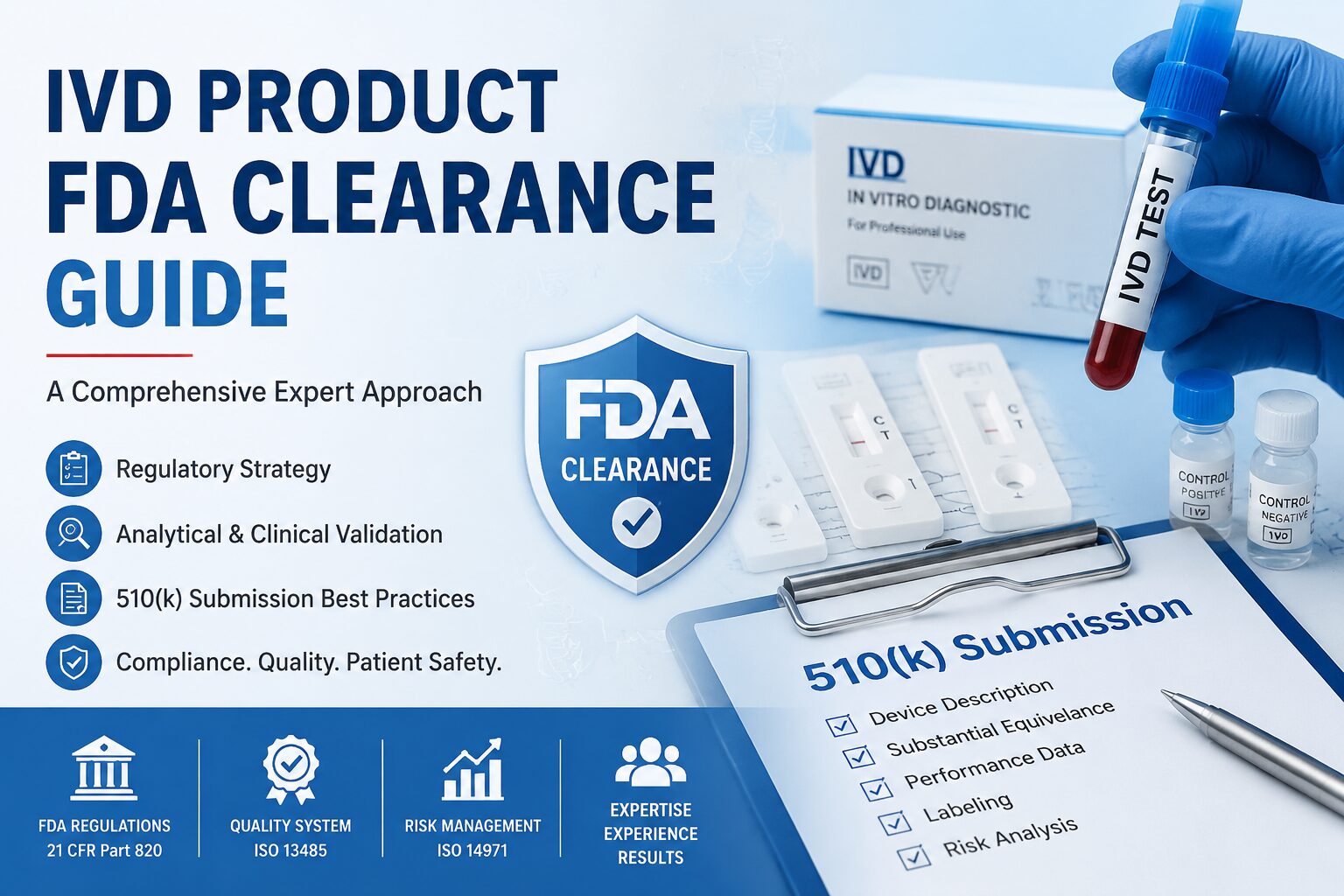
Achieving FDA clearance for an in-vitro diagnostic (IVD) product is a rigorous process that demands strategic planning, thorough understanding of regulatory requirements, and precise execution. For manufacturers, CDMOs, and startups entering the U.S. market, mastering the FDA clearance pathway is critical for market access, compliance, and patient safety.
This guide delivers a practical, step-by-step roadmap to navigate FDA regulations, covering classification, pre-submission strategies, testing protocols, documentation, and submission management. The content reflects real-world operational experience in IVD product development, grounded in FDA standards and industry best practices.
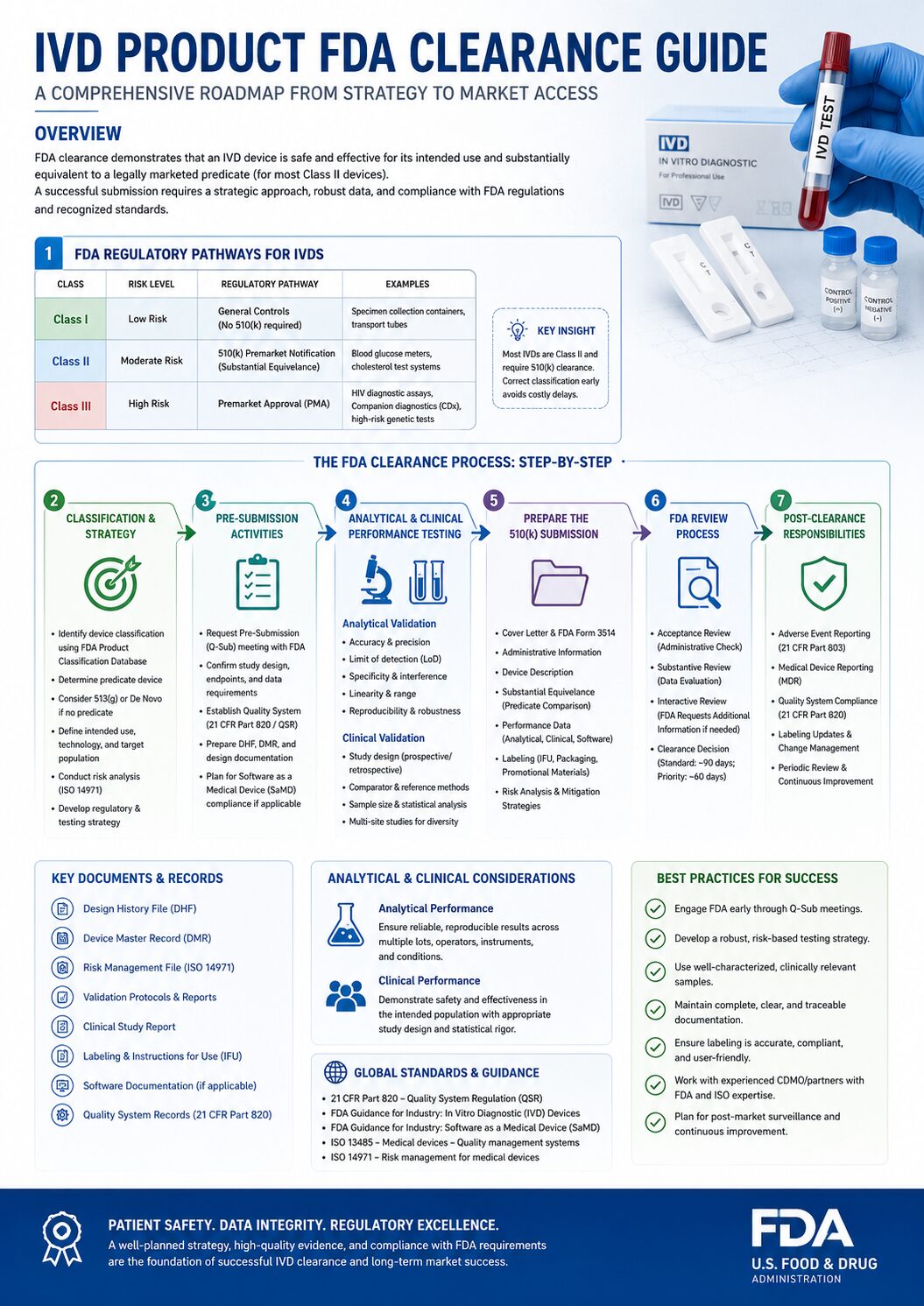
1. Understanding FDA Regulatory Pathways for IVDs
The FDA classifies medical devices, including IVDs, based on risk to patients and complexity of use:
- Class I (Low Risk): Minimal risk; subject to general controls. Examples: specimen collection containers such as sample cups and transport tubes.
- Class II (Moderate Risk): Requires 510(k) premarket notification demonstrating substantial equivalence to a legally marketed predicate. Examples: blood glucose meters.
- Class III (High Risk): Requires Premarket Approval (PMA) with extensive clinical validation. Examples: HIV diagnostic assays, companion diagnostics (CDx) and high-risk genetic disease detection assays.
Key Insight: Most IVDs fall under Class II. Determining the correct classification early is critical to avoid submission delays.
2. IVD Product Classification and Regulatory Strategy
a) Device Classification
- Review FDA’s Product Classification Database to identify your IVD category.
- If no legally marketed predicate device is available, you may submit a 513(g) Device Classification Request or proceed with a De Novo Classification Request.
b) Regulatory Strategy Development
- Align intended use, target population, and technology with FDA classification.
- Conduct a risk-based assessment to determine necessary analytical and clinical studies in line with ISO 14971.
- Plan for labeling compliance, including intended use statement, warnings, and Instructions for Use (IFU).
Pro Tip: Partnering with an experienced IVD CDMO during the planning phase can help optimize device design and testing to meet FDA expectations.
3. Pre-Submission Activities
a) Pre-Submission Meetings (Q-Sub)
- FDA encourages Q-Sub meetings to clarify testing protocols, study design, and submission format.
- Prepare detailed questions regarding:
- Clinical trial endpoints
- Analytical validation protocols
- Comparator devices and reference materials
b) Documentation Preparation
- Design History File (DHF) and Device Master Record (DMR) must be maintained in accordance with 21 CFR Part 820 (Quality System Regulation, QSR).
- For IVD products integrated with software or algorithms, compile complete documentation for Software as a Medical Device (SaMD) as required by FDA rules.
- Core documents to prepare:
- Device description and specifications
- Risk analysis (ISO 14971)
- Labeling drafts
- Validation protocols
4. Analytical and Clinical Performance Testing
a) Analytical Validation
- Ensure robust testing covering:
- Accuracy and precision
- Limit of detection (LoD)
- Specificity and interference
- Linearity and range
- Follow FDA dedicated guidance for IVDs, including Guidance for Industry: Validation of Analytical Procedures for In Vitro Diagnostic Devices. Additional specialized guidelines apply to molecular assays, point-of-care (POC) tests and other segmented IVD products.
b) Clinical Validation
- Demonstrate the device’s safety and effectiveness in intended use populations. FDA enforces stricter clinical requirements for over-the-counter (OTC) at-home IVD products compared to professional-use diagnostics.
- Key considerations:
- Study design (prospective vs. retrospective)
- Comparator selection
- Sample size and statistical analysis
- Multi-site trials for diversity and reliability
Tip: Collaborating with a CDMO with ISO 13485-compliant facilities ensures that sample handling and testing align with FDA expectations.
5. Preparing the 510(k) Submission
For most Class II IVDs, the 510(k) premarket notification includes:
- Cover Letter and FDA Form 3514
- Administrative Information: Manufacturer, contact info, device name
- Device Description: Technology, components, mechanism of action
- Substantial Equivalence Justification: Predicate comparison table
- Performance Data: Analytical, clinical, and software validation
- Labeling: IFU, packaging, and promotional materials
- Risk Analysis & Mitigation Strategies
Pro Insight: Use a clear, organized submission structure with cross-referenced data tables to reduce FDA review cycles.
6. FDA Review Process
- Acceptance Review (Administrative check) – ensures submission completeness.
- Substantive Review – evaluates substantial equivalence, analytical and clinical data.
- Interactive Review – FDA may request additional data (Additional Information, AI).
- Clearance Decision – A standard 510(k) review takes approximately 90 days, while priority 510(k) pathways feature shortened review timelines.
Strategic Tip: Early engagement with the FDA and thorough pre-submission documentation minimizes additional information requests, accelerating clearance.
7. Post-Clearance Compliance
- Maintain Quality System Regulation (QSR) compliance: 21 CFR Part 820.
- Establish a post-market surveillance plan:
- Complaint handling
- Adverse event reporting (MDR)
- Device tracking and recalls, if necessary
- Ensure labeling updates reflect the latest regulatory guidance.
8. Best Practices for IVD CDMOs
- Integrated Regulatory & Manufacturing Approach
- Align development, testing, and documentation early.
- Ensure ISO 13485-certified production for smooth regulatory submission.
- Data Integrity
- Maintain electronic and physical records with audit trails.
- Use validated software systems for data capture and reporting.
- Regulatory Intelligence
- Monitor FDA guidance updates, industry standards, and enforcement trends.
- Proactively update processes to maintain compliance.
- Global Market Readiness
- Consider simultaneous CE-IVD and FDA submissions.
- Harmonize analytical and clinical validation to reduce duplication.
Navigating FDA clearance for IVD products is a complex, multi-step process requiring expertise in regulatory science, clinical validation, and quality systems. By understanding classification, executing meticulous pre-submission planning, conducting robust validation, and maintaining post-market compliance, manufacturers can achieve timely FDA clearance while ensuring patient safety and market competitiveness.
Partnering with an experienced IVD CDMO accelerates this journey, providing technical, operational, and regulatory support, from concept to clearance.
Why Professional IVD CDMOs Improve FDA Clearance Success & Their Core Roles in IVD Commercialization
Many IVD developers struggle with prolonged review cycles, repeated additional information requests or even submission rejection when applying for FDA clearance. Teaming up with a professional IVD CDMO dramatically boosts the pass rate and streamlines the entire go-to-market process, thanks to the unique strengths and full-lifecycle capabilities of specialized CDMO institutions.
First, professional IVD CDMOs possess in-depth, up-to-date regulatory expertise. Their dedicated regulatory teams keep real-time track of FDA policy adjustments, guidance revisions and audit focuses for IVD devices. Unlike in-house teams that may lack cross-project experience, CDMO professionals are familiar with FDA’s review logic, common non-compliant pitfalls and predicate device matching rules. They formulate targeted classification strategies, complete standardized 510(k), De Novo or PMA documentation, and optimize content structure to match FDA’s review preferences, effectively avoiding foundational errors that lead to submission failure.
Second, CDMOs deliver fully compliant development and testing systems. Certified with ISO 13485 and operating under strict 21 CFR Part 820 QSR requirements, their laboratories and production facilities follow FDA-aligned operating standards throughout analytical validation, clinical sample testing and production. All test data, records and audit trails are generated in full compliance with FDA data integrity rules. Reliable, traceable and standardized test results eliminate data 质疑,which is one of the top reasons for FDA supplementary inquiries. Meanwhile, CDMOs can reasonably design clinical trial schemes, select qualified testing sites and control the whole process of sample management, ensuring clinical evidence meets FDA efficacy and safety requirements.
Third, CDMOs drive seamless cross-linkage across all project stages. FDA clearance is not an isolated submission work; it runs through R&D, design verification, manufacturing and labeling. Professional CDMOs adopt a one-stop model, unifying standards from product design, formula optimization and process development to final production and labeling drafting. They align design intent with regulatory requirements at the early R&D stage, rather than making remedial adjustments after development is completed. This front-end control prevents design defects that cannot pass FDA review, saving massive time and cost for revision.
Fourth, CDMOs support efficient FDA communication and response. They are experienced in organizing Q-Sub pre-submission meetings to confirm uncertain technical and regulatory issues in advance. Once the FDA issues Additional Information requests during the review phase, CDMO teams can quickly interpret official requirements, organize supplementary data and revise documents with professional precision, shortening the interactive review period significantly.
Beyond FDA clearance itself, IVD CDMOs play irreplaceable key roles in the full lifecycle of IVD product launch. After obtaining FDA clearance, they continue to support post-market quality control, complaint handling, adverse event reporting and annual compliance maintenance to help clients sustain long-term market compliance. For brands targeting both the U.S. and European markets, CDMOs can also harmonize validation data to support dual submission of FDA and CE-IVD, realizing global market layout with minimal repeated work.
In summary, a professional IVD CDMO acts as a regulatory navigator, compliant testing executor, full-process project manager and long-term compliance guardian. For IVD enterprises of all sizes, cooperating with a qualified CDMO is the most efficient and reliable way to cut through FDA regulatory barriers, accelerate product commercialization and secure long-term stable operation in the U.S. market.
Author Profile

- Written by the IVDCDMO technical and regulatory team, with expertise in diagnostic assay development, GMP manufacturing, ISO 13485 systems, and global IVD commercialization for biotech innovators worldwide.
Latest entries
 Assay DevelopmentSeptember 23, 2026CDMO Custom Development of Test Kits: From Assay Concept to Scalable IVD Manufacturing
- IVD ManufacturingJuly 24, 2026Manufacturing for IVD Products: From Assay Transfer to Reliable Commercial Supply
- IVD ManufacturingJuly 13, 2026IVD Contract Manufacturing Cost: NRE, Tooling, Validation, MOQ and Unit Economics
- KnowledgeJuly 6, 2026IVD CDMO vs CRO vs CMO: Which Partner Do You Need at Each Development Stage?