
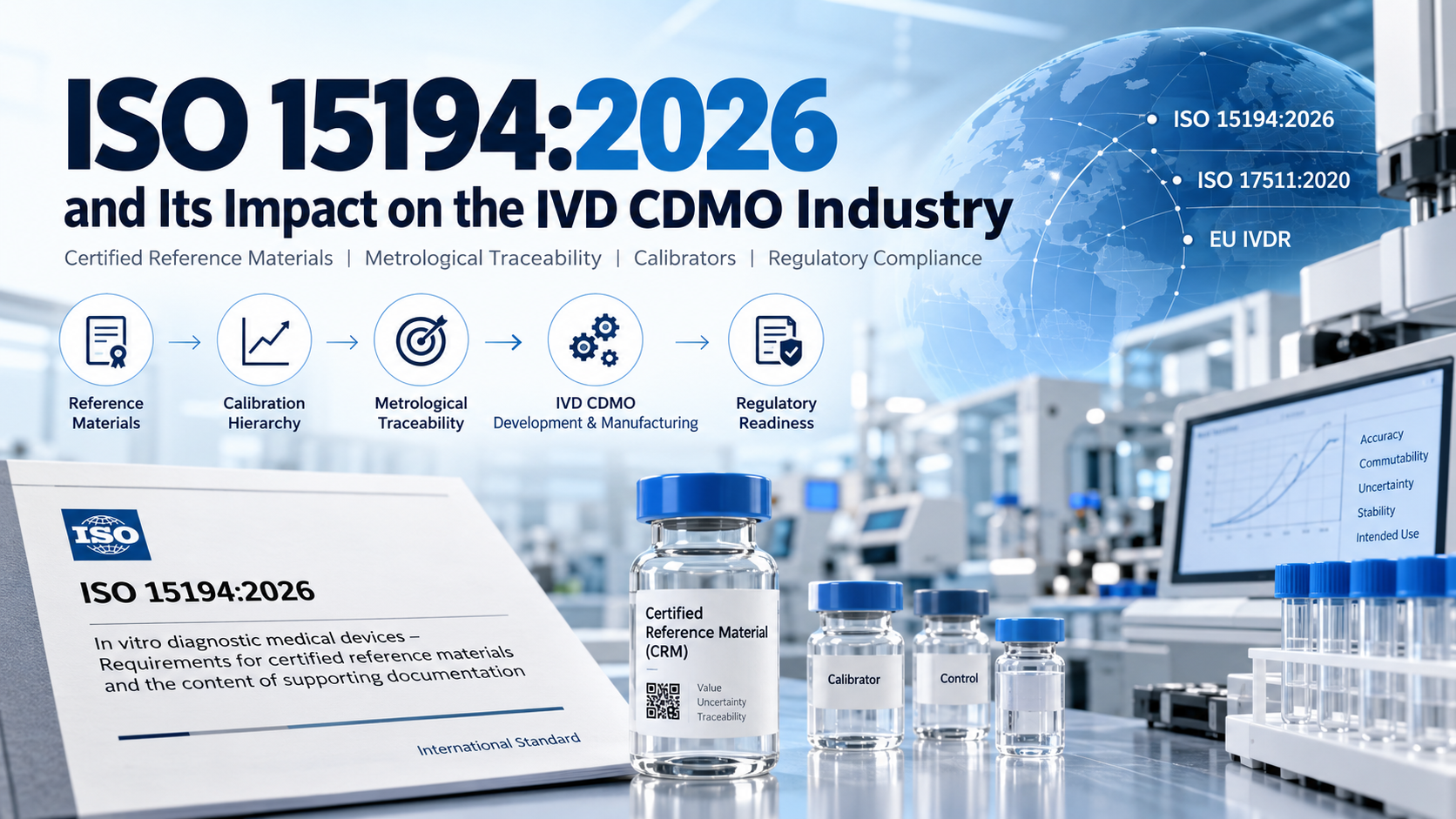
The publication of ISO 15194:2026 marks an important update to the international framework governing certified reference materials used at higher levels of metrological traceability in laboratory medicine.
For the IVD CDMO industry, the significance of the new standard goes beyond reference material producers themselves. Companies involved in assay development, calibrator development, control material manufacturing, analytical validation, reagent manufacturing, technology transfer, and regulatory documentation increasingly operate within the same metrological traceability chain.
ISO 15194:2026 therefore deserves attention from IVD manufacturers and their CDMO partners—particularly when developing quantitative assays whose calibration hierarchy ultimately relies on certified reference materials (CRMs).
The practical message is straightforward:
IVD development is moving toward more explicitly documented, scientifically defensible, and transparent metrological traceability.
For CDMOs, this means that choosing a reference material is no longer merely a purchasing decision. Its intended use, certified value, uncertainty, stability, homogeneity, commutability where applicable, and position within the calibration hierarchy can affect the scientific credibility of the entire measurement system.
What Is ISO 15194:2026?
ISO 15194:2026 — In vitro diagnostic medical devices — Requirements for certified reference materials and the content of supporting documentation is the third edition of the international standard.
It replaces ISO 15194:2009 and addresses certified reference materials of higher metrological order used within calibration hierarchies for laboratory medicine.
The standard applies to CRMs intended for roles such as:
- primary reference materials;
- secondary calibrators;
- international conventional calibrators;
- and trueness controls.
It also establishes requirements relating to determination of certified values, evaluation of those values, measurement uncertainty, intended use, and supporting documentation.
Importantly, ISO 15194:2026 should not be interpreted as a general manufacturing standard requiring every reagent, calibrator, control, or reference material produced by an IVD company or CDMO to become a CRM.
For example, an IVD manufacturer’s working calibrator or end-user calibrator within a calibration hierarchy is not automatically within the standard’s CRM scope. Nevertheless, some ISO 15194 principles may be useful when evaluating such materials.
That distinction is important for regulatory and technical teams seeking to avoid unnecessary compliance work.
What Changed in ISO 15194:2026?
The 2026 edition is a technical revision of ISO 15194:2009 rather than simply an editorial update.
One of its most important developments is closer alignment with the modern metrological traceability framework established by ISO 17511:2020.
The revision includes several important directions.
1. Closer Alignment with ISO 17511:2020
ISO 15194:2026 incorporates concepts, terminology, and requirements intended to make the standard consistent with ISO 17511:2020.
This matters because reference materials should not be evaluated in isolation.
They exist within a calibration hierarchy.
For an IVD measurement system, the central question is therefore not simply:
“Do we have a reference material?”
The more meaningful question is:
“How does the assigned value of our end-user result connect through a documented calibration hierarchy to the highest available metrological reference?”
That shift has major implications for IVD development.
2. Greater Emphasis on Intended Use
The 2026 edition places additional emphasis on clearly describing the intended use of the CRM.
This may appear administrative, but it is technically important.
A material that is suitable for one purpose is not necessarily appropriate for another.
For example, a reference material may potentially be used as:
- a higher-order calibrator;
- a secondary calibrator;
- a trueness control;
- a material for method validation;
- or another defined element of a traceability system.
The intended use determines which characteristics become critical.
For IVD CDMO projects, this means that reference material selection should begin with the intended measurement and calibration architecture rather than simply with analyte availability.
3. Commutability Becomes More Visible
One of the most consequential themes for IVD developers is commutability.
In practical terms, commutability concerns whether a reference material behaves sufficiently like relevant clinical samples across specified measurement procedures.
This is crucial because a material can have a highly accurate assigned value and still produce problematic calibration transfer if its behavior differs from that of patient specimens.
Consider an immunoassay.
A purified analyte added to an artificial matrix may generate a technically precise concentration. However, its interaction with antibodies, matrix components, sample preparation procedures, or signal-generation systems may differ from the behavior of the analyte in native human specimens.
A traceability chain based on such a material can therefore introduce systematic bias.
ISO 15194:2026 gives greater prominence to information concerning commutability when applicable.
For IVD CDMOs, this reinforces an important development principle:
Reference material characterization must be considered in the context of the measurement procedure—not simply as an isolated material qualification exercise.
Why ISO 15194:2026 Matters to IVD CDMOs
At first glance, ISO 15194 appears primarily relevant to CRM producers.
Its practical influence, however, extends further.
Modern IVD development frequently involves multiple organizations:
CRM producer → reference laboratory → IVD manufacturer → CDMO → reagent/calibrator manufacturer → finished-device manufacturer → clinical laboratory
Responsibility may be distributed, but metrological traceability cannot simply disappear at an organizational boundary.
An IVD CDMO developing or manufacturing part of a measurement system therefore needs to understand where its work sits within that chain.
This is particularly important in projects involving:
- quantitative clinical chemistry assays;
- immunoassays;
- hormone testing;
- cardiac biomarkers;
- therapeutic drug monitoring;
- coagulation measurements;
- protein biomarkers;
- enzyme assays;
- quantitative molecular diagnostics;
- quantitative point-of-care testing;
- and other systems reporting numerical measurement results.
ISO 15194:2026 and ISO 17511:2020: The Connection CDMOs Need to Understand
ISO 15194:2026 cannot be properly understood without considering ISO 17511:2020.
ISO 17511 establishes requirements for the metrological traceability of values assigned to calibrators, trueness control materials, and human samples measured by IVD medical devices.
At its simplest, a calibration hierarchy may be conceptualized as:
Higher-order reference → reference measurement procedure → CRM/reference material → manufacturer’s calibration procedure → working calibrator → product calibrator → routine measurement procedure → patient result
The actual hierarchy varies depending on the measurand and the available reference system.
Not every analyte has a complete SI-traceable reference system.
That is precisely why traceability strategy needs to be established early during IVD development.
For CDMO projects, asking about the calibration hierarchy only after assay optimization has been completed can be expensive.
By then, critical decisions concerning raw materials, calibrators, matrices, target concentrations, acceptance criteria, analytical performance, and manufacturing processes may already have been made.
Impact on IVD Reference Material Development
Reference material development is likely to become an increasingly specialized capability within the IVD supply chain.
A credible material needs much more than a target concentration printed on a certificate.
Depending on its intended role, technical evaluation may involve:
| Area | Key Consideration |
|---|---|
| Material identity | What exactly is the measurand? |
| Source | Human, recombinant, synthetic, purified, pooled or other |
| Matrix | How closely does it represent the relevant specimen matrix? |
| Homogeneity | Is the assigned property sufficiently consistent between units? |
| Stability | Does the material remain suitable throughout storage and use? |
| Value assignment | How was the certified value established? |
| Traceability | To what higher-order reference is the value traceable? |
| Uncertainty | What uncertainty accompanies the assigned value? |
| Commutability | Does the material behave appropriately across relevant measurement procedures? |
| Intended use | What role is the material designed to perform? |
| Documentation | Is the evidence sufficient to support the stated claims? |
This has direct implications for CDMOs offering IVD reference material development or calibrator development.
The competitive advantage will increasingly come from the ability to provide scientifically defensible characterization—not simply from manufacturing materials at scale.
Impact on Calibrator Development
Calibration is one of the areas where ISO 15194:2026 can indirectly influence CDMO development workflows most strongly.
Suppose an IVD manufacturer outsources development of a quantitative biomarker assay.
The CDMO may be responsible for:
- selecting reference materials;
- preparing master calibrators;
- establishing working calibrators;
- defining calibration levels;
- assigning values;
- transferring values between lots;
- establishing acceptance criteria;
- and validating calibration performance.
Every step can influence the final patient result.
A weakly defined calibration hierarchy may create problems including:
- systematic bias;
- poor agreement between reagent lots;
- poor comparability between instruments;
- inconsistent results between laboratories;
- unsuccessful method-comparison studies;
- and regulatory questions regarding traceability.
For this reason, experienced IVD CDMOs should define the calibration architecture during assay development, rather than treating calibration as a final manufacturing activity.
Measurement Uncertainty Can No Longer Be an Afterthought
Another important principle reinforced by higher-order reference systems is measurement uncertainty.
Metrological traceability is not merely an unbroken chain of names and certificates.
Each relevant step in a traceability chain can contribute uncertainty.
This means that developers need to understand how uncertainty propagates through the hierarchy.
For example:
CRM → master calibrator → working calibrator → product calibrator → measurement system
If uncertainty becomes excessive during value transfer, the final assay may struggle to meet its analytical performance specifications even if individual manufacturing steps appear well controlled.
For CDMOs, uncertainty analysis can therefore become an important design tool rather than simply a documentation exercise.
It can help identify where additional characterization, tighter manufacturing control, improved calibration procedures, or alternative reference systems may be necessary.
Greater Pressure on Reference Material Supplier Qualification
ISO 15194:2026 also raises practical questions for procurement and supplier-quality teams.
Price, lead time, concentration, and nominal purity are insufficient criteria for selecting higher-order reference materials.
For relevant applications, an IVD manufacturer or CDMO should understand:
- What is the exact measurand?
- What is the material’s stated intended use?
- How was the certified value assigned?
- What is the associated uncertainty?
- What is the stated metrological traceability?
- What evidence supports homogeneity?
- What evidence supports stability?
- Is commutability relevant, and if so, what evidence is available?
- What storage and handling requirements apply?
- What documentation accompanies the material?
- What happens if the reference material is discontinued or materially changed?
This last question is frequently underestimated.
A discontinued CRM can create a significant lifecycle-management problem for an established assay if the manufacturer has no scientifically justified bridging strategy.
ISO 15194:2026 and EU IVDR Compliance
The relevance of these principles becomes particularly clear for IVD products intended for Europe.
The EU In Vitro Diagnostic Medical Devices Regulation (EU) 2017/746 (IVDR) requires, where device performance depends on calibrators or control materials, that the metrological traceability of assigned values be assured through suitable higher-order reference measurement procedures and/or reference materials.
Where available, traceability should be established to certified reference materials or reference measurement procedures.
The regulatory framework also expects technical documentation concerning the metrological traceability of calibrator and control-material values.
ISO 15194:2026 does not replace IVDR, nor should publication of the ISO standard itself be interpreted as automatically creating a new regulatory obligation for every IVD manufacturer.
Instead, the standard provides an updated technical framework relevant to the higher-order reference materials that can underpin the traceability systems manufacturers use to demonstrate scientifically robust calibration.
For CDMOs supporting EU-bound IVD products, understanding this relationship is increasingly important.
Documentation Will Become a Bigger Part of CDMO Deliverables
One of the clearest trends reflected in ISO 15194:2026 is the importance of documentation.
A sophisticated IVD CDMO should therefore think beyond the traditional deliverable:
“Here is the developed assay.”
Increasingly, customers need something closer to:
“Here is the assay, its development history, its calibration hierarchy, its traceability rationale, its validation evidence, its uncertainty considerations, and the documentation required to support regulatory submission.”
This changes the value proposition of IVD contract development.
High-value CDMO services increasingly combine:
scientific development + manufacturing engineering + metrology + quality systems + regulatory documentation.
That combination is particularly important for complex quantitative assays.
Impact on IVD Raw Material Manufacturers
The influence of ISO 15194:2026 may also move upstream.
Manufacturers of antibodies, antigens, recombinant proteins, enzymes, nucleic acids, analyte standards, biological matrices, calibrators, and controls increasingly serve customers who need better characterization and traceability documentation.
Not every IVD raw material is a CRM, and it would be technically incorrect to treat ordinary critical raw materials as though ISO 15194 automatically applied to them.
Nevertheless, customers may increasingly expect stronger documentation concerning:
- identity;
- purity;
- concentration assignment;
- biological activity;
- lot consistency;
- stability;
- source;
- characterization methods;
- uncertainty where relevant;
- and traceability of assigned quantitative properties.
Therefore, ISO 15194:2026 contributes to a broader market movement from selling “reagents” toward selling well-characterized measurement components supported by evidence.
A Practical ISO 15194:2026 Readiness Framework for IVD CDMOs
For an IVD CDMO, the most effective response is not to add ISO 15194 to a compliance checklist.
Instead, review the complete development workflow.
Phase 1 — Define the Measurand
Precisely define what the assay is intended to measure.
Avoid relying solely on broad analyte names.
Different molecular forms, isoforms, modifications, complexes, biological activities, or measurement definitions can produce materially different measurement systems.
Phase 2 — Map the Calibration Hierarchy
Identify the highest available reference for the measurand.
Determine whether appropriate:
- primary reference materials;
- certified reference materials;
- reference measurement procedures;
- international conventional reference systems;
- or other recognized higher-order references
are available.
Phase 3 — Evaluate Reference Materials
Assess intended use, traceability, uncertainty, stability, homogeneity, matrix, and commutability where applicable.
Phase 4 — Design Value Transfer
Define how values will move from higher-order references to master, working, and product calibrators.
Phase 5 — Establish Uncertainty Considerations
Identify important contributors to uncertainty throughout the calibration hierarchy and determine whether the resulting system remains compatible with the assay’s performance requirements.
Phase 6 — Validate Commutability Where Relevant
Do not assume that a processed, purified, spiked, or artificial material behaves like a clinical specimen.
Evaluate this scientifically where the intended role requires it.
Phase 7 — Control Manufacturing
Ensure that manufacturing changes do not compromise the established calibration relationship.
Particular attention should be paid to:
- new raw-material lots;
- formulation changes;
- process changes;
- reference material replacement;
- new production sites;
- instrument changes;
- and reagent reformulation.
Phase 8 — Maintain Lifecycle Traceability
Traceability is not a one-time development activity.
It should remain defensible across commercial manufacturing, lot changes, reference-material changes, and relevant product modifications.
What IVD Companies Should Ask Their CDMO
When selecting an IVD CDMO for quantitative assay development, manufacturers should go beyond asking whether the contractor has ISO-certified facilities.
More useful technical questions include:
- How will you establish the calibration hierarchy?
- Which higher-order reference materials or measurement procedures are available?
- How will values be assigned to master and working calibrators?
- How will measurement uncertainty be addressed?
- How will commutability be evaluated where relevant?
- How will calibrator lots be bridged?
- What happens if the selected CRM becomes unavailable?
- How will traceability documentation be transferred to us?
- How will manufacturing changes be assessed for their impact on calibration?
- Can the resulting documentation support our target regulatory market?
The quality of the answers often reveals more about a CDMO’s technical maturity than a general list of certifications.
Business Impact: From Manufacturing Capacity to Metrological Capability
ISO 15194:2026 also highlights a larger structural change occurring in the IVD outsourcing industry.
Historically, many contract manufacturers competed primarily on:
cost + production capacity + delivery time.
Advanced IVD outsourcing increasingly competes on:
development capability + manufacturing capability + quality + metrology + regulatory readiness.
This creates opportunities for CDMOs capable of integrating reference material strategy into product development.
Potential high-value services include:
- CRM and reference material sourcing;
- custom reference material development;
- calibrator development;
- control material development;
- calibration hierarchy design;
- value-assignment studies;
- commutability studies;
- stability studies;
- lot-to-lot bridging;
- analytical performance studies;
- metrological traceability documentation;
- and regulatory technical-file support.
These services are difficult to commoditize because they depend on scientific expertise, measurement infrastructure, validated processes, and accumulated technical knowledge.
What ISO 15194:2026 Does Not Mean
Several misconceptions should be avoided.
It does not mean that every IVD raw material must become a certified reference material.
It does not automatically apply in full to every manufacturer’s working or end-user calibrator.
It does not mean every IVD assay has an SI-traceable CRM available.
It does not replace ISO 17511.
And it does not by itself establish regulatory approval for an IVD product.
Instead, ISO 15194:2026 addresses a particularly important part of the measurement infrastructure supporting laboratory medicine: higher-order certified reference materials and the documentation necessary to support their proper use.
Understanding those boundaries is essential for proportionate implementation.
The Bigger Picture: Comparable Results Across Laboratories and Platforms
The ultimate purpose of metrological traceability is not paperwork.
It is measurement comparability.
A patient sample measured in different laboratories—or using different legitimate measurement systems intended to measure the same measurand—should not produce clinically significant disagreement simply because their calibration chains are poorly established.
This is why reference materials, reference measurement procedures, uncertainty, and commutability matter.
They connect manufacturing science with clinical reliability.
For the IVD CDMO industry, ISO 15194:2026 reinforces a fundamental principle:
An assay is not fully defined by its reagent formulation. It is also defined by the measurement system that gives meaning to its results.
Conclusion: What ISO 15194:2026 Means for the Future of IVD CDMO
ISO 15194:2026 is likely to strengthen the role of metrology within IVD development and contract manufacturing.
Its direct scope focuses on higher-order certified reference materials, but its practical influence reaches into IVD CDMO development, calibrator design, reference material selection, analytical validation, supplier qualification, manufacturing transfer, lifecycle management, and regulatory documentation.
For IVD manufacturers, the key question when evaluating a CDMO should therefore no longer be only:
“Can this company develop and manufacture our assay?”
An equally important question is:
“Can this company build and document a scientifically defensible measurement system?”
CDMOs that can combine assay science, manufacturing, reference-material expertise, metrological traceability, quality management, and regulatory documentation will be better positioned to support increasingly sophisticated global IVD programs.
As laboratory medicine moves toward greater harmonization and comparability of measurement results, ISO 15194:2026, ISO 17511:2020, certified reference materials, commutability, and metrological traceability will become increasingly important concepts for both IVD manufacturers and their development partners.
Frequently Asked Questions
What is ISO 15194:2026?
ISO 15194:2026 is the third edition of the international standard specifying requirements for higher-order certified reference materials used in laboratory medicine and for their supporting documentation. It replaces ISO 15194:2009.
Does ISO 15194:2026 apply to every IVD product?
No. Its direct scope concerns certified reference materials of higher metrological order. However, manufacturers and IVD CDMOs developing measurement systems whose calibration hierarchies depend on such materials should understand its requirements and implications.
Does ISO 15194:2026 apply to ordinary IVD raw materials?
Not automatically. Antibodies, antigens, enzymes, recombinant proteins, buffers, substrates, and other routine IVD raw materials do not become CRMs merely because they are used in an IVD product.
What is the relationship between ISO 15194:2026 and ISO 17511:2020?
ISO 17511:2020 defines requirements for establishing metrological traceability of values assigned to calibrators, trueness control materials, and human samples. ISO 15194:2026 addresses higher-order certified reference materials that can form part of those calibration hierarchies.
Why is commutability important?
A reference material used in an appropriate calibration role should behave sufficiently like relevant clinical samples across the measurement procedures for which commutability is required. Otherwise, calibration based on that material may introduce bias even when its assigned value is well characterized.
How does ISO 15194:2026 affect IVD CDMO projects?
Its strongest practical impact is expected in quantitative assay development, reference material strategy, calibrator development, value assignment, traceability planning, uncertainty evaluation, commutability considerations, supplier qualification, and regulatory documentation.
Is ISO 15194:2026 relevant to EU IVDR?
Yes, particularly from a technical perspective. EU IVDR requires metrological traceability of values assigned to calibrators and control materials where device performance depends on them, using suitable higher-order reference materials and/or reference measurement procedures. ISO 15194:2026 provides an updated international framework for higher-order CRMs used within such traceability systems.
What should an IVD manufacturer discuss with its CDMO before starting development?
The parties should establish the measurand definition, intended use, target regulatory markets, available higher-order references, calibration hierarchy, value-transfer strategy, uncertainty considerations, commutability requirements where applicable, lot-bridging strategy, and required technical documentation before critical assay-development decisions are finalized.
Author Profile

- Written by the IVDCDMO technical and regulatory team, with expertise in diagnostic assay development, GMP manufacturing, ISO 13485 systems, and global IVD commercialization for biotech innovators worldwide.
Latest entries
 IVD ManufacturingNovember 2, 2026OEM IVD Manufacturing & Private Label Diagnostics: A Practical Guide from Product Concept to Market Launch
- IVD ManufacturingOctober 29, 2026IVD Manufacturing Company: A Complete Guide to Choosing the Right Diagnostic Manufacturing Partner
- IVD ManufacturingOctober 26, 2026IVD Raw Materials Manufacturing: A Practical Guide to Quality, Scale-Up and Supplier Selection
- IVD ManufacturingOctober 19, 2026In Vitro Diagnostic Contract Manufacturing Buyer Guide