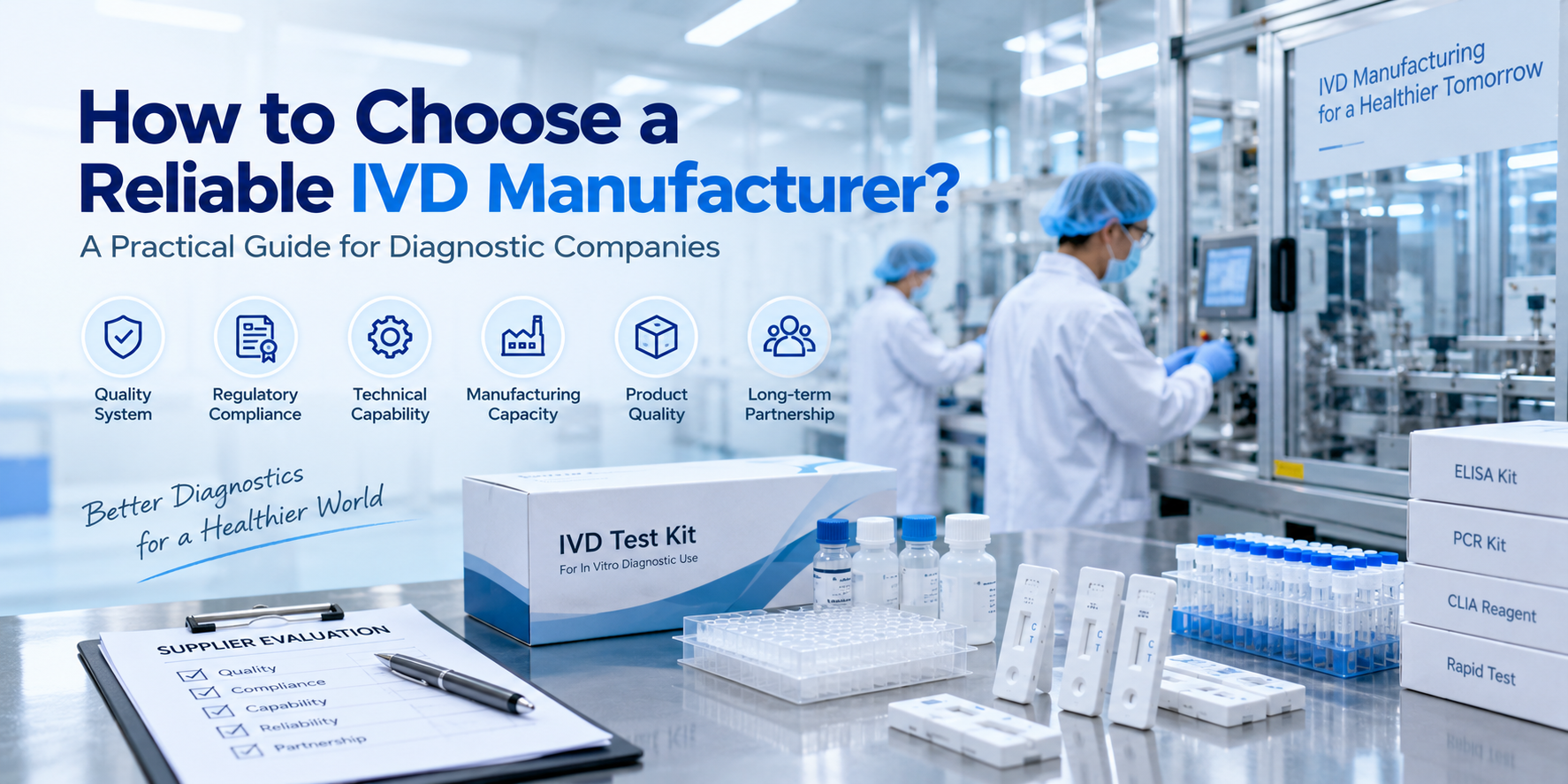
Choosing a reliable IVD manufacturer requires much more than comparing prices, certificates and product catalogs. In vitro diagnostic products directly influence clinical decisions, and seemingly small variations in raw materials, reagent formulation, manufacturing processes, calibration or storage conditions can affect analytical performance.
For diagnostic companies, distributors, laboratories and healthcare organizations sourcing internationally, the more useful question is therefore not simply:
“Does this supplier manufacture IVD products?”
It is:
“Can this manufacturer consistently produce the specific IVD product we need, at the required quality, scale and regulatory standard?”
That distinction is fundamental.
A credible supplier should be evaluated across several dimensions: regulatory readiness, quality management, technical competence, manufacturing capability, raw-material control, analytical verification, traceability, scalability and post-market support.
This guide explains how professional buyers can systematically evaluate an IVD manufacturer before entering a long-term supply, OEM, ODM or CDMO relationship.
1. Start With the Product, Not the Factory
One of the most common sourcing mistakes is searching for a “good IVD factory” before clearly defining what the product must accomplish.
IVD manufacturing is highly specialized. A company experienced in lateral flow rapid tests is not automatically qualified to manufacture quantitative chemiluminescence assays. Likewise, expertise in clinical chemistry reagents does not necessarily translate into molecular diagnostics.
Before approaching manufacturers, create a basic Target Product Profile (TPP) or equivalent requirement document.
At minimum, define:
| Requirement | Questions to Answer |
|---|---|
| Intended use | What condition, analyte or biomarker will the test detect? |
| Sample type | Serum, plasma, whole blood, urine, saliva, swab or another specimen? |
| Technology | Lateral flow, ELISA, CLIA, FIA, PCR, qPCR, chemistry, immunoturbidimetry? |
| Result | Qualitative, semi-quantitative or quantitative? |
| Performance | Required sensitivity, specificity, precision and measuring range? |
| Format | Manual kit, POCT cartridge or automated analyzer reagent? |
| Throughput | Tests per hour/day and expected annual volume? |
| Shelf life | 12, 18, 24 months or another target? |
| Storage | Ambient, refrigerated or frozen? |
| Target market | EU, United States, Middle East, Latin America, Asia or multiple markets? |
| Commercial model | Finished product, private label, OEM, ODM, CDMO or technology transfer? |
A manufacturer should be evaluated against these requirements rather than against a generic definition of a “good supplier.”
2. Verify the Manufacturer’s Quality Management System
For most professional IVD sourcing projects, the quality management system should be examined early.
ISO 13485:2016 is the internationally recognized quality-management-system standard for medical devices. It addresses quality-management requirements relevant to organizations involved in medical-device design and manufacturing. ISO confirmed the 2016 edition again in 2025, so it remains current.
However, possessing an ISO 13485 certificate should not automatically end your due diligence.
Verify the certificate itself
Check:
- Legal manufacturer name
- Manufacturing-site address
- Certification body
- Certificate number
- Validity period
- Scope of certification
- Product categories covered
The scope matters.
A certificate covering one type of medical device should not automatically be interpreted as evidence that every diagnostic product offered by the company falls within the same certified activities.
Look beyond the certificate
A functioning quality system should leave operational evidence.
Depending on the relationship and level of due diligence, buyers may investigate areas such as:
- Document control
- Supplier qualification
- Incoming inspection
- Production records
- Equipment calibration
- Nonconforming product control
- CAPA
- Complaint handling
- Change control
- Training records
- Batch release
- Traceability
- Risk management
The objective is not to collect certificates.
The objective is to determine whether quality controls actually operate throughout the product lifecycle.
3. Match Regulatory Capability to Your Target Market
There is no universal regulatory credential that makes an IVD manufacturer suitable for every country.
Regulatory requirements depend on the product, intended use, risk classification and target jurisdiction.
European Union
For products intended for the EU, buyers should assess the manufacturer’s ability to operate within the requirements of the EU In Vitro Diagnostic Medical Devices Regulation (IVDR).
The European Commission emphasizes that manufacturers are responsible for bringing compliant IVDs to the European market, while IVDR places increased emphasis on risk classification, notified-body oversight where applicable, clinical evidence and lifecycle/post-market surveillance.
Therefore, asking only:
“Do you have CE?”
is often inadequate.
A more meaningful investigation examines the specific device, its regulatory status, applicable conformity-assessment route and supporting documentation.
United States
For the United States, buyers should understand the regulatory status of the specific product rather than treating FDA establishment registration as equivalent to product authorization.
FDA explicitly states that establishment registration does not constitute approval of an establishment or authorization of its products. Device listing likewise does not by itself establish that a device is legally authorized for U.S. marketing.
This distinction is extremely important in international sourcing.
Important 2026 change: FDA QMSR
As of February 2, 2026, FDA’s Quality Management System Regulation became effective. The revised 21 CFR Part 820 incorporates ISO 13485:2016 by reference, while retaining additional applicable FDA requirements.
For U.S.-oriented projects, supplier assessments should therefore reflect the current QMSR framework rather than relying solely on historical references to the former Quality System Regulation.
4. Evaluate Real Technical Competence
A reliable IVD manufacturer should understand the underlying assay—not merely know how to assemble and package the final kit.
This becomes particularly important for OEM, ODM and CDMO projects.
For an immunodiagnostic product, for example, technical competence may involve:
- Antibody-pair selection
- Antigen design
- Conjugation chemistry
- Blocking systems
- Buffer formulation
- Membrane selection
- Calibration
- Signal optimization
- Interference reduction
For molecular diagnostics, capabilities may include:
- Target selection
- Primer/probe design
- Enzyme systems
- Extraction compatibility
- Internal controls
- Multiplex optimization
- Contamination control
- Amplification efficiency
For clinical chemistry:
- Enzyme stabilization
- Reagent formulation
- Calibration
- Linearity optimization
- Interference studies
- Analyzer adaptation
This leads to a useful sourcing principle:
Evaluate the technical team behind the product, not just the product catalog in front of you.
A large catalog can indicate commercial reach, but it does not by itself prove deep development capability.
5. Determine Whether the Manufacturer Controls Critical Raw Materials
IVD performance often depends heavily on biological and chemical raw materials.
These can include:
- Antibodies
- Antigens
- Enzymes
- Primers and probes
- Calibrators
- Controls
- Membranes
- Fluorescent particles
- Magnetic beads
- Latex particles
- Substrates
- Buffers and stabilizers
Ask where critical materials come from and how suppliers are qualified.
Important questions include:
Is there more than one qualified source for critical materials?
How is incoming material inspected?
How is lot-to-lot variation evaluated?
What happens if a critical antibody or enzyme becomes unavailable?
Does changing a raw-material supplier trigger formal change control and appropriate verification?
This becomes especially important for long-term OEM relationships.
A diagnostic kit may perform well today yet become commercially unreliable if its supply chain cannot reproduce the same critical materials three years later.
6. Ask for Evidence of Analytical Performance
Professional supplier qualification should move beyond statements such as:
“High sensitivity.”
“Excellent accuracy.”
“Reliable results.”
These are marketing descriptions, not sufficient analytical evidence.
Depending on the assay type and intended use, relevant performance characteristics may include:
- Analytical sensitivity
- Limit of detection
- Analytical specificity
- Precision
- Repeatability
- Reproducibility
- Linearity
- Measuring range
- Interference
- Cross-reactivity
- Carryover
- Hook effect
- Cutoff determination
- Method comparison
Not every parameter applies to every assay.
The important principle is that claimed performance should be supported by appropriately designed evidence.
7. Examine Lot-to-Lot Consistency
A prototype working correctly is only the beginning.
Commercial diagnostics require repeatable performance across manufacturing batches.
Consider asking the manufacturer how it demonstrates consistency across:
Raw-material lots → Intermediate products → Finished reagent lots → Final released kits
For quantitative assays, reviewing QC results across multiple production lots can be particularly informative.
The question buyers should ask is not:
“Can you make this product?”
but:
“Can you repeatedly make substantially the same product within defined acceptance criteria?”
That is a much higher manufacturing standard.
8. Evaluate Manufacturing Capacity—but Do Not Be Distracted by Factory Size
Factory photographs are useful but can easily become misleading.
A large facility does not automatically indicate superior IVD manufacturing.
What matters more is whether the facility has the right processes, equipment, controls and capacity for your particular product.
Evaluate:
- Production-line configuration
- Environmental requirements
- Critical equipment
- Automation level
- Process controls
- QC laboratory capabilities
- Calibration and maintenance
- Current utilization
- Maximum practical capacity
- Batch sizes
- Lead times
- Expansion capability
Capacity claims should also be interpreted carefully.
A factory theoretically capable of producing 10 million tests per month may not have that capacity available to your project.
Ask about available capacity, not merely installed capacity.
9. Understand the Difference Between R&D Samples and Commercial Manufacturing
This distinction is especially important in custom IVD development.
An experienced scientist may successfully produce 100 test strips manually.
That does not prove that the same formulation can be reliably manufactured as 100,000 tests.
Scaling introduces new variables:
- Mixing volumes
- Coating uniformity
- Drying conditions
- Dispensing accuracy
- Environmental exposure
- Equipment differences
- Assembly tolerances
- Packaging
- Operator variation
- Material consumption
- Yield
For custom projects, ask how the manufacturer handles:
Prototype → Engineering batch → Pilot batch → Validation batch → Commercial production
Manufacturability should be considered during development rather than after development has supposedly finished.
10. Review Stability Data Carefully
Shelf life has direct commercial consequences.
A 24-month shelf life, for example, affects inventory planning, international shipping, distributor stock and usable selling time.
Ask how the claimed shelf life was established.
Depending on the product and development stage, stability programs may involve:
- Real-time stability
- Accelerated stability
- Open-vial stability
- In-use stability
- Transport simulation
- Freeze-thaw studies
- Temperature excursions
Accelerated testing can provide valuable development information, but buyers should understand the basis for the manufacturer’s final shelf-life claim and what supporting data are available.
Also examine packaging.
For many IVD products, moisture, oxygen, light and temperature exposure can be as important as the reagent formulation itself.
11. Investigate Traceability
Imagine discovering a performance problem six months after importing 50,000 tests.
Can the manufacturer determine:
- Which finished batch was affected?
- Which raw-material lots were used?
- When it was produced?
- Which production line was involved?
- Which QC results were recorded?
- Which customers received related batches?
- Whether other lots may be affected?
This is where traceability becomes commercially important.
A strong traceability system makes investigation, containment and corrective action possible.
Without it, a relatively narrow batch problem can become a much larger supply-chain problem.
12. Evaluate Change Control
Change control is one of the most underestimated factors in supplier selection.
During a multi-year supply relationship, changes are inevitable.
A manufacturer may change:
- Raw-material supplier
- Antibody lot
- Formulation
- Equipment
- Production process
- Packaging material
- Software
- Labeling
- Manufacturing location
The critical issue is whether these changes are controlled, assessed, documented and communicated when required.
Buyers should establish contractual expectations regarding significant changes before commercial supply begins.
Otherwise, a product you validated in Year 1 may not be technically identical to the product being supplied in Year 3.
13. Assess OEM, ODM and CDMO Capabilities Separately
Not every manufacturer needs to be a CDMO.
The appropriate capability depends on your project.
| Model | Manufacturer’s Primary Role | Appropriate When |
|---|---|---|
| Private Label | Existing product with customized branding | Fast market entry |
| OEM | Manufacture to defined specifications | Buyer already controls product design |
| ODM | Product design/adaptation + manufacturing | Product customization is required |
| CDMO | Development + scale-up + manufacturing | New or technically differentiated product |
| Technology Transfer | Development/process transferred to buyer | Buyer intends to manufacture locally |
A company that is excellent at producing an established rapid test may not necessarily have the R&D infrastructure required for a novel CDMO project.
Likewise, paying for extensive development capabilities may be unnecessary if you simply need private-label supply of an established product.
14. Audit the Manufacturer When the Risk Justifies It
For important projects, document review should eventually be complemented by an audit.
This can be performed:
- On-site
- Remotely
- Through an independent third-party auditor
The depth of the audit should be proportionate to product and supplier risk.
Potential audit areas include:
- Quality management
- Warehouse controls
- Incoming inspection
- Production processes
- Environmental controls
- QC laboratory
- Batch records
- Equipment management
- CAPA
- Complaint handling
- Supplier management
- Traceability
- Change control
The purpose of an audit is not to find a perfectly clean factory.
It is to understand whether the manufacturer has a functioning system capable of identifying, documenting and controlling problems.
15. Do Not Select an IVD Manufacturer on Price Alone
Unit price matters.
But purchase price and total sourcing cost are different things.
Consider the potential cost of:
- Failed incoming inspection
- Rejected batches
- Delayed shipments
- Short shelf life
- Regulatory documentation gaps
- Customer complaints
- Product recalls
- Revalidation after undocumented changes
- Lost tenders
- Distributor disputes
- Emergency replacement inventory
A slightly cheaper kit can become significantly more expensive when quality problems appear after international distribution.
This does not mean the most expensive manufacturer is the best.
It means price should be evaluated after minimum technical, quality and regulatory requirements have been satisfied.
16. Red Flags When Evaluating an IVD Manufacturer
No single warning sign automatically proves that a supplier is unreliable. Several occurring together, however, justify deeper investigation.
Be cautious when a manufacturer:
- Cannot clearly identify the legal manufacturing entity
- Provides certificates that cannot be independently verified
- Avoids questions about critical raw materials
- Cannot explain batch-release criteria
- Makes regulatory claims without identifying the specific product
- Treats FDA registration as equivalent to FDA product authorization
- Provides only marketing brochures instead of performance evidence
- Cannot explain how complaints and CAPA are handled
- Cannot provide basic lot traceability
- Changes important components without documented control
- Claims unrealistically broad technical capabilities without supporting evidence
- Refuses reasonable audit or documentation requests without explanation
One particularly useful signal is technical transparency.
Experienced manufacturers generally understand that sophisticated buyers will ask difficult questions.
17. A Practical IVD Manufacturer Evaluation Framework
A supplier evaluation can be organized into six dimensions:
A. Regulatory Fit
Can the manufacturer support the regulatory requirements of the specific product and destination market?
B. Quality System
Does the manufacturer operate an appropriate, documented and functioning quality-management system?
C. Technical Capability
Does its R&D and engineering team understand the assay technology involved?
D. Manufacturing Capability
Can the process be reproduced consistently at the required commercial scale?
E. Supply-Chain Reliability
Can critical raw materials and production capacity be maintained over the expected product lifecycle?
F. Commercial Support
Can the supplier provide appropriate documentation, communication, change notification, technical support and post-market cooperation?
Only after these areas have been evaluated does a meaningful price comparison become possible.
18. Questions to Ask Before Choosing an IVD Manufacturer
A useful first-round supplier questionnaire might include:
- What is the legal name and address of the actual manufacturing entity?
- Which products are manufactured at this facility?
- What quality-management certifications does the facility hold?
- What is the exact scope and validity of those certifications?
- What regulatory status does the specific product have in our target market?
- Which critical raw materials are manufactured internally and which are externally sourced?
- How are critical suppliers qualified?
- What analytical performance data are available?
- How is lot-to-lot consistency monitored?
- What stability data support the stated shelf life?
- What are the standard batch size and production lead time?
- How are finished products released?
- What traceability records are maintained?
- How are customer complaints investigated?
- How are CAPA activities managed?
- How are significant product or process changes controlled and communicated?
- Can we conduct a factory audit?
- Can you support pilot production before commercial orders?
- What technical documentation can be provided?
- What happens if a critical raw material becomes unavailable?
The quality of the answers can reveal almost as much as the answers themselves.
How IVD CDMO Can Support Manufacturer Sourcing
Finding an IVD manufacturer through an online search is relatively easy.
Determining whether that manufacturer is appropriate for a specific diagnostic project is much more difficult.
IVD CDMO is a specialized platform designed to connect international diagnostic buyers and project owners with manufacturers, development organizations and supply-chain resources across the IVD industry.
Projects may involve areas such as:
- Rapid diagnostic tests
- Lateral flow assays
- ELISA
- CLIA
- Fluorescence immunoassays
- Clinical chemistry
- Molecular diagnostics
- PCR and qPCR
- Diagnostic instruments
- Antibodies and antigens
- Diagnostic enzymes and raw materials
- OEM and ODM manufacturing
- Custom test kit development
- CDMO services
- Technology transfer
The platform approach is particularly useful when sourcing requirements extend beyond finding a product catalog and require matching product technology, manufacturing capability, regulatory requirements and commercial objectives.
Frequently Asked Questions
What certifications should a reliable IVD manufacturer have?
There is no single certificate that proves universal suitability. ISO 13485 is an important internationally recognized medical-device quality-management standard, but buyers should also evaluate its scope, the specific product’s regulatory requirements and the requirements of the destination market.
Does FDA registration mean an IVD manufacturer is FDA approved?
No. FDA states that establishment registration does not constitute approval of the establishment or its devices. Product-specific regulatory status should be verified separately.
Is ISO 13485 enough to qualify an IVD supplier?
Not by itself. ISO 13485 provides an important quality-management framework, but supplier qualification should also examine product-specific technical competence, manufacturing processes, analytical performance, regulatory fit, traceability and supply-chain controls.
Should I audit an IVD factory before ordering?
For higher-risk products, large-volume purchases or strategic OEM/CDMO relationships, an appropriately scoped supplier audit can provide information that certificates and questionnaires alone cannot.
What is the difference between an IVD manufacturer and an IVD CDMO?
A conventional manufacturer may primarily manufacture established products. An IVD CDMO typically provides a broader development pathway that can include feasibility studies, assay development, formulation, optimization, pilot production, scale-up and commercial manufacturing.
How can I verify an IVD manufacturer’s quality claims?
Start with primary evidence: certificates and their issuing bodies, product-specific regulatory records where applicable, analytical reports, manufacturing documentation, stability evidence, samples, batch records and audits. Avoid relying exclusively on website claims or sales presentations.
Conclusion: Choose an IVD Manufacturing System, Not Just a Supplier
The most reliable IVD manufacturer is not necessarily the company with the largest factory, longest product catalog, lowest quotation or most certificates displayed on its website.
Professional supplier selection requires a more systematic approach.
Start with the intended product and market. Verify the quality system. Examine product-specific regulatory status. Evaluate the technical team. Understand critical raw materials. Review analytical and stability evidence. Investigate manufacturing scalability, lot consistency, traceability and change control. Finally, confirm that the commercial relationship can remain reliable throughout the product lifecycle.
The objective is not simply to find a factory capable of producing an IVD test today.
It is to identify a manufacturing partner capable of consistently delivering the required product, at the required quality, under the required regulatory framework, over time.
For diagnostic companies sourcing internationally, that distinction can determine whether a promising IVD product becomes a sustainable commercial product—or a recurring supply-chain problem.
Author Profile

- Written by the IVDCDMO technical and regulatory team, with expertise in diagnostic assay development, GMP manufacturing, ISO 13485 systems, and global IVD commercialization for biotech innovators worldwide.
Latest entries
 IVD ManufacturingNovember 2, 2026OEM IVD Manufacturing & Private Label Diagnostics: A Practical Guide from Product Concept to Market Launch
- IVD ManufacturingOctober 29, 2026IVD Manufacturing Company: A Complete Guide to Choosing the Right Diagnostic Manufacturing Partner
- IVD ManufacturingOctober 26, 2026IVD Raw Materials Manufacturing: A Practical Guide to Quality, Scale-Up and Supplier Selection
- IVD ManufacturingOctober 19, 2026In Vitro Diagnostic Contract Manufacturing Buyer Guide