In today’s highly competitive healthcare and biotechnology landscape, speed-to-market has become one of the most decisive factors influencing commercial success. This is particularly true in the in vitro diagnostics (IVD) industry, where technological innovation, regulatory pressure, evolving disease patterns, and global market demand continue to accelerate product development cycles.
For many IVD companies, especially startups and innovation-driven biotechnology firms, bringing a diagnostic product from concept to commercialization is no longer simply a scientific challenge. It has become a complex operational process involving:
- Assay development
- Antibody sourcing
- Reagent optimization
- Manufacturing scale-up
- Quality management
- Regulatory compliance
- Supply chain coordination
- Global market readiness
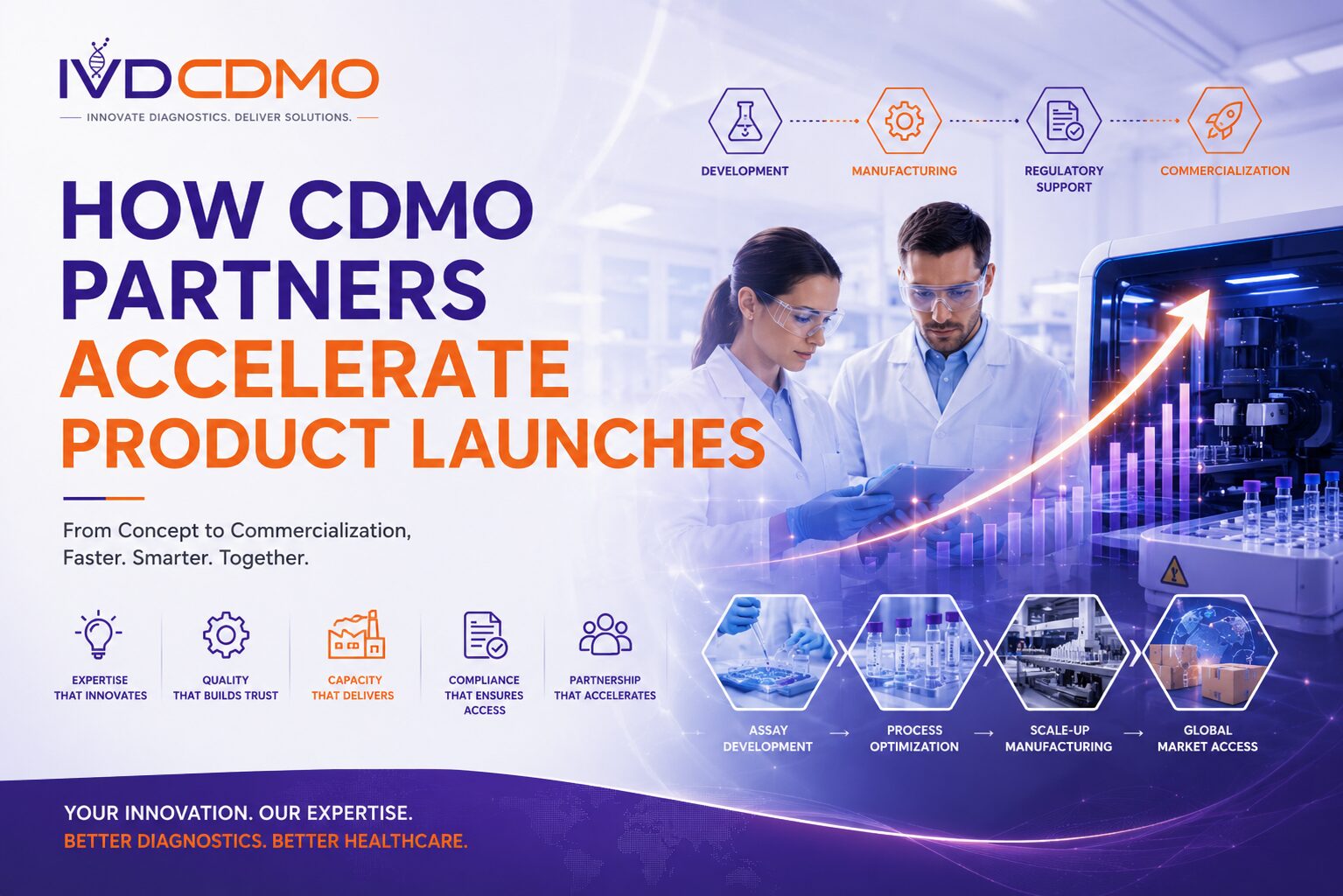
Under these conditions, Contract Development and Manufacturing Organizations (CDMOs) have emerged as strategic partners capable of significantly reducing development timelines, minimizing operational risks, and accelerating product launches.
Rather than functioning merely as outsourced manufacturers, modern CDMO partners increasingly serve as integrated technical and regulatory collaborators throughout the entire product lifecycle.
This article explores how CDMO partnerships accelerate product commercialization in the modern IVD industry and why strategic outsourcing has become a critical growth model for diagnostic companies worldwide.
The Growing Pressure for Faster Product Commercialization
The global diagnostics market has undergone substantial transformation over the past decade.
Several industry trends are reshaping product development expectations:
- Rapid expansion of point-of-care testing (POCT)
- Increased demand for molecular diagnostics
- Personalized medicine growth
- Emerging infectious disease threats
- Shorter product innovation cycles
- Intensifying regulatory requirements
- Investor pressure for faster returns
In this environment, delays in commercialization can result in:
- Lost market opportunities
- Reduced competitive advantage
- Regulatory obsolescence
- Increased development costs
- Investor dissatisfaction
For many IVD companies, internal development resources alone are no longer sufficient to maintain competitive launch timelines.
This has significantly increased reliance on specialized CDMO partners.
What Is a CDMO in the IVD Industry?
Contract Development and Manufacturing Organization refers to a third-party organization providing integrated development and manufacturing services for medical device, biotechnology, pharmaceutical, and diagnostic companies.
In the IVD sector, CDMO services may include:
- Antibody development
- Antigen engineering
- Assay optimization
- Reagent formulation
- Prototype development
- Pilot production
- OEM manufacturing
- Quality system support
- Regulatory documentation
- Stability testing
- Packaging and labeling
- Supply chain management
Some advanced CDMO providers also support:
- Clinical validation
- Technology transfer
- International registration preparation
- IVDR and FDA compliance assistance
The goal is not only manufacturing efficiency, but also commercialization acceleration.
Why Traditional Internal Development Is Often Slow
Many diagnostic companies initially attempt to develop products entirely in-house.
However, several structural limitations commonly slow down internal development programs.
Limited Technical Resources
Developing a successful IVD product requires multidisciplinary expertise, including:
- Immunology
- Biochemistry
- Materials science
- Process engineering
- Quality systems
- Regulatory affairs
- Manufacturing validation
Building all these capabilities internally requires substantial investment and time.
Infrastructure Constraints
Scaling from laboratory research to commercial manufacturing involves major operational changes.
Challenges may include:
- Cleanroom construction
- Equipment qualification
- Environmental monitoring
- Process validation
- Automation integration
These infrastructure requirements can significantly delay commercialization.
Regulatory Complexity
Global diagnostic regulations continue to become more demanding.
Examples include:
- European IVDR
- FDA quality system requirements
- ISO 13485 compliance
- Performance validation expectations
- Traceability requirements
Companies lacking dedicated regulatory experience often encounter costly delays during submission and approval processes.
Supply Chain Challenges
Diagnostic products frequently depend on highly specialized raw materials such as:
- Monoclonal antibodies
- Recombinant proteins
- Fluorescent particles
- Nitrocellulose membranes
- Enzyme conjugates
Managing supplier qualification and supply stability can become a major bottleneck.
How CDMO Partnerships Accelerate Product Launches
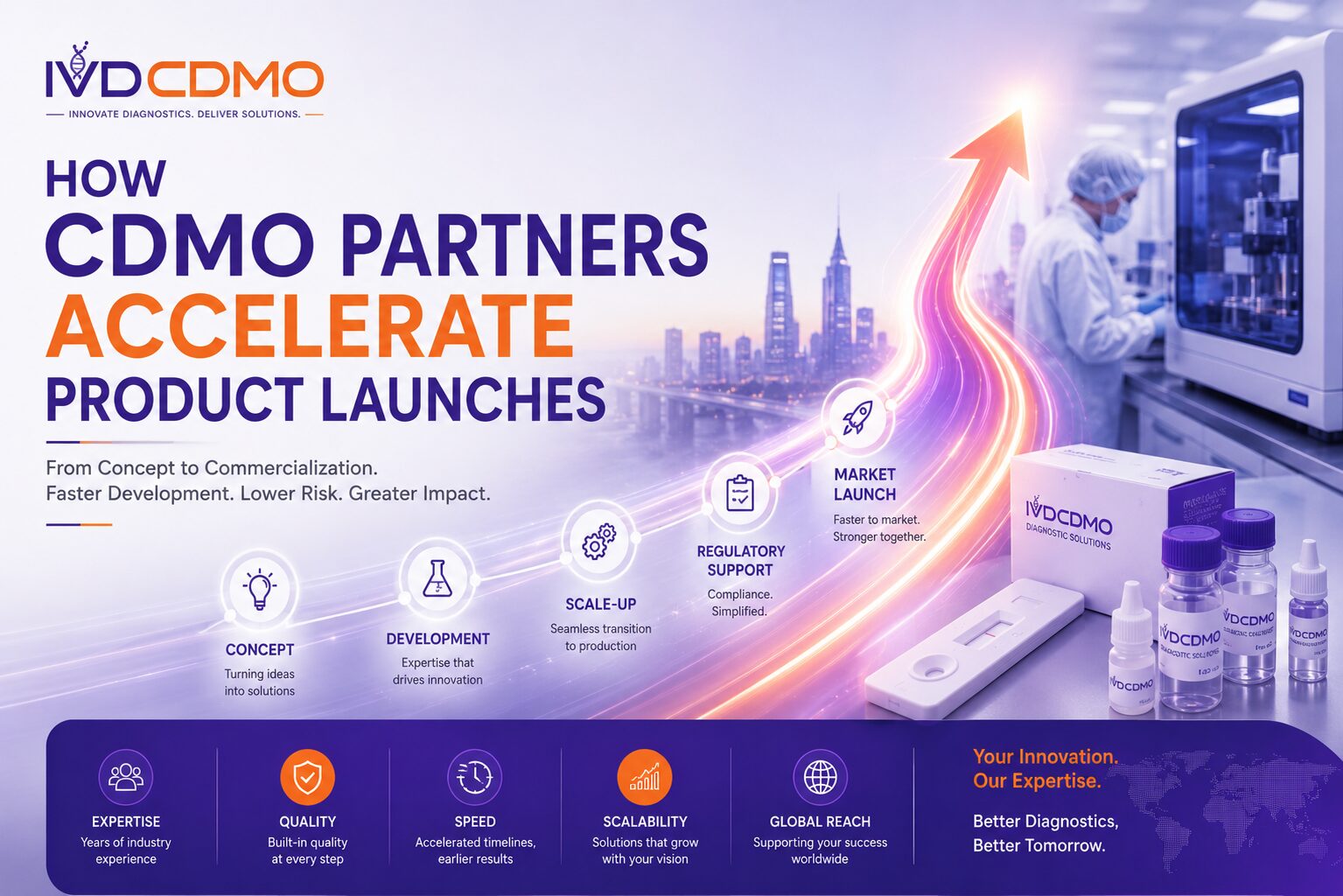
1. Established Technical Platforms Reduce Development Time
One of the biggest advantages of experienced CDMO partners is the availability of mature development platforms.
Instead of building workflows from scratch, CDMOs often possess validated systems for:
- Antibody screening
- Assay optimization
- Buffer formulation
- Membrane selection
- Conjugation chemistry
- Signal amplification
This significantly shortens early-stage R&D timelines.
For example, an experienced POCT CDMO may already have optimized lateral flow development protocols capable of accelerating assay development by several months.
2. Existing Manufacturing Infrastructure Enables Faster Scale-Up
Scaling production is one of the most difficult transitions in diagnostics commercialization.
CDMOs typically maintain:
- GMP-compliant facilities
- ISO 13485-certified systems
- Validated manufacturing equipment
- Established SOPs
- Trained technical teams
This allows clients to bypass lengthy facility construction and validation phases.
As a result, pilot production and commercial manufacturing can begin much earlier.
3. Integrated Quality Systems Improve Regulatory Readiness
Modern diagnostic development requires regulatory thinking from the earliest stages.
Experienced CDMOs already operate within established quality management frameworks.
This includes:
- Document control systems
- Traceability procedures
- CAPA systems
- Risk management workflows
- Change control procedures
- Validation documentation
These systems help clients avoid common regulatory deficiencies later in development.
For many startup diagnostic companies, partnering with an ISO 13485-certified CDMO dramatically improves regulatory preparedness.
4. Specialized Expertise Reduces Technical Failure Risk
Many IVD development delays originate from technical optimization failures.
Common challenges include:
- Low assay sensitivity
- Poor specificity
- Cross-reactivity
- Stability issues
- Reproducibility problems
- Signal inconsistency
Experienced CDMOs have often encountered these issues across multiple projects and can identify solutions more efficiently.
This accumulated technical knowledge significantly reduces trial-and-error cycles.
5. Faster Supply Chain Integration
Established CDMOs frequently maintain long-term relationships with qualified suppliers.
This can accelerate sourcing for critical materials such as:
- Diagnostic antibodies
- Membranes
- Plastic cartridges
- Fluorescent labels
- Packaging materials
In many cases, supplier qualification processes are already completed, saving substantial time.
6. Parallel Development and Manufacturing Activities
Traditional development models often follow a sequential process:
R&D → Validation → Manufacturing Setup → Regulatory Preparation
Modern CDMOs can execute many activities in parallel.
For example:
- Manufacturing process development
- Stability studies
- Documentation preparation
- Packaging validation
- Supplier qualification
may occur simultaneously with late-stage assay optimization.
This integrated approach substantially compresses commercialization timelines.
CDMO Partnerships in POCT Development
Point-of-care testing represents one of the fastest-growing segments of the diagnostics industry.
However, POCT commercialization requires balancing:
- Analytical sensitivity
- User simplicity
- Manufacturing consistency
- Rapid turnaround time
- Cost control
Specialized POCT CDMOs often possess deep expertise in:
- Lateral flow assay design
- Cartridge engineering
- Reader integration
- Membrane optimization
- Signal enhancement technologies
This experience can dramatically shorten product development cycles.
The Importance of Regulatory Experience
Regulatory compliance has become one of the most critical factors affecting product launch speed.
A technically successful product may still fail commercially if regulatory documentation is incomplete or poorly structured.
Experienced CDMO partners can support:
- Design history file preparation
- Risk analysis documentation
- Validation protocols
- Technical file organization
- Stability study design
- Traceability systems
For international expansion, this support becomes even more valuable.
CDMOs as Strategic Innovation Partners
The role of CDMOs has evolved significantly.
Today’s leading CDMOs are no longer simply manufacturers.
They increasingly function as:
- Technical advisors
- Innovation collaborators
- Regulatory consultants
- Commercialization accelerators
Some CDMOs actively participate in:
- Assay co-development
- Technology platform innovation
- AI-assisted diagnostics
- Biosensor integration
- Automation system design
This shift reflects broader industry movement toward collaborative innovation ecosystems.
Choosing the Right CDMO Partner
Not all CDMO providers offer the same level of capability.
Key evaluation criteria include:
Technical Expertise
Evaluate experience in:
- CLIA
- ELISA
- FIA
- Molecular diagnostics
- POCT platforms
- Antibody development
Regulatory Compliance
Look for:
- ISO 13485 certification
- GMP compliance
- IVDR readiness
- FDA familiarity
Manufacturing Scalability
Assess whether the CDMO can support:
- Pilot production
- Medium-scale manufacturing
- High-volume commercialization
Communication and Project Management
Efficient collaboration requires:
- Transparent communication
- Fast technical feedback
- Structured project timelines
- Clear documentation
Supply Chain Stability
Reliable raw material sourcing is essential for long-term commercialization success.
Future Trends in CDMO-Driven Product Development
The global CDMO market is expected to continue growing rapidly due to:
- Rising diagnostic demand
- Increased outsourcing
- Complexity of modern IVD products
- Regulatory specialization
- AI-driven diagnostics
- Decentralized healthcare systems
Future CDMO models will likely emphasize:
- Digital manufacturing integration
- Smart quality systems
- AI-assisted assay optimization
- Flexible manufacturing platforms
- Faster technology transfer
- Globalized supply networks
Companies capable of integrating innovation with scalable manufacturing will hold major competitive advantages.
Conclusion
In the modern diagnostics industry, speed-to-market has become a strategic necessity rather than a competitive luxury.
CDMO partnerships enable IVD companies to accelerate commercialization by providing:
- Specialized technical expertise
- Established manufacturing infrastructure
- Integrated quality systems
- Regulatory support
- Supply chain efficiency
- Scalable production capabilities
For many diagnostic companies, partnering with the right CDMO can reduce development risk, compress launch timelines, improve regulatory readiness, and significantly enhance global market competitiveness.
As the healthcare industry continues shifting toward rapid diagnostics, precision medicine, and decentralized testing, the role of CDMO partners will become increasingly central to successful product innovation and commercialization.
FAQ
What does CDMO mean in the IVD industry?
CDMO stands for Contract Development and Manufacturing Organization. In the IVD industry, CDMOs provide integrated services including assay development, reagent manufacturing, quality management, and regulatory support.
Why do IVD companies work with CDMO partners?
IVD companies partner with CDMOs to accelerate development timelines, reduce operational risk, access specialized expertise, and improve manufacturing scalability.
Can CDMOs help with regulatory compliance?
Yes. Many experienced CDMOs support ISO 13485 compliance, validation documentation, risk management, and regulatory submission preparation.
Are CDMOs only for large companies?
No. Startup biotechnology companies and emerging diagnostic brands increasingly rely on CDMOs to avoid major infrastructure investments and accelerate commercialization.
How much time can a CDMO partnership save?
Depending on project complexity and development stage, experienced CDMO partnerships may reduce commercialization timelines by several months or more compared with fully internal development models.
Author Profile

- Written by the IVDCDMO technical and regulatory team, with expertise in diagnostic assay development, GMP manufacturing, ISO 13485 systems, and global IVD commercialization for biotech innovators worldwide.
Latest entries
 Assay DevelopmentSeptember 23, 2026CDMO Custom Development of Test Kits: From Assay Concept to Scalable IVD Manufacturing
- IVD ManufacturingJuly 24, 2026Manufacturing for IVD Products: From Assay Transfer to Reliable Commercial Supply
- IVD ManufacturingJuly 13, 2026IVD Contract Manufacturing Cost: NRE, Tooling, Validation, MOQ and Unit Economics
- KnowledgeJuly 6, 2026IVD CDMO vs CRO vs CMO: Which Partner Do You Need at Each Development Stage?