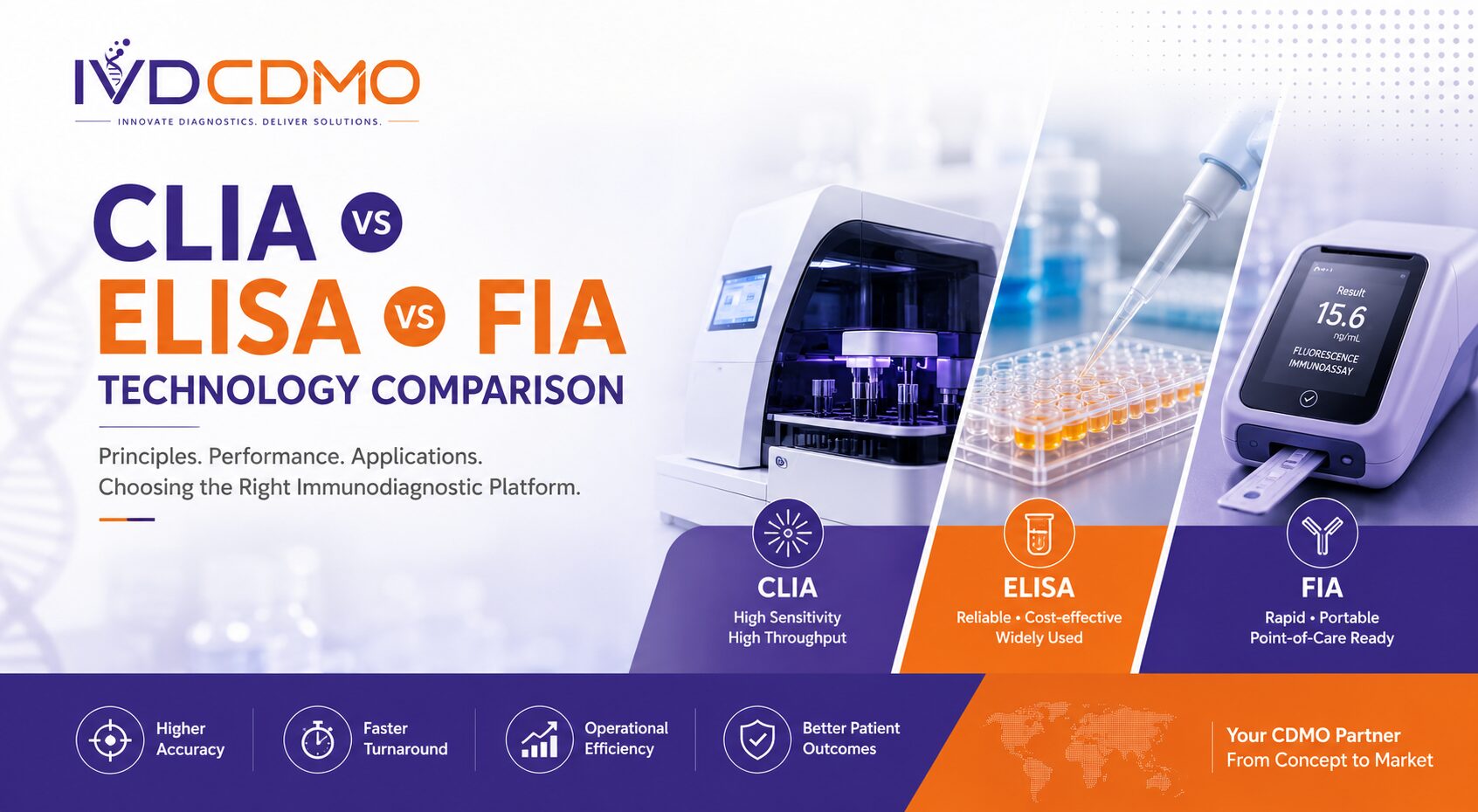
In modern in vitro diagnostics (IVD), immunoassay technologies play a central role in disease screening, clinical diagnosis, biomarker monitoring, and public health surveillance. Among the most widely adopted platforms, Chemiluminescent Immunoassay (CLIA), Enzyme-Linked Immunosorbent Assay (ELISA), and Fluorescence Immunoassay (FIA) represent three foundational technologies used across hospitals, diagnostic laboratories, research institutions, and point-of-care testing (POCT) environments.
Although all three methods are based on antigen-antibody interactions, their detection principles, analytical sensitivity, instrumentation requirements, throughput capabilities, and clinical applications differ substantially. Selecting the appropriate technology platform is therefore critical for diagnostic manufacturers, laboratories, and healthcare providers seeking optimal performance, cost efficiency, and regulatory compliance.
This article provides a comprehensive technical comparison of CLIA, ELISA, and FIA from the perspective of analytical chemistry, clinical diagnostics, assay development, manufacturing scalability, and future industry trends.
Understanding the Core Principles
What Is ELISA?
Enzyme-Linked Immunosorbent Assay is one of the earliest and most established immunoassay technologies used in modern diagnostics.
ELISA relies on enzyme-labeled antibodies or antigens to produce a measurable colorimetric reaction. After the antigen-antibody binding process occurs, an enzyme substrate is introduced, generating a visible color change proportional to the analyte concentration.
The technology became widely adopted due to its:
- High specificity
- Relatively low cost
- Straightforward workflow
- Strong reproducibility
- Compatibility with large-scale laboratory testing
ELISA remains extensively used in:
- Infectious disease testing
- Hormone analysis
- Food safety testing
- Veterinary diagnostics
- Technology laboratories
What Is CLIA?
Chemiluminescent Immunoassay is an advanced immunoassay platform that uses chemiluminescent labels instead of colorimetric enzymes.
In CLIA systems, chemical reactions generate photons of light during the detection process. The emitted light intensity is measured by highly sensitive photomultiplier detectors and directly correlates with analyte concentration.
Compared with traditional ELISA, CLIA offers:
- Significantly higher analytical sensitivity
- Broader dynamic range
- Faster turnaround time
- Higher automation capability
- Reduced background interference
Today, CLIA has become the dominant platform in centralized hospital laboratories and high-throughput diagnostic systems.
Typical applications include:
- Cardiac markers
- Tumor markers
- Thyroid function tests
- Infectious disease screening
- Autoimmune disease diagnostics
What Is FIA?
Fluorescence Immunoassay utilizes fluorescent molecules as signal reporters.
When excited by light at a specific wavelength, fluorescent labels emit measurable fluorescence signals. The emitted fluorescence intensity reflects the concentration of the target analyte.
FIA technology combines:
- High sensitivity
- Rapid detection speed
- Compact instrumentation
- Quantitative capability
This makes FIA particularly suitable for:
- Point-of-care testing
- Emergency diagnostics
- Rapid infectious disease screening
- Small and decentralized laboratories
Modern FIA systems are commonly integrated into portable analyzers and POCT devices.
Technical Comparison of CLIA, ELISA, and FIA
Detection Principle
| Technology | Signal Type | Detection Mechanism |
|---|---|---|
| ELISA | Colorimetric | Enzyme-substrate chromogenic reaction |
| CLIA | Chemiluminescence | Chemical light emission |
| FIA | Fluorescence | Fluorescent molecule excitation and emission |
The fundamental difference lies in how the analytical signal is generated and measured.
CLIA generally achieves the highest signal amplification efficiency, while FIA provides rapid optical detection with compact instrumentation. ELISA, although less sensitive, remains highly reliable and cost-effective.
Sensitivity and Analytical Performance
Sensitivity is one of the most critical performance indicators in immunodiagnostics.
CLIA: Highest Sensitivity
CLIA systems are widely recognized for ultra-high sensitivity due to low background noise and strong signal amplification.
Advantages include:
- Detection of extremely low analyte concentrations
- Early disease detection capability
- Improved precision for low-abundance biomarkers
CLIA is particularly advantageous for:
- Cardiac troponin testing
- Oncology biomarkers
- Hormone assays
- Viral load-associated biomarkers
FIA: High Sensitivity with Rapid Response
FIA also provides excellent analytical sensitivity, especially in rapid diagnostic applications.
Compared with ELISA, FIA typically delivers:
- Faster signal acquisition
- Better low-concentration detection
- Improved quantitative performance in POCT environments
However, fluorescence quenching and optical interference may affect assay stability under certain conditions.
ELISA: Reliable but Moderate Sensitivity
ELISA generally offers lower sensitivity compared with CLIA and FIA.
Nevertheless, its robustness and standardization make it highly suitable for:
- Routine laboratory diagnostics
- Large population screening
- Academic research
- Cost-sensitive testing environments
For many applications, ELISA sensitivity remains clinically sufficient.
Throughput and Automation
CLIA Dominates High-Throughput Laboratories
Modern CLIA analyzers are highly automated and capable of processing hundreds of samples per hour.
Major advantages include:
- Random-access testing
- Minimal manual intervention
- Continuous sample loading
- Integrated data management
Large hospital laboratories increasingly prefer CLIA for operational efficiency and scalability.
ELISA Requires More Manual Operations
Traditional ELISA workflows often involve:
- Multiple washing steps
- Longer incubation periods
- Batch processing
- Manual pipetting
Although automated ELISA systems exist, the technology is generally less efficient for very high-throughput environments.
FIA Excels in Decentralized Testing
FIA platforms are optimized for rapid testing rather than large-scale throughput.
Advantages include:
- Portable instrumentation
- Short assay time
- Minimal operator training
- Fast clinical decision support
This makes FIA highly valuable in:
- Emergency rooms
- Clinics
- Pharmacies
- Mobile healthcare settings
Turnaround Time Comparison
| Technology | Typical Assay Time |
|---|---|
| ELISA | 2–5 hours |
| CLIA | 15–60 minutes |
| FIA | 5–20 minutes |
Turnaround time has become increasingly important in modern healthcare systems, especially for acute care and infectious disease management.
FIA currently offers the fastest response speed, while CLIA balances speed with laboratory-grade sensitivity.
Cost Considerations
ELISA Remains the Most Economical
ELISA systems typically have:
- Lower instrument costs
- Lower reagent costs
- Widely available consumables
This makes ELISA attractive for:
- Developing markets
- Technology laboratories
- Educational institutions
- Budget-sensitive testing programs
CLIA Requires Higher Capital Investment
CLIA systems involve:
- Sophisticated instrumentation
- Proprietary reagents
- Automated analyzers
- Advanced optics and detection modules
Although operational efficiency is high, initial investment costs are significantly greater.
FIA Occupies the Mid-Range
FIA systems generally fall between ELISA and CLIA in terms of cost.
Portable FIA analyzers are increasingly affordable and widely adopted in decentralized healthcare environments.
Clinical Application Scenarios
Best Applications for ELISA
ELISA is ideal for:
- Academic research
- Epidemiological studies
- Routine infectious disease testing
- Food allergen detection
- Veterinary diagnostics
Best Applications for CLIA
CLIA is preferred for:
- High-volume hospital laboratories
- Precision diagnostics
- Oncology testing
- Endocrinology
- Advanced infectious disease diagnostics
Best Applications for FIA
FIA performs particularly well in:
- Point-of-care testing
- Emergency medicine
- Rapid respiratory testing
- Community healthcare
- Resource-limited environments
Future Trends in Immunodiagnostics
The global IVD industry is rapidly evolving toward:
- Higher sensitivity
- Faster turnaround
- Greater automation
- Decentralized testing
- AI-assisted diagnostics
CLIA is expected to remain dominant in centralized clinical laboratories, while FIA continues expanding in the POCT market due to rising demand for rapid testing solutions.
ELISA, despite being a mature technology, will likely retain strong relevance because of its affordability, regulatory familiarity, and widespread global adoption.
Emerging hybrid technologies combining fluorescence, chemiluminescence, microfluidics, and digital biosensing may further reshape the diagnostic landscape over the next decade.
Conclusion
CLIA, ELISA, and FIA each represent essential pillars of modern immunodiagnostics, yet they serve different operational and clinical needs.
- ELISA remains a dependable and economical solution for routine and research applications.
- CLIA offers superior sensitivity, automation, and throughput for advanced clinical laboratories.
- FIA provides rapid and flexible testing capabilities ideally suited for point-of-care environments.
There is no universally “best” technology platform. The optimal choice depends on multiple factors, including clinical objectives, laboratory infrastructure, regulatory requirements, testing volume, sensitivity expectations, and commercialization strategy.
For IVD manufacturers and CDMO partners, understanding the strengths and limitations of these technologies is fundamental to successful assay development, regulatory approval, and global market competitiveness.
FAQ
Which technology is more sensitive, CLIA or ELISA?
CLIA generally provides significantly higher analytical sensitivity than ELISA due to its chemiluminescent signal amplification and lower background interference.
Is FIA suitable for quantitative testing?
Yes. Modern FIA systems support quantitative and semi-quantitative analysis and are widely used in rapid diagnostic applications.
Why is ELISA still widely used despite newer technologies?
ELISA remains highly valued because of its low cost, strong reproducibility, regulatory familiarity, and suitability for large-scale routine testing.
Which technology is best for point-of-care testing?
FIA is currently one of the most widely adopted technologies for POCT because of its rapid turnaround time and compact instrumentation.
Can CLIA systems be fully automated?
Yes. Most modern CLIA analyzers are highly automated and designed for high-throughput clinical laboratory environments.
Author Profile

- Written by the IVDCDMO technical and regulatory team, with expertise in diagnostic assay development, GMP manufacturing, ISO 13485 systems, and global IVD commercialization for biotech innovators worldwide.
Latest entries
 Assay DevelopmentSeptember 23, 2026CDMO Custom Development of Test Kits: From Assay Concept to Scalable IVD Manufacturing
- IVD ManufacturingJuly 24, 2026Manufacturing for IVD Products: From Assay Transfer to Reliable Commercial Supply
- IVD ManufacturingJuly 13, 2026IVD Contract Manufacturing Cost: NRE, Tooling, Validation, MOQ and Unit Economics
- KnowledgeJuly 6, 2026IVD CDMO vs CRO vs CMO: Which Partner Do You Need at Each Development Stage?