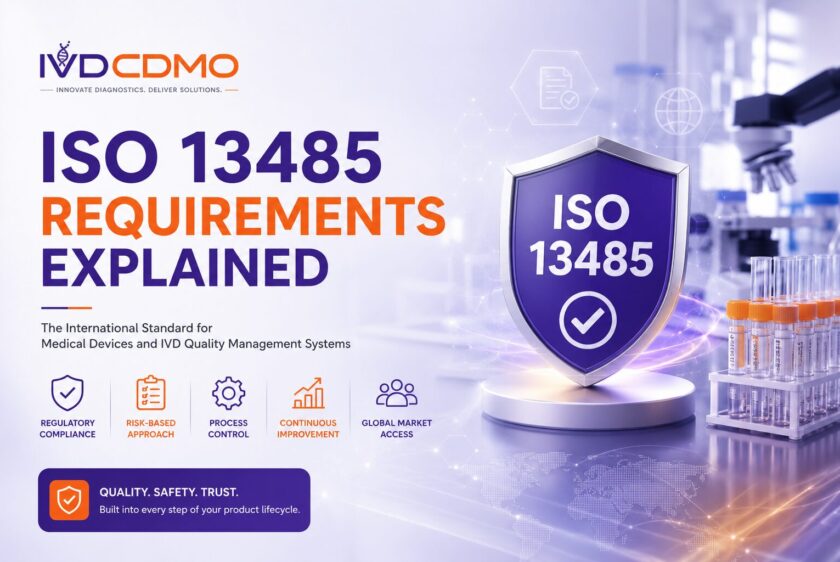
In the global medical device and in vitro diagnostics (IVD) industry, regulatory compliance is no longer simply a legal obligation — it has become a fundamental requirement for market access, product credibility, and long-term business sustainability. Among all internationally recognized quality standards, International Organization for Standardization 13485 stands as one of the most important frameworks governing quality management systems for medical device manufacturers and related service providers.
For companies involved in:
- IVD reagent development
- Diagnostic antibody manufacturing
- Medical device OEM/ODM production
- CDMO services
- POCT platform development
- Sterile consumables manufacturing
- Regulatory support services
ISO 13485 certification has become an essential indicator of operational maturity, risk management capability, and international compliance readiness.
This article provides a detailed explanation of ISO 13485 requirements, implementation principles, documentation systems, audit expectations, and industry applications from a professional regulatory and manufacturing perspective.
What Is ISO 13485?
ISO 13485 is an internationally recognized quality management system (QMS) standard specifically developed for the medical device industry.
The official title of the standard is:
Medical devices — Quality management systems — Requirements for regulatory purposes
Unlike general quality standards such as ISO 9001, ISO 13485 is specifically designed to address the stringent regulatory, safety, traceability, and risk management requirements associated with medical devices and IVD products.
The standard applies to organizations involved in one or more stages of the medical device lifecycle, including:
- Design and development
- Manufacturing
- Packaging and labeling
- Storage and distribution
- Installation and servicing
- Technical support
- Regulatory consulting
- Contract manufacturing
ISO 13485 is widely recognized across:
- North America
- Europe
- Asia-Pacific
- Middle East markets
- Latin America
For many international markets, ISO 13485 certification is either mandatory or strongly expected before commercial cooperation can begin.
Why ISO 13485 Matters
Regulatory Compliance
Many regulatory authorities either directly require or strongly reference ISO 13485 as part of medical device approval processes.
Examples include:
- European Union IVDR and MDR frameworks
- Canada Medical Device Regulations
- Australia TGA requirements
- Japan PMDA expectations
- Several ASEAN regulatory systems
Although the United States FDA does not officially require ISO 13485 certification, the FDA Quality System Regulation (QSR) shares substantial overlap with ISO 13485 principles.
Global Market Access
For medical device and IVD manufacturers, ISO 13485 certification significantly improves access to:
- International distributors
- Hospital procurement systems
- OEM partnerships
- CDMO collaborations
- Government tenders
- Cross-border regulatory submissions
Many global buyers now consider ISO 13485 certification a minimum qualification requirement.
Risk Reduction
The medical device industry involves direct implications for patient safety and clinical outcomes.
ISO 13485 emphasizes:
- Risk-based thinking
- Process control
- Product traceability
- Corrective actions
- Validation systems
- Complaint handling
These mechanisms help reduce:
- Product failures
- Regulatory violations
- Recalls
- Clinical risks
- Supply chain disruptions
Core Structure of ISO 13485
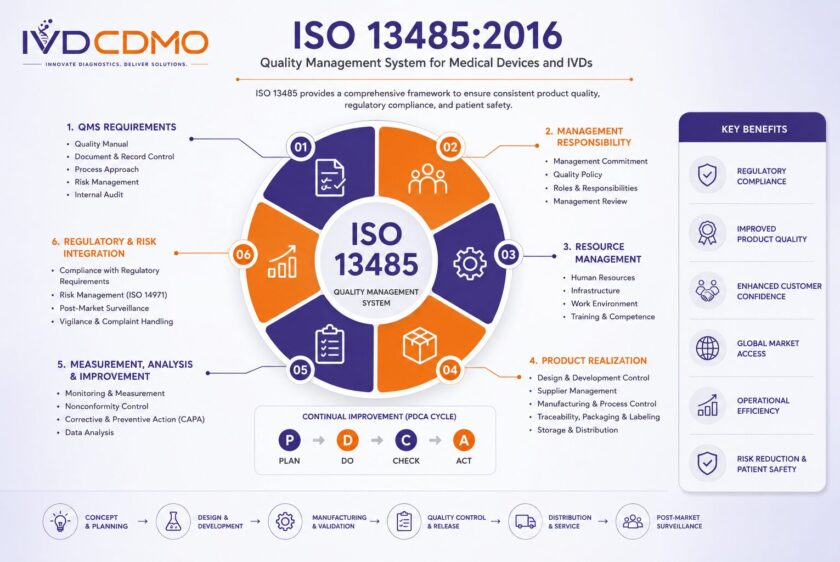
ISO 13485 is organized around a process-based quality management framework.

The standard contains several major sections covering operational and regulatory requirements.
1. Quality Management System Requirements
Organizations must establish, document, implement, and maintain a formal quality management system.
Key requirements include:
- Quality manual creation
- Document control procedures
- Record retention systems
- Process interaction mapping
- Risk management integration
- Internal audit systems
The QMS must be fully documented and consistently maintained.
Documentation integrity is a critical focus during certification audits.
2. Management Responsibility
Top management plays a central role in ISO 13485 compliance.
Leadership responsibilities include:
- Establishing quality policies
- Defining organizational responsibilities
- Conducting management reviews
- Ensuring regulatory compliance
- Allocating adequate resources
Auditors typically evaluate whether management demonstrates active involvement in quality system oversight.
3. Resource Management
Organizations must ensure sufficient resources for maintaining product quality and regulatory compliance.
This includes:
- Personnel competency
- Training programs
- Infrastructure management
- Environmental controls
- Equipment calibration
- Contamination prevention
For IVD and biotechnology manufacturers, environmental monitoring and laboratory controls are especially important.
4. Product Realization
Product realization represents one of the most operationally intensive sections of ISO 13485.
It covers:
- Product planning
- Design control
- Supplier qualification
- Manufacturing control
- Process validation
- Sterility assurance
- Traceability systems
- Packaging validation
- Storage and distribution
For IVD manufacturers, this section is particularly important because diagnostic performance depends heavily on process consistency and reagent stability.
Design and Development Controls
ISO 13485 places significant emphasis on design control procedures.
Organizations must establish documented processes for:
- Design planning
- Design inputs
- Design outputs
- Design verification
- Design validation
- Design transfer
- Design changes
In IVD development, design control may include:
- Antibody screening
- Assay optimization
- Clinical performance studies
- Stability testing
- Sensitivity and specificity validation
Incomplete design control documentation is one of the most common causes of audit findings.
Supplier and Purchasing Controls
Medical device manufacturers are responsible not only for internal quality but also for supply chain quality management.
ISO 13485 requires:
- Supplier evaluation
- Approved supplier lists
- Incoming inspection procedures
- Supplier monitoring
- Purchasing documentation controls
This is especially critical for IVD products because raw material variability can significantly impact assay performance.
Examples include:
- Antibodies
- Antigens
- Nitrocellulose membranes
- Enzymes
- Fluorescent particles
- Plastic consumables
Process Validation Requirements
Certain manufacturing processes cannot be fully verified through final inspection alone.
ISO 13485 therefore requires process validation for critical operations.
Examples include:
- Sterilization
- Automated filling
- Reagent coating
- Lyophilization
- Software-controlled production
- Environmental monitoring systems
Validation activities typically include:
- IQ (Installation Qualification)
- OQ (Operational Qualification)
- PQ (Performance Qualification)
Validation documentation must be scientifically justified and regularly maintained.
Traceability and Record Control
Traceability is a fundamental principle within ISO 13485.
Manufacturers must establish systems capable of tracing:
- Raw materials
- Production batches
- Finished products
- Distribution records
- Complaint investigations
In the event of product recalls or adverse events, traceability systems become essential for regulatory response.
For IVD manufacturers, lot traceability is particularly critical because batch-to-batch consistency directly affects diagnostic reliability.
Complaint Handling and CAPA
ISO 13485 requires organizations to maintain formal systems for:
- Complaint handling
- Nonconformance management
- Root cause analysis
- Corrective and preventive actions (CAPA)
An effective CAPA system demonstrates organizational maturity and continuous improvement capability.
Auditors often pay close attention to whether CAPA investigations are:
- Scientifically justified
- Timely
- Properly documented
- Effectively closed
Internal Audits
Internal audits are mandatory under ISO 13485.
Organizations must periodically evaluate whether their QMS:
- Conforms to regulatory requirements
- Meets documented procedures
- Operates effectively
Internal audits should be:
- Independent
- Risk-based
- Systematic
- Properly documented
Audit findings must trigger corrective actions when necessary.
Risk Management Under ISO 13485
Risk management is deeply integrated throughout the standard.
Although ISO 13485 references ISO 14971 for detailed medical device risk management methodology, organizations are expected to apply risk-based thinking across all operational activities.
This includes:
- Product design risks
- Manufacturing risks
- Supplier risks
- Regulatory risks
- Post-market risks
For IVD products, risk analysis may involve:
- False positive risks
- False negative risks
- Cross-reactivity
- Stability degradation
- User interpretation errors
ISO 13485 vs ISO 9001
Although ISO 13485 evolved from ISO 9001 principles, the two standards differ substantially.
| Area | ISO 9001 | ISO 13485 |
|---|---|---|
| Industry Scope | General industries | Medical devices |
| Regulatory Focus | Limited | Strong |
| Risk Management | General | Extensive |
| Documentation | Flexible | Highly controlled |
| Traceability | Limited | Critical |
| Sterility Controls | Not emphasized | Essential |
| Design Controls | Optional | Mandatory for many manufacturers |
ISO 13485 is considerably more rigorous due to patient safety considerations.
ISO 13485 Certification Process
The certification process generally includes:
Step 1 — Gap Analysis
Organizations evaluate current systems against ISO 13485 requirements.
Step 2 — QMS Development
Procedures, records, and quality documentation are established.
Step 3 — Implementation
Processes are formally deployed across departments.
Step 4 — Internal Audit and Management Review
The organization conducts internal assessments before certification.
Step 5 — Certification Audit
A third-party notified body or certification organization performs formal audits.
Step 6 — Surveillance Audits
Periodic follow-up audits ensure continued compliance.
Certification is typically valid for three years with annual surveillance audits.
ISO 13485 in the IVD Industry
For IVD manufacturers and CDMO companies, ISO 13485 certification has become increasingly important because diagnostic products face growing regulatory scrutiny worldwide.
Areas particularly influenced by ISO 13485 include:
- Antibody production
- POCT kit manufacturing
- ELISA reagent manufacturing
- CLIA reagent development
- Molecular diagnostics
- OEM diagnostic production
- CDMO partnerships
Today, many global distributors and healthcare procurement systems will not engage suppliers lacking ISO 13485 certification.
Future Trends
The global medical device industry is moving toward:
- Stronger regulatory harmonization
- Digital quality systems
- Electronic traceability
- AI-assisted quality control
- Risk-based supplier management
- Real-time production monitoring
ISO 13485 will likely remain one of the foundational global standards supporting these transitions.
As the IVD market expands rapidly through molecular diagnostics, decentralized testing, and precision medicine, ISO 13485 compliance will become even more critical for international competitiveness.
Conclusion
ISO 13485 is far more than a certification label — it is a comprehensive quality management framework designed to ensure safety, consistency, traceability, and regulatory compliance throughout the medical device lifecycle.
For medical device manufacturers, IVD developers, OEM factories, and CDMO service providers, ISO 13485 certification represents:
- Operational discipline
- Regulatory readiness
- International credibility
- Risk management capability
- Long-term market access
In an increasingly regulated and quality-driven healthcare environment, organizations that successfully implement ISO 13485 gain not only compliance advantages, but also stronger customer trust, improved manufacturing consistency, and enhanced global competitiveness.
FAQ
Is ISO 13485 mandatory for medical device manufacturers?
In many international markets, ISO 13485 is either mandatory or strongly expected for medical device and IVD manufacturers seeking regulatory approval or commercial partnerships.
What is the difference between ISO 13485 and ISO 9001?
ISO 13485 is specifically designed for medical devices and includes stronger requirements related to regulatory compliance, risk management, traceability, and design controls.
Does ISO 13485 apply to IVD manufacturers?
Yes. ISO 13485 is widely used throughout the IVD industry, including antibody manufacturers, diagnostic reagent suppliers, POCT developers, and CDMO companies.
How long does ISO 13485 certification take?
Implementation timelines vary depending on company size and operational complexity, but most organizations require several months to establish and validate a compliant quality management system.
Can small biotech companies obtain ISO 13485 certification?
Yes. Many startup biotechnology and IVD companies implement ISO 13485 early to support regulatory submissions, investor confidence, and international market expansion.
Author Profile

- Written by the IVDCDMO technical and regulatory team, with expertise in diagnostic assay development, GMP manufacturing, ISO 13485 systems, and global IVD commercialization for biotech innovators worldwide.
Latest entries
 Assay DevelopmentSeptember 23, 2026CDMO Custom Development of Test Kits: From Assay Concept to Scalable IVD Manufacturing
- IVD ManufacturingJuly 24, 2026Manufacturing for IVD Products: From Assay Transfer to Reliable Commercial Supply
- IVD ManufacturingJuly 13, 2026IVD Contract Manufacturing Cost: NRE, Tooling, Validation, MOQ and Unit Economics
- KnowledgeJuly 6, 2026IVD CDMO vs CRO vs CMO: Which Partner Do You Need at Each Development Stage?