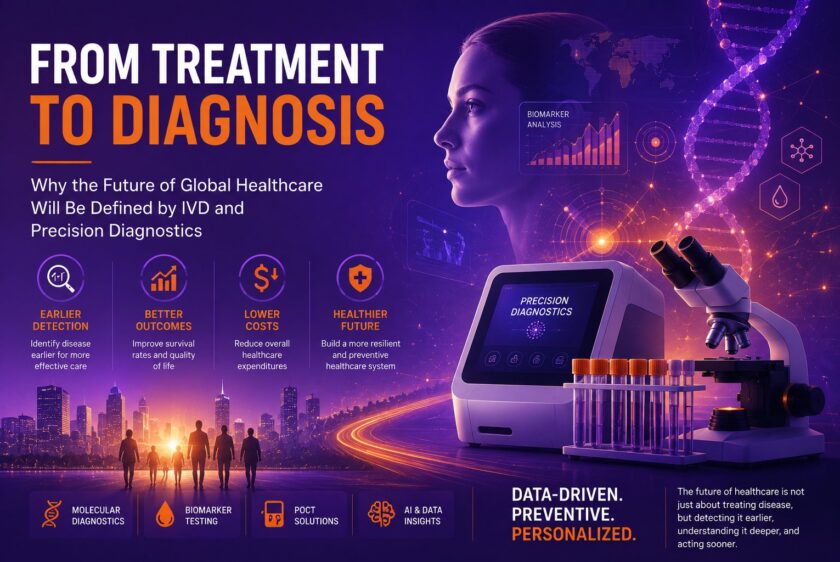
For more than a century, modern healthcare systems have been fundamentally organized around one dominant principle: treating disease after symptoms emerge. Hospitals, pharmaceutical companies, insurance systems, and clinical workflows were largely designed to intervene once illness had already progressed into a detectable and often costly condition.
That paradigm is now changing.
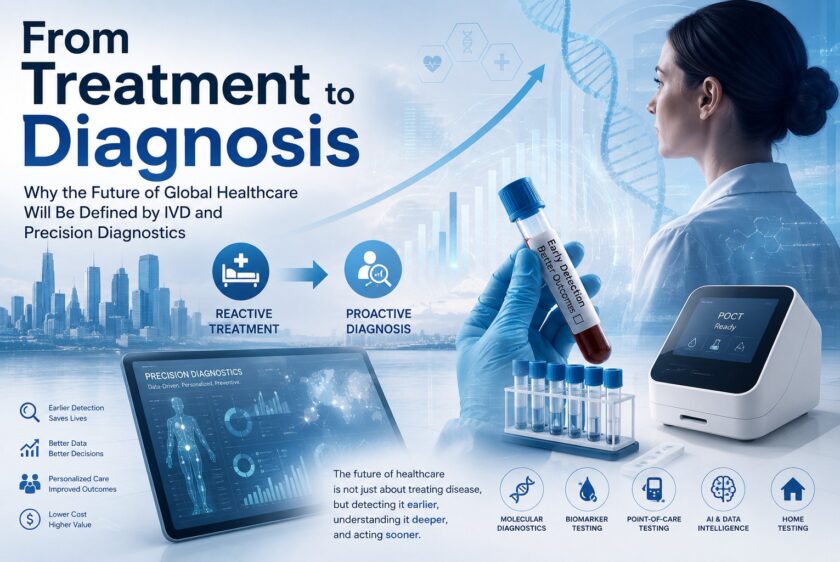
Across the global healthcare industry, a profound structural transition is underway — from reactive treatment toward proactive diagnosis. Increasingly, the economic, technological, and clinical center of gravity in medicine is shifting upstream, toward earlier detection, continuous monitoring, predictive analytics, and precision diagnostics.
This transformation is not a temporary trend accelerated by the COVID-19 pandemic. It represents a long-term reconfiguration of healthcare itself. In the coming decades, the organizations that control diagnostic infrastructure, biomarker discovery, molecular testing, and decentralized testing platforms may become as strategically important as pharmaceutical innovators once were.
At the center of this transition stands the rapidly expanding in vitro diagnostics (IVD) industry.
Diagnosis Is Becoming the New Front Line of Medicine
Historically, diagnosis was often viewed as a supporting function of healthcare — necessary, but secondary to treatment. The value chain of medicine revolved primarily around therapeutics: drugs, surgeries, hospital procedures, and clinical interventions.
Today, that hierarchy is reversing.
The economic logic is increasingly clear: preventing disease progression is dramatically less expensive than treating advanced disease. Healthcare systems under mounting financial pressure are therefore prioritizing early detection, risk stratification, and continuous patient monitoring.
This shift is particularly visible in oncology.
Modern cancer care is rapidly evolving toward a model in which molecular diagnostics, companion diagnostics, liquid biopsy technologies, and genomic profiling guide virtually every stage of clinical decision-making. In many cases, the diagnostic test itself determines whether a patient is eligible for a targeted therapy. As precision medicine expands, diagnostics are no longer merely identifying disease — they are actively shaping treatment pathways.
The same dynamic is unfolding across cardiovascular disease, infectious disease, autoimmune disorders, fertility medicine, metabolic disorders, and neurodegenerative conditions.
In practical terms, the future healthcare question is no longer simply:
“What drug should be used?”
But increasingly:
“How early can disease be detected, characterized, and monitored?”
The Economic Drivers Behind the Diagnostic Revolution
Several macroeconomic forces are accelerating this transformation simultaneously.
1. Aging Populations and Chronic Disease Burden
Global demographics are fundamentally reshaping healthcare demand. Aging populations require more frequent testing, long-term monitoring, and chronic disease management. Unlike acute episodic treatment models, aging societies generate recurring diagnostic demand over many years.
The prevalence of diabetes, cardiovascular disease, cancer, neurodegenerative disorders, and autoimmune diseases continues to rise worldwide. These conditions require continuous biomarker monitoring rather than one-time intervention. (Yahoo Finance)
This structural reality favors diagnostics-intensive healthcare systems.
2. Precision Medicine Depends on Diagnostics
Precision medicine cannot exist without precision diagnostics.
Modern targeted therapies increasingly rely on molecular and immunological characterization of patients before treatment decisions can be made. Genomic sequencing, biomarker identification, companion diagnostics, and multi-omics analysis are becoming foundational components of clinical workflows. (Precedence Technology)
The expansion of:
- next-generation sequencing (NGS),
- liquid biopsy,
- AI-assisted pathology,
- molecular diagnostics,
- and companion diagnostics
is transforming IVD from a laboratory service industry into a strategic pillar of modern medicine.
As a result, diagnostics companies are increasingly participating directly in therapeutic ecosystems rather than operating on the periphery.
3. COVID-19 Permanently Changed Global Healthcare Priorities
The COVID-19 pandemic fundamentally altered public and governmental perceptions of diagnostics.
For decades, diagnostics remained largely invisible to the public. During the pandemic, diagnostics moved from the laboratory “backstage” to the public health frontline. Governments discovered that testing infrastructure was not merely a medical utility, but a strategic national capability. (OUP Academic)
The pandemic accelerated:
- molecular diagnostics adoption,
- decentralized testing,
- rapid antigen testing,
- home-based diagnostics,
- supply chain localization,
- and regulatory modernization.
Global IVD markets experienced unprecedented expansion during this period. According to PwC analyses, the global IVD market exceeded approximately €80 billion in 2020, with molecular diagnostics and immunoassay segments demonstrating exceptionally strong growth. (PwC)
Although COVID-specific testing volumes have normalized, the structural investments made during the pandemic continue to reshape the diagnostics landscape.
Why In Vitro Diagnostics Is Becoming a Strategic Industry
The modern IVD industry is no longer limited to traditional clinical chemistry analyzers and laboratory reagents.
Today’s IVD ecosystem includes:
- molecular diagnostics,
- immunodiagnostics,
- POCT platforms,
- AI-assisted diagnostics,
- liquid biopsy,
- wearable biosensing,
- decentralized home testing,
- cloud-connected diagnostic systems,
- and multi-omics data integration.
This evolution is expanding both the economic scale and strategic importance of diagnostics.
Current market projections consistently estimate the global IVD market in the range of approximately USD 80–100 billion, with long-term forecasts exceeding USD 150 billion over the next decade depending on segmentation methodology. (novaoneadvisor.com)
Importantly, some of the fastest-growing segments include:
- molecular diagnostics,
- point-of-care testing (POCT),
- oncology diagnostics,
- home diagnostics,
- and AI-integrated diagnostic platforms. (novaoneadvisor.com)
These are precisely the segments aligned with the global transition toward preventive and precision healthcare.
The Rise of Decentralized and Point-of-Care Diagnostics
One of the most significant long-term industry transformations is the decentralization of testing.
Traditionally, diagnostics depended heavily on centralized laboratory infrastructure. Increasingly, testing is moving closer to the patient.
Point-of-care testing (POCT), rapid diagnostics, and home-based testing platforms are redefining how healthcare is delivered.
Several forces are driving this trend:
- demand for faster clinical decisions,
- reduced healthcare costs,
- telemedicine integration,
- aging populations,
- and consumerized healthcare expectations.
Modern patients increasingly expect diagnostic accessibility similar to consumer technology experiences — faster, more portable, and more continuous.
This transition has profound implications for IVD manufacturers, CDMOs, reagent suppliers, and diagnostic platform developers.
Artificial Intelligence Will Further Expand Diagnostic Demand
Artificial intelligence is often discussed as a disruptive force in medicine, but in reality, AI may dramatically increase the importance of diagnostics rather than replace it.
AI systems depend on data.
And modern medical data increasingly originates from diagnostic platforms:
- imaging,
- pathology,
- genomics,
- proteomics,
- biomarker testing,
- and longitudinal patient monitoring.
AI-assisted diagnostics are already improving sensitivity, workflow efficiency, and predictive modeling in areas such as digital pathology, liquid biopsy analysis, and molecular diagnostics. (novaoneadvisor.com)
The more sophisticated AI becomes, the more healthcare systems will require:
- high-quality biomarker data,
- structured diagnostic datasets,
- and scalable testing infrastructure.
In this sense, diagnostics may become the foundational data layer of AI-driven medicine.
Why the CDMO Model Is Expanding Rapidly in IVD
The growing complexity of diagnostics is also reshaping manufacturing models.
Building a fully integrated IVD company today requires expertise in:
- antibody development,
- assay optimization,
- reagent chemistry,
- ISO 13485 quality systems,
- regulatory compliance,
- pilot manufacturing,
- scale-up engineering,
- and global supply chain management.
For many biotech startups and emerging diagnostic brands, building this infrastructure internally is economically impractical.
As a result, the IVD CDMO model is becoming increasingly important.
Much like semiconductor fabrication or pharmaceutical outsourcing, specialized IVD CDMOs now provide critical infrastructure for innovation across the diagnostics industry.
This trend is particularly significant in Asia, where manufacturing ecosystems in China, Singapore, South Korea, and other regions are becoming deeply integrated into global diagnostics supply chains.
China’s Emerging Strategic Position in Global Diagnostics
China is rapidly becoming one of the most important manufacturing and innovation hubs in the global IVD industry.
Several structural advantages are driving this rise:
- highly integrated supply chains,
- advanced manufacturing infrastructure,
- large engineering talent pools,
- strong reagent production capabilities,
- growing domestic healthcare demand,
- and increasing biotechnology investment.
Cities such as Shenzhen, Suzhou, Shanghai, Guangzhou, and Hangzhou have developed increasingly sophisticated diagnostics ecosystems spanning:
- antibodies,
- reagents,
- POCT devices,
- molecular diagnostics,
- laboratory automation,
- and OEM/CDMO manufacturing.
Over time, the global diagnostics industry may increasingly resemble the battery and electronics industries, where Asian manufacturing ecosystems became dominant global infrastructure providers.
The Future of Healthcare Will Be Increasingly Diagnostic-Centric
The most important healthcare companies of the next two decades may not necessarily be those that treat disease most effectively, but those that detect disease earliest, monitor it continuously, and generate actionable biological intelligence at scale.
This is the deeper significance of the current transition.
Healthcare is evolving from:
- episodic intervention,
- hospital-centered treatment,
- and reactive medicine
toward:
- continuous monitoring,
- decentralized testing,
- predictive diagnostics,
- and data-driven precision care.
In that future, diagnostics will no longer function merely as support tools for medicine.
Diagnostics will increasingly become the architecture upon which modern healthcare operates.
And within that transformation, IVD and IVD CDMO industries are positioned not simply as suppliers to healthcare — but as foundational infrastructure for the future of medicine itself.
References
- PwC, In Vitro Diagnostics (IVD) Market Trends Overview (PwC)
- Oxford Academic, Global IVD: Barriers, Trends, and Future (OUP Academic)
- Nova One Advisor, In Vitro Diagnostics Market Size 2024–2034 (novaoneadvisor.com)
- Precedence Technology, Next-Generation IVD Market 2025–2034 (Precedence Technology)
- DeciBio Consulting, Worldwide IVD Market Forecast (decibio.com)
- Cervicorn Consulting, In Vitro Diagnostics Market Growth Analysis (Cervicorn Consulting)
Author Profile

- Written by the IVDCDMO technical and regulatory team, with expertise in diagnostic assay development, GMP manufacturing, ISO 13485 systems, and global IVD commercialization for biotech innovators worldwide.
Latest entries
 Assay DevelopmentSeptember 23, 2026CDMO Custom Development of Test Kits: From Assay Concept to Scalable IVD Manufacturing
- IVD ManufacturingJuly 24, 2026Manufacturing for IVD Products: From Assay Transfer to Reliable Commercial Supply
- IVD ManufacturingJuly 13, 2026IVD Contract Manufacturing Cost: NRE, Tooling, Validation, MOQ and Unit Economics
- KnowledgeJuly 6, 2026IVD CDMO vs CRO vs CMO: Which Partner Do You Need at Each Development Stage?