
The global in vitro diagnostics contract development and manufacturing organization (IVD CDMO) industry has evolved into an indispensable outsourcing backbone of the modern diagnostic healthcare ecosystem. Driven by the rapid iteration of diagnostic technologies toward molecular precision, decentralized testing, and intelligent automation, IVD manufacturers, biotech startups, and pharmaceutical enterprises are increasingly adopting asset-light strategies, outsourcing core development, manufacturing, validation, and regulatory compliance workflows to specialized third-party partners.
Sustained industry growth is underpinned by multiple long-term structural factors: the rising global prevalence of chronic diseases and cancers, the widespread penetration of precision medicine and companion diagnostics, the full enforcement of the EU In Vitro Diagnostic Devices Regulation (IVDR), global supply chain risk restructuring, and growing demand for decentralized point-of-care testing (POCT).
Based on authoritative industry estimates from Grand View Technology, Frost & Sullivan and industry institutional databases, the global IVD reagent and consumable outsourcing market surpassed USD 20.8 billion in 2025, with a projected compound annual growth rate (CAGR) of 7.2%–9.5% from 2025 to 2035, representing stable high-single-digit to low-double-digit growth. Molecular diagnostics, POCT microfluidic systems, and oncology companion diagnostics will remain the three core growth engines of the industry over the next decade.
Meanwhile, escalating global regulatory stringency, manufacturing localization policies, AI-powered intelligent production upgrading, and cross-border capacity redistribution are comprehensively reshaping the competitive landscape of the global IVD outsourcing market. This report systematically analyzes the industry definition, full lifecycle service scope, core growth drivers, technological iteration trends, regional market patterns, competitive dynamics, industry challenges, and 2026–2035 long-term market outlook, providing in-depth insights for industry participants, investors, and market entrants.
1. Industry Definition and Core Business Scope
1.1 What Is IVD CDMO?
IVD CDMO refers to professional third-party service providers that deliver one-stop customized services including process development, formula optimization, pilot-scale production, commercial manufacturing, analytical performance validation, and global regulatory compliance support for in vitro diagnostic products.
Distinct from traditional pharmaceutical CDMOs focusing on small-molecule drugs and biological preparations, IVD CDMOs are highly specialized in diagnostic scenario requirements, with core business covering reagent R&D and production, diagnostic hardware manufacturing, and full-process compliance verification. The core product coverage includes:
- Molecular diagnostic reagents (PCR, qPCR, digital PCR, NGS library preparation reagents)
- Immunodiagnostic products (chemiluminescence, colloidal gold, latex turbidimetry reagents)
- Infectious disease and oncology detection kits
- POCT portable testing devices and disposable consumables
- Microfluidic chips and lab-on-a-chip system components
- Targeted therapy companion diagnostic assays
- Clinical laboratory general consumables and specialized testing supplies
- Diagnostic instrument assembly, debugging and prototyping services
- Bioanalytical testing and batch consistency verification services
The industry serves a diversified global client ecosystem, covering IVD startups, biotechnology companies, pharmaceutical groups, hospital independent laboratory systems, precision medicine research institutions, and international mainstream diagnostic brands.
1.2 Core Service Categories
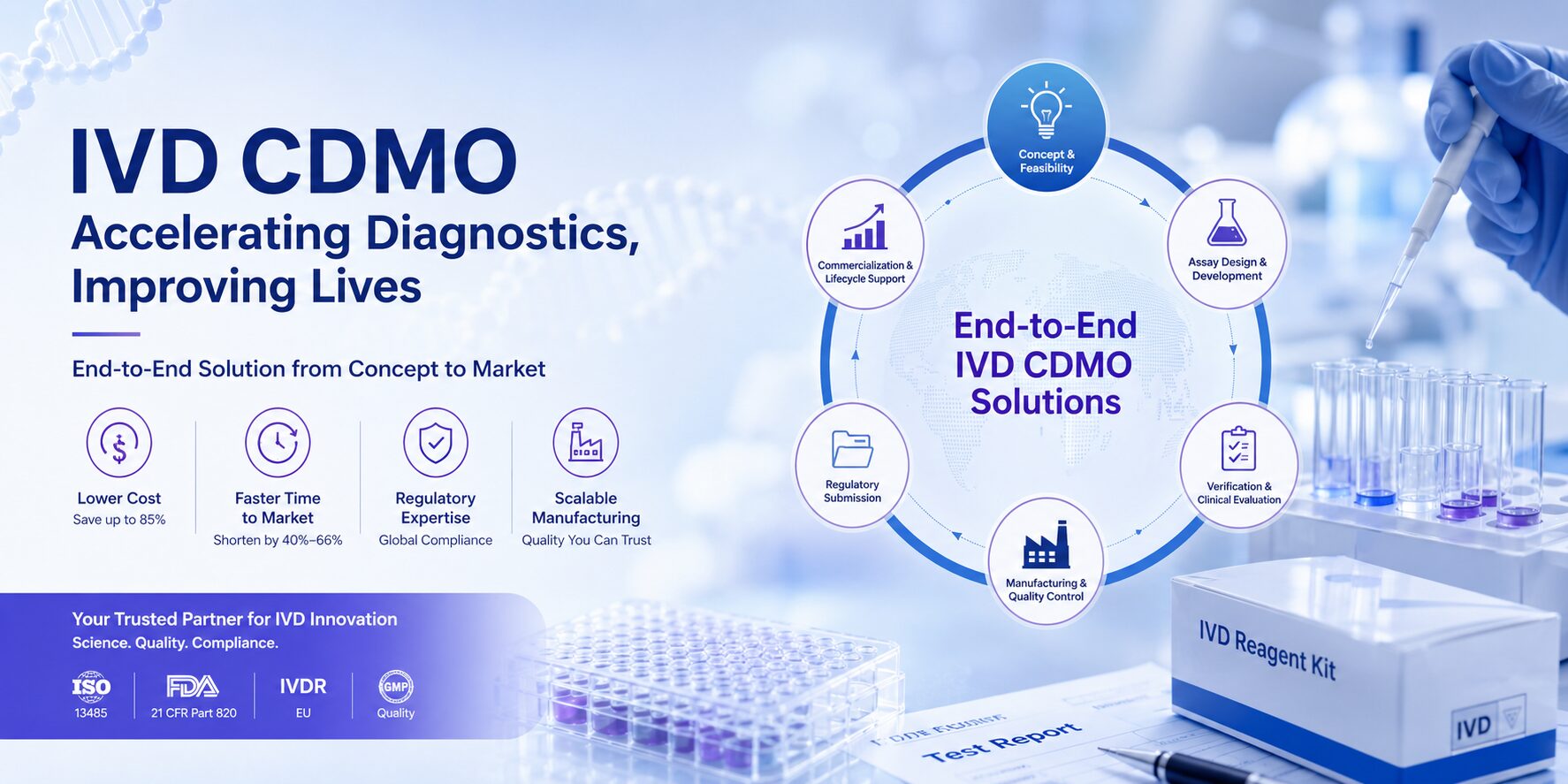
Leading modern IVD CDMO providers have formed a full-lifecycle service system covering product R&D, verification, production, compliance and commercialization, realizing end-to-end support for client projects.
Reagent Development and Manufacturing
Covers the whole process from formula research to commercial mass production, including PCR reagent system formulation, antibody and antigen affinity optimization, enzyme activity stabilization and modification, lyophilization process development and parameter optimization, bulk reagent large-scale production, sterile fill-finish, customized packaging and batch release. It solves client pain points of unstable reagent performance and low mass production yield.
Diagnostic Device Outsourcing
Focuses on precision manufacturing of IVD hardware and microfluidic carriers, including POCT instrument hardware design and development, microfluidic chip injection molding, surface modification and sealing process, precision biosensor integration, electronic circuit assembly and debugging, and prototype trial production and iterative optimization. This segment features high precision thresholds and strict batch consistency requirements.
Analytical and Validation Services
Includes long-term stability testing under different temperature and humidity conditions, product clinical performance verification, detection sensitivity and specificity calibration, batch-to-batch consistency analysis, routine quality control testing, and bioanalytical data support for clinical trials, ensuring products meet global technical standards.
Regulatory and Compliance Services
Provides full-process global regulatory declaration support, covering FDA 510(k) pre-market notification, EU IVDR technical document compilation and clinical performance evaluation, ISO 13485 quality system certification guidance, CE marking application, China NMPA registration and filing, and ISO 14971 medical device risk management document preparation.
Supply Chain and Commercialization Support
Covers professional cold-chain logistics for biological reagents, sterile dust-free packaging, customized OEM/ODM manufacturing, global raw material sourcing and supply chain coordination, and finished product distribution support, helping clients achieve rapid global market commercialization.
2. Global Market Size and Industry Growth Outlook
2.1 Market Growth Overview
Driven by global aging population, rising tumor and chronic disease incidence, accelerated precision medicine penetration, and the shift from centralized laboratory testing to decentralized home and community testing, the global IVD outsourcing industry has entered a sustainable structural growth cycle.
Authorized by Grand View Technology and Frost & Sullivan industry tracking data, the global IVD reagent and consumable outsourcing market scale reached USD 20.8 billion in 2025. When incorporating diagnostic hardware manufacturing, third-party analytical verification, and laboratory outsourcing services, the overall market size of the global IVD CDMO ecosystem exceeds USD 28 billion. It is expected to maintain a CAGR of 7.2%–9.5% from 2025 to 2035, with steady growth momentum in the long term.
Regionally, North America and Europe dominate high-end technology-intensive and regulatory-compliant outsourcing markets, while the Asia-Pacific region is the fastest-growing manufacturing base with outstanding cost advantages and capacity scale effects.
2.2 Regional Market Structure
North America
North America is the world’s largest high-value IVD CDMO market, supported by a mature healthcare system, complete medical insurance reimbursement mechanism, high penetration rate of precision medicine, and strict FDA regulatory barriers. The region gathers a large number of biotech startups and international pharmaceutical giants, with leading global innovation capabilities in companion diagnostics, liquid biopsy, and high-end molecular testing. Most emerging diagnostic technologies in North America rely on professional CDMO outsourcing to accelerate clinical transformation and commercialization.
Europe
Europe is the most regulation-sensitive IVD market worldwide. The full implementation of the EU IVDR in 2022 has significantly raised the technical threshold and compliance costs for IVD products, bringing explosive growth in demand for third-party technical document compilation, clinical performance verification, regulatory consulting, and compliant manufacturing. A large number of European small and medium-sized IVD enterprises have abandoned self-built production lines and turned to long-term cooperation with professional CDMOs to reduce compliance risks and operating costs.
Asia-Pacific
The Asia-Pacific region has become the global fastest-growing and largest-scale IVD manufacturing outsourcing hub. Countries including China, Singapore, South Korea and India have formed complete industrial chains in reagent mass production, microfluidic chip manufacturing, POCT equipment OEM/ODM assembly, and localized raw material production. Among them, China’s IVD CDMO industry is undergoing a critical transformation from domestic import substitution to global export-oriented manufacturing, with continuous improvement in high-precision processing and compliant production capabilities, gradually undertaking global mid-to-high-end outsourcing orders.
3. Key Technology Segments Driving Industry Expansion
3.1 Molecular Diagnostics
Molecular diagnostics is the highest-growth and highest-value track in the global IVD CDMO industry, with a market growth rate significantly higher than the industry average. Core business covers conventional PCR, quantitative qPCR, digital PCR ultra-precise detection, NGS sample library preparation, tumor liquid biopsy, CRISPR-based rapid molecular detection, infectious disease pathogen screening, and oncology gene detection.
With the continuous improvement of detection accuracy and technical complexity of molecular diagnostic products, the R&D threshold and production difficulty have increased sharply. Most biotech companies lack professional enzyme modification, reagent stabilization and batch consistency control capabilities, making outsourcing an inevitable choice for industrialization, which strongly drives the growth of molecular IVD CDMO business.
3.2 Point-of-Care Testing (POCT)
The global diagnostic industry is undergoing a profound shift from centralized hospital laboratory testing to decentralized testing scenarios including community clinics, retail pharmacies, emergency departments, home healthcare and remote medical institutions. This trend has spawned massive market demand for portable, fast, and miniaturized POCT diagnostic systems.
POCT CDMO core services focus on portable instrument development, disposable detection cartridges, miniaturized biosensor integration, and integrated microfluidic testing platforms. The segment has extremely high requirements for manufacturing precision, cartridge batch consistency, and scalable automated assembly, forming strong technical and manufacturing barriers, and is highly dependent on professional CDMO outsourcing.
3.3 Companion Diagnostics
Companion diagnostics is the core supporting infrastructure of modern precision medicine and targeted tumor therapy. With the continuous expansion of global targeted anti-tumor drugs and individualized treatment programs, pharmaceutical enterprises have put forward higher requirements for synchronous development and commercialization of diagnostic reagents.
IVD CDMOs provide full-process support including biomarker screening and verification, diagnostic assay co-development with drugs, clinical sample testing and data analysis, regulatory joint declaration, and commercial-scale stable manufacturing. The deep integration of diagnosis and treatment has formed a rigid long-term demand for professional companion diagnostic outsourcing services.
3.4 Microfluidic and Lab-on-a-Chip Technologies
Microfluidic chip technology is the core foundational technology of next-generation integrated and automated diagnostics, with significant advantages such as low reagent consumption, ultra-fast detection speed, high automation, portable integration, and multi-index parallel detection. It is widely used in POCT, molecular detection, and single-cell analysis scenarios.
However, microfluidic manufacturing faces high technical barriers, including high-precision mold processing, chip surface hydrophilic and hydrophobic modification, precise fluid channel control, high-strength sealing technology, and mass production yield stability. Only professional specialized CDMOs can meet industrial production requirements, making microfluidic outsourcing a high-growth track in the industry.
4. Core Industry Growth Drivers
4.1 Rising Global Disease Burden and Diagnostic Demand Upgrade
According to WHO public health statistics, chronic diseases, cancers and recurrent infectious diseases have become the main causes of global mortality. Global healthcare demand is shifting from late-stage treatment to early screening, preventive diagnosis and long-term dynamic monitoring. The popularization of personalized physical examination, tumor early screening, chronic disease management and infectious disease surveillance has continuously expanded the market space for IVD products, and further drives the demand for professional CDMO outsourcing supporting industrialization.
4.2 Escalating Global Regulatory Complexity
Global IVD regulatory systems have entered a period of comprehensive tightening. Major mainstream regulatory frameworks including FDA 510(k), FDA QSR 820, EU IVDR, ISO 13485 quality management system, ISO 14971 risk management, and CLSI clinical testing standards have put forward standardized and stringent requirements for product R&D, production, verification and market access.
Most IVD startups and small-sized diagnostic enterprises lack professional regulatory teams and compliant production systems. Outsourcing to professional CDMOs has become the most cost-effective way to meet global market access requirements, directly boosting industry demand.
4.3 Global Supply Chain Resilience Restructuring and Localization Trend
The COVID-19 pandemic exposed the vulnerability of the highly concentrated global IVD supply chain, especially the supply risks of core biological raw materials and high-precision consumables. In the post-pandemic era, global medical enterprises have fully adjusted their supply chain strategies, prioritizing multi-region capacity layout, diversified raw material procurement, localized production matching, safety inventory reserve, and dual-supplier mechanism construction.
This global supply chain restructuring trend greatly benefits regional IVD CDMO enterprises with standardized compliant capacity and stable supply chain integration capabilities, bringing sustained order growth.
4.4 Asset-Light Strategy and Capital Efficiency Optimization
Building a GMP-compliant IVD production system requires massive fixed asset investment in dust-free clean rooms, automated production equipment, quality management systems, and professional verification teams, with long construction cycles and high operating costs. To optimize capital efficiency, reduce fixed asset pressure and focus on core R&D and market expansion, most innovative IVD and biotech enterprises adopt asset-light operation modes and fully outsource production and verification links to professional CDMOs, which is the core long-term driving force of the industry.
5. Major Industry Challenges
5.1 Strict Global Regulatory Compliance Pressure
IVD products belong to high-risk medical devices in most countries and regions, facing multi-dimensional and cross-border regulatory supervision. Maintaining compliant production and market access in North America, Europe, Asia and other regions simultaneously greatly increases enterprise operational complexity and compliance costs. Non-compliant problems such as unqualified technical documents and unstable production quality may lead to product recalls, regulatory warning letters, market access restrictions and long-term brand reputation damage, bringing continuous operational risks to CDMO enterprises.
5.2 High Dependence on Imported Core Raw Materials
The global IVD industry still has a high concentration of core raw material supply. Key strategic materials including high-activity diagnostic enzymes, high-specificity monoclonal antibodies, rare fluorescent markers, special detection membranes, and microfluidic chip substrate materials are monopolized by a small number of international suppliers. Raw material supply shortages, price fluctuations and delivery delays directly affect the production stability and delivery cycle of CDMO enterprises, becoming a key industry bottleneck.
5.3 Ultra-High Manufacturing Precision and Consistency Requirements
Different from ordinary consumer goods manufacturing, IVD products have extremely strict requirements for technical indicators such as detection sensitivity, specificity, repeatability, thermal stability, and batch-to-batch consistency. Slight differences in production processes and operating environments may lead to fluctuations in product detection performance. Maintaining high yield and stable quality in large-scale mass production while ensuring analytical performance is the core technical challenge restricting the development of the industry.
5.8 Homogenized Competition and Structural Profit Differentiation
The low-end links of the industry such as simple reagent dilution and sub-packaging, basic POCT assembly and ordinary OEM processing have obvious homogenization and commoditization characteristics, with fierce price competition and continuously compressed profit margins. In contrast, high-end links including molecular reagent customization, microfluidic chip precision manufacturing, companion diagnostic co-development and full-lifecycle regulatory services have high technical barriers and stable premium capabilities. Future industry competition will fully shift from price competition to technical strength and integrated service capability competition.
6. Competitive Landscape
6.1 Global Integrated Full-Service Leaders
Lonza
A global leading life sciences outsourcing giant, with comprehensive capabilities in compliant diagnostic reagent manufacturing, process development optimization, and full-process regulatory support. It occupies a leading position in high-end molecular diagnostics and companion diagnostic CDMO business, serving top global pharmaceutical and diagnostic brands.
Thermo Fisher Scientific
The most influential comprehensive player in the global IVD outsourcing industry, covering core businesses such as high-end diagnostic reagent R&D and production, laboratory professional testing services, diagnostic equipment OEM manufacturing and analytical verification, with complete industrial chain layout and global service capabilities.
Jabil & Flex
Both are world-class precision medical device manufacturing service providers, focusing on IVD diagnostic hardware and electromechanical equipment outsourcing (not traditional reagent CDMO business). They have outstanding advantages in high-precision instrument assembly, electronic system integration and large-scale standardized production, and are core suppliers of global mainstream POCT and molecular diagnostic instrument brands.
6.2 Global Specialized IVD CDMO Players
Meridian Bioscience
A global specialized IVD outsourcing enterprise, focusing on infectious disease diagnostic reagent development and production, with independent core biological raw material R&D and supply capabilities, and prominent advantages in pathogen detection CDMO business.
DCN Dx
A leading global rapid diagnostic CDMO, specializing in lateral flow assay (LFA) product development, process optimization and mass production services, covering colloidal gold, latex microsphere and other rapid detection technical routes.
Invetech
Focuses on diagnostic instrument engineering development, automated system design and prototype iterative optimization, providing professional hardware R&D and intelligent manufacturing solutions for IVD enterprises worldwide.
6.3 Chinese Emerging IVD CDMO Representative Players
China’s IVD CDMO industry has achieved rapid development in recent years, gradually forming a group of competitive export-oriented enterprises, mainly layout in reagent OEM/ODM manufacturing, POCT equipment assembly, molecular diagnostic mass production, microfluidic chip processing and other fields. Representative enterprises include Sansure Biotech, Molarray, and Join-Cheer Biotechnology. Local manufacturers are accelerating the localization substitution of core raw materials and precision manufacturing technologies, and their global market participation and overseas order scale are continuously improving, gradually undertaking mid-to-high-end global outsourcing business.
7. Dominant Industry Development Trends
7.1 AI-Driven Intelligent and Automated Manufacturing
The industry is accelerating the transformation from traditional manual production to digital intelligent manufacturing. Leading CDMO enterprises are actively deploying AI-assisted full-process quality control systems, including AI visual defect detection for reagents and chips, automated filling and packaging production lines, equipment predictive maintenance, intelligent real-time QC monitoring, and digital factory management platforms. Intelligent manufacturing effectively reduces human error, improves batch consistency and production yield, and has become a core competitive advantage of leading enterprises.
7.2 Full-Lifecycle Integrated Outsourcing Becomes Mainstream
Client demand is evolving from single-process outsourcing (only production or only verification) to full-lifecycle integrated outsourcing covering upstream R&D formula optimization, midstream pilot and commercial production, downstream performance verification, regulatory declaration and post-market commercial support. This trend greatly favors large-scale integrated CDMO platforms with complete service chains, while squeezing the living space of single-link small and medium-sized outsourcing enterprises.
7.3 Global Capacity Redistribution and Dual-Center Pattern Formation
The global IVD manufacturing capacity is continuing to shift to the Asia-Pacific region relying on cost advantages, scale effects and complete industrial supporting facilities. At the same time, European and American countries have introduced localized manufacturing support policies to ensure supply chain security, forming adual-center pattern of “Asia-Pacific large-scale manufacturing + Europe and America high-end R&D and compliant production”. Cross-border multi-site capacity layout will become the standard configuration of leading global CDMO enterprises.
7.4 Accelerated Industry Consolidation and Platform-Based Development
The global IVD CDMO industry is entering a stage of accelerated integration. Leading enterprises expand their technical boundaries and service scope through strategic mergers and acquisitions, technical integration and vertical supply chain layout. Small and medium-sized enterprises with single technical routes and insufficient capacity will face elimination or merger and acquisition. The industry will gradually form a market pattern dominated by comprehensive platform-based leading enterprises and supplemented by specialized segmented enterprises.
7.5 Emerging Technology Empowers Industrial Iteration
Cutting-edge technologies such as synthetic biology, single-cell detection, and ultra-high-throughput multiplex detection are continuously empowering the upgrading of the IVD industry. Corresponding customized CDMO services for emerging technical routes are emerging rapidly, becoming a new growth pole of the industry in the next decade.
8. Long-Term Industry Outlook (2026–2035)
From 2026 to 2035, the global IVD CDMO industry will maintain stable and sustainable structural growth, driven by the long-term deterministic trends of global population aging, precision medicine popularization, decentralized medical care upgrading, and intelligent diagnostic iteration.
In terms of segmented tracks, molecular diagnostics and microfluidic integrated detection systems will maintain the highest growth rate, and oncology companion diagnostics will become the most strategic high-value segment. In terms of regional patterns, the Asia-Pacific region will further consolidate its position as the world’s largest IVD manufacturing and outsourcing center, while North America and Europe will continue to dominate high-end technological innovation, cutting-edge product R&D and regulatory-intensive high-value outsourcing services.
In the next decade, the core competitive factors of the industry will be fully upgraded from traditional cost and capacity advantages to comprehensive capabilities including global multi-region regulatory expertise, high-precision manufacturing technical depth, AI intelligent automation level, supply chain resilience and cross-border capacity coordination capabilities. Enterprises with full-lifecycle integrated service ecosystems will occupy the leading position in the global market.
9. Conclusion
The global IVD CDMO industry has become an indispensable core component of the modern diagnostic healthcare ecosystem. With the continuous improvement of IVD product technical complexity and the increasing rigor of global regulatory systems, professional outsourcing cooperation has evolved from an optional business model to a necessary industrial supporting link for IVD product R&D transformation and commercialization.
Although the industry faces multiple challenges such as stringent compliance supervision, core raw material supply dependence, high manufacturing technical thresholds and homogenized low-end competition, it is supported by multiple long-term deterministic growth drivers including global medical demand upgrading, precision medicine penetration, supply chain restructuring and asset-light strategy popularization.
In the 2026–2035 decade, IVD CDMO enterprises that integrate global regulatory capabilities, high-precision intelligent manufacturing technology, stable supply chain guarantee and full-lifecycle integrated services will seize the industry development dividend and lead the new round of global diagnostic outsourcing market iteration and upgrading.
Author Profile

- Written by the IVDCDMO technical and regulatory team, with expertise in diagnostic assay development, GMP manufacturing, ISO 13485 systems, and global IVD commercialization for biotech innovators worldwide.
Latest entries
 Assay DevelopmentSeptember 23, 2026CDMO Custom Development of Test Kits: From Assay Concept to Scalable IVD Manufacturing
- IVD ManufacturingJuly 24, 2026Manufacturing for IVD Products: From Assay Transfer to Reliable Commercial Supply
- IVD ManufacturingJuly 13, 2026IVD Contract Manufacturing Cost: NRE, Tooling, Validation, MOQ and Unit Economics
- KnowledgeJuly 6, 2026IVD CDMO vs CRO vs CMO: Which Partner Do You Need at Each Development Stage?