The IVD Contract Manufacturing Market: A Fully Corrected and Enhanced Analysis
1. Market Growth Is Being Driven by Structural Outsourcing, Not Just Capacity Gaps
The global IVD contract manufacturing market has reached a scale of tens of billions of dollars. Multiple market research reports show steady high single-digit to low double-digit annual growth in recent years. This performance proves that outsourcing was never merely a short-term solution to production shortages; it has evolved into a long-term mainstream operating model across the industry.
The strongest growth is seen in segments requiring high technical precision, strict regulatory compliance and scalable, controllable production processes, including:
- Immunoassay reagents and kits
- Molecular diagnostics components
- Rapid diagnostic tests and lateral flow assay products
- Calibrators and quality controls
- Sample preparation consumables
- Lyophilized reagents
- Analyzer-matched OEM consumables
- Customized diagnostic kits for regional markets
Market expansion has also accelerated as numerous IVD innovators focus on R&D rather than in-house manufacturing. University spin-offs, biomarker developers, AI-powered diagnostic companies and specialty assay firms own valuable intellectual property but lack mature internal production systems. Experienced IVD CDMOs help translate laboratory assay concepts into fully validated, reproducible and commercially packaged end products.
2. Regulatory Compliance Becomes the Ultimate Differentiator
Regulatory changes have become the most powerful force reshaping the IVD contract manufacturing landscape. Compliance is no longer just a hurdle for product developers, but a strategic entry barrier that top-tier CDMOs leverage to create competitive advantages.
The EU IVDR Transition Framework
In Europe, Regulation (EU) 2017/746 (IVDR) has substantially raised requirements for clinical evidence, performance evaluation and technical documentation. Following Regulation (EU) 2024/1860 and related guidelines, the transition periods for legacy devices holding valid EC certificates or declarations of conformity issued before May 26, 2022 have been extended significantly:
- Class D: December 31, 2027
- Class C: December 31, 2028
- Class B and Class A sterile products: December 31, 2029
Accordingly, 2026 is not a hard compliance deadline for Class C IVD products. The industry still faces challenges including limited capacity of Notified Bodies, stringent rules for technical documentation, and supplementary clinical evidence requirements for legacy products. Meanwhile, the actor registration module of EUDAMED became mandatory in December 2024. Due to ongoing system validation, the full enforcement of other core modules covering UDI, device registration, certificates, clinical investigations and vigilance has not been finalised. The sector is gradually moving toward higher operational transparency.
The U.S. LDT Regulatory Reversal
The regulatory landscape for Laboratory Developed Tests (LDTs) in the U.S. has experienced major shifts. The FDA’s controversial 2024 Final Rule, which aimed to classify LDTs as regulated medical devices, was vacated by a federal court on the grounds that the FDA exceeded its statutory authority. The FDA subsequently withdrew its relevant enforcement measures and returned to its long-standing enforcement discretion for LDTs, while clinical laboratories continue to operate under CLIA rules.
This court ruling preserves the flexible, fast-to-market pathway for laboratories conducting in-house tests, yet creates a dual regulatory environment. Commercial IVD kits following the official FDA registration route are subject to far stricter manufacturing oversight compared with LDT workflows.
The QMS Strategic Partnership
Persistent regulatory complexity has redefined the value proposition of contract manufacturers. Leading service providers have evolved from pure production facilities into dedicated Quality Management System (QMS) partners. They help clients avoid costly risks such as flawed design transfer, validation failures, incomplete documentation and inconsistent batch performance, which may lead to global regulatory rejection or post-market compliance audits.
3. Reagents and Consumables Remain the Core Revenue Engine
Within IVD contract manufacturing, reagents and consumables represent a high-value segment with recurring demand and high technical barriers. Unlike diagnostic instruments with long replacement cycles, reagents and consumables are continuously used in clinical settings. Once a diagnostic product is launched for routine clinical use, its supply chain must deliver stable production, consistent quality and reliable delivery.
For this reason, CDMOs with expertise in reagent formulation, coating, dispensing, filling, lyophilization, packaging, labeling and stability management have secured solid market positions. Core capabilities widely recognised by IVD clients include:
- Antibody and antigen handling
- Buffer formulation and optimisation
- Enzyme stabilisation
- Lyophilised bead and cake development
- Liquid reagent filling
- Conjugate pad treatment
- Membrane processing
- Cassette assembly
- Pouching and desiccant control
- Accelerated and real-time stability studies
- Lot-to-lot consistency management
The core technical challenge is not merely to produce a functional diagnostic kit. The real difficulty lies in maintaining uniform product performance across batches, operating environments, logistics conditions and the full shelf life.
4. Molecular Diagnostics Raised the Technical Barrier
Molecular diagnostics has profoundly transformed the outsourcing landscape. PCR, isothermal amplification, sequencing, syndromic panels and infectious disease assays all demand much stricter process control than conventional IVD products.
This trend brings both opportunities and challenges for CDMOs. Molecular products feature higher profit margins, but require advanced contamination control protocols, standardised cleanroom operations, fully validated workflows, professional cold chain management, expertise in nucleic acid stabilisation and specialised quality control methods.
The market favours CDMOs with capabilities to support:
- Primer and probe handling
- Master mix formulation
- Nucleic acid extraction consumables
- Lyophilised molecular reagents
- Syndromic multiplex panel assembly
- Contamination prevention systems
- High-sensitivity QC testing
- Sealed microfluidic cartridges and closed-system formats
As molecular testing expands from central laboratories to point-of-care facilities, manufacturing complexity keeps rising. Commercial products need better stability, simpler operation and higher tolerance to variable transport and storage conditions.
5. Point-of-Care Testing Expanded Demand for Integrated Manufacturing
Point-of-care testing (POCT) is a long-term key driver for IVD contract manufacturing. Healthcare providers pursue faster clinical decisions, shorter patient waiting times and on-site testing services, which in turn fuel demand for compact, reliable and user-friendly diagnostic products.
POCT products involve highly complex manufacturing that integrates biological reagents, plastic parts, membranes, microfluidic structures, electronic components, embedded software, packaging and ergonomic design.
This trend benefits CDMOs delivering full-spectrum integrated services, rather than fragmented standalone production. Buyers increasingly prefer partners capable of managing the entire workflow, from prototype optimisation and pilot production to validation batch manufacturing, regulatory support and full-scale commercial production.
For small and mid-sized diagnostic firms, integrated services reduce cross-party coordination work. For large enterprises, such partnerships provide flexible production capacity and accelerate product line expansion.
6. Supply Chain Resilience Became a Strategic Purchasing Criterion
The global pandemic exposed widespread vulnerabilities in diagnostic supply chains. While emergency testing demand has normalised, the industry has learned a critical lesson: IVD manufacturing relies on a fragile supply network covering biological raw materials, membranes, plastics, enzymes, antibodies, packaging materials and specialised production equipment.
As a result, IVD companies now evaluate CDMO partners based on supply chain resilience, rather than price alone. Key supplier selection criteria include:
- Dual sourcing for critical raw materials
- Regional manufacturing and local packaging solutions
- Standardised supplier qualification systems
- Robust inventory planning
- Validated alternative raw materials
- Transparent change control processes
- Cold chain and humidity control capabilities
- Comprehensive business continuity planning
This shift benefits CDMOs across Asia, Europe and North America that deliver consistent quality, cost efficiency and access to regional and global supply networks.
7. Quality Positioning Supersedes Cost in the Asia-Pacific Region
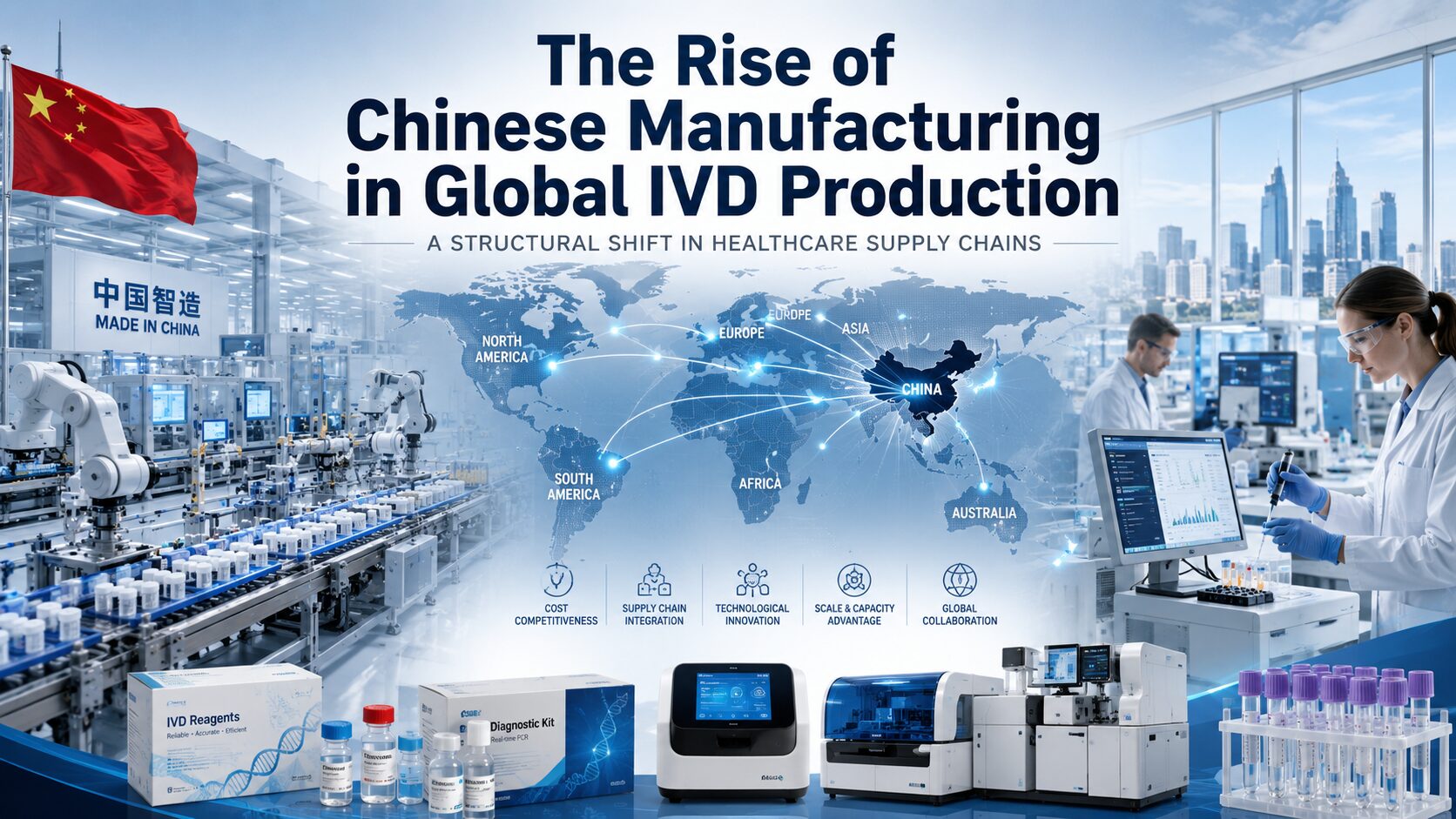
The Asia-Pacific region remains one of the fastest-growing hubs for IVD contract manufacturing. It benefits from large-scale manufacturing infrastructure, abundant engineering talent, growing domestic demand and increasingly mature regulatory and quality management systems.
China has built strong industrial advantages in rapid diagnostics, reagents, consumables, lyophilisation, membrane processing and microfluidic component moulding. Even so, global buyers have become far more selective. Low production cost is no longer a sustainable competitive edge. To compete globally, Asia-based IVD CDMOs must demonstrate proven capabilities in:
- ISO 13485-compliant quality management systems
- Standardised technical documentation for global regulatory submissions
- Full traceability of product lots and components
- Transparent raw material supply chain management
- Fully validated production processes and automated line changeovers
- Stable multilingual technical communication for seamless technology transfer
- Cross-border regulatory support for markets including the EU, the U.S., the Middle East, Latin America and Southeast Asia
In short, competition has moved beyond low-cost manufacturing. The new benchmark is to deliver compliant, scalable and export-ready production services.
8. The Market Shifted from OEM Production to CDMO Partnership
Traditional OEM manufacturing focuses on producing finished products strictly in accordance with clients’ specifications. The modern CDMO model covers far broader scope.
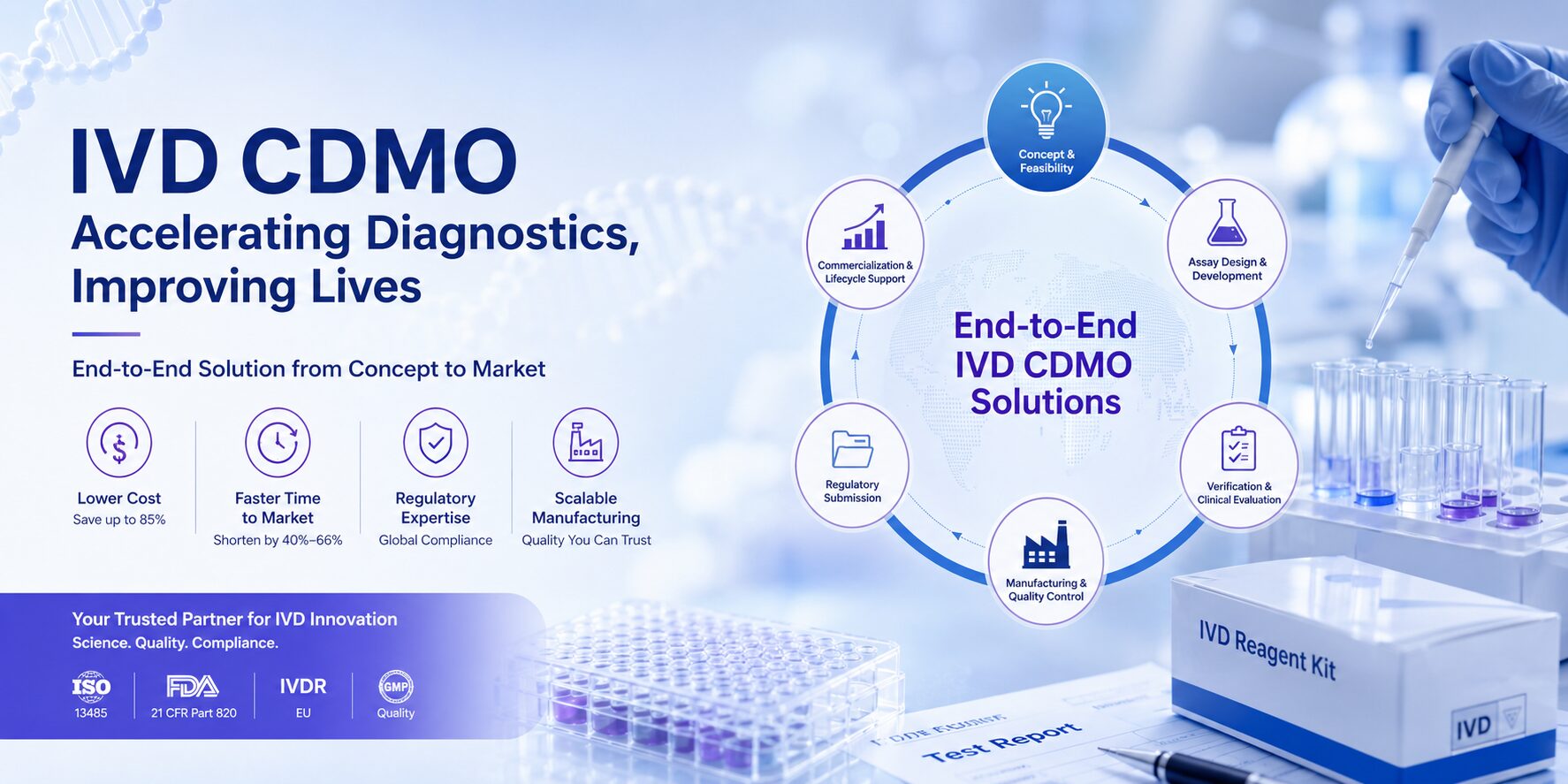
Leading IVD CDMOs now provide end-to-end services including:
- Assay development support
- Formulation optimisation
- Design transfer
- Pilot-scale production
- Process validation
- Stability study design
- Technical documentation compilation
- Packaging and labelling adaptation for regional markets
- Cross-region compliance support
- Commercial-scale manufacturing
- Continuous product lifecycle improvement
This evolution is highly significant, as most diagnostic companies need more than extra production capacity — they require professional manufacturability guidance. Many products that perform well in R&D labs encounter scale-up issues caused by unregulated formulation parameters, loose dispensing tolerances, unstable raw material quality, improper drying, substandard packaging humidity or non-standard operating procedures. Top-tier CDMOs help clients identify and mitigate such risks before commercial launch.
9. Margin Pressure Pushed More Companies Toward Outsourcing
In recent years, the IVD industry has faced growing price pressure from hospitals, public procurement, reimbursement policies and competitive bidding. Meanwhile, spending on regulatory compliance and quality control keeps rising.
The industry faces a clear challenge: to upgrade product compliance and performance while containing operational costs.
Outsourcing has become an effective solution, converting fixed in-house manufacturing investment into flexible on-demand capacity. Instead of building fully independent production facilities, IVD companies cooperate with specialised partners to handle non-core product lines, region-specific customised production and peak order volumes.
This does not mean full outsourcing of all production. Major diagnostic groups still maintain in-house lines for their core product platforms. Nevertheless, selective outsourcing continues to grow steadily, especially for non-core products, regional SKUs, private labels and product lifecycle extension projects.
10. Technology Reshaped IVD Manufacturing Operations
Digital manufacturing technologies are widely adopted across IVD production lines. CDMOs investing in data-driven quality systems gain distinct competitive edges. Key applied technologies include:
- Electronic Batch Records (EBR)
- Manufacturing Execution Systems (MES)
- Digital QC data collection and Statistical Process Control (SPC)
- Real-time cleanroom environmental monitoring systems
- Automated dispensing, precision liquid filling and vision inspection systems
- Barcode and full UDI (Unique Device Identification) lifecycle traceability
- AI-assisted demand forecasting and supply planning
- Digital document management systems to facilitate client audits
These technologies deliver values beyond higher production efficiency. They also keep facilities audit-ready, support root cause analysis for production deviations and streamline communication with clients. In this highly regulated industry, reliable data integrity has become a tangible commercial advantage.
11. Key Risks Facing the IVD Contract Manufacturing Market
Despite robust growth, the market still faces tangible operational risks:
- Regulatory Bottlenecks: Limited Notified Body capacity under IVDR, stringent technical documentation rules and frequently updated local registration policies continue to delay product launch timelines.
- Raw Material Variability: Biological raw materials such as antibodies, antigens, enzymes and membranes vary in performance across suppliers and batches, directly affecting assay stability.
- Overcapacity in Low-End Products: Generic rapid tests and undifferentiated basic products have become commoditised, leading to widespread overcapacity.
- Geopolitical and Procurement Restrictions: Regional procurement rules, trade frictions, localisation policies and tariff adjustments influence global supplier selection.
- Quality Failures: Quality issues in diagnostics lead to severe consequences, including clinical risks, product recalls, brand damage and regulatory penalties.
For the above reasons, buyers set stricter standards when selecting contract manufacturing partners.
12. Strategic Outlook: Where the Market Is Going
The IVD contract manufacturing market will evolve along five major trends in the future.
First, outsourcing will become increasingly strategic. Companies will prioritise partners capable of supporting product development, regulatory compliance, production scale-up and full lifecycle management.
Second, molecular diagnostics and POCT will set higher technical thresholds. CDMOs with advanced expertise in reagent development, cartridge manufacturing, lyophilisation and contamination control will gain favourable market positions.
Third, regulatory capabilities will become a core competitive differentiator. Standardised documentation, complete validation systems, full traceability and audit readiness will be equally important as production cost.
Fourth, regionalised supply chains will grow in importance. Businesses will strike a balance between global cost efficiency and regional supply security.
Fifth, the market will see a clear divide between commodity manufacturers and high-value CDMO partners. The former will continue to compete mainly on price, while the latter will differentiate themselves through superior quality, faster delivery, stronger technical capabilities and reliable regulatory support.
The IVD contract manufacturing market has entered a mature, strategy-driven development phase. Its growth is fuelled not only by rising demand for diagnostic products, but also by profound changes in industry regulations, manufacturing technologies, supply chain frameworks and product development models.
For diagnostic companies, a reliable manufacturing partner helps shorten time-to-market, reduce compliance risks, ensure consistent product quality and support global business expansion. For CDMO service providers, the market brings tremendous opportunities: the industry demands partners that combine solid production capabilities, professional technical expertise, strong regulatory awareness and comprehensive global supply chain management capabilities.
The future of IVD outsourcing no longer belongs to pure low-cost manufacturers. Success will be achieved by contract manufacturers that deliver stable, high-quality products, robust quality systems, scalable production workflows and long-term trustworthy cooperation.
Author Profile

- Written by the IVDCDMO technical and regulatory team, with expertise in diagnostic assay development, GMP manufacturing, ISO 13485 systems, and global IVD commercialization for biotech innovators worldwide.
Latest entries
 Assay DevelopmentSeptember 23, 2026CDMO Custom Development of Test Kits: From Assay Concept to Scalable IVD Manufacturing
- IVD ManufacturingJuly 24, 2026Manufacturing for IVD Products: From Assay Transfer to Reliable Commercial Supply
- IVD ManufacturingJuly 13, 2026IVD Contract Manufacturing Cost: NRE, Tooling, Validation, MOQ and Unit Economics
- KnowledgeJuly 6, 2026IVD CDMO vs CRO vs CMO: Which Partner Do You Need at Each Development Stage?